




Aerospace & Defense Technology - June 2014
Inside this issue
Overview
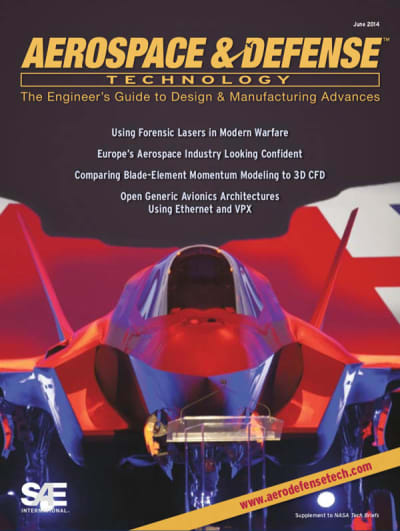
The June 2014 issue of Aerospace & Defense Technology presents a comprehensive overview of the latest advancements and trends in the aerospace and defense sectors. This edition features a variety of articles that delve into innovative technologies, industry insights, and emerging applications that are shaping the future of these fields.
One of the highlighted topics is the use of forensic lasers in modern warfare. This article discusses how laser technology is being integrated into military operations for various applications, including target identification and precision strikes. The use of lasers enhances the accuracy and effectiveness of military engagements, providing a significant advantage in combat scenarios. The article emphasizes the importance of these technologies in improving operational efficiency and reducing collateral damage.
Another key feature of this issue is an exploration of Europe’s aerospace industry, which is portrayed as confident and resilient despite economic challenges. The article outlines the growth prospects for European aerospace companies, driven by increasing demand for air travel and advancements in aircraft technology. It discusses the collaborative efforts among European nations to enhance their aerospace capabilities and maintain competitiveness in the global market. The piece highlights significant projects and partnerships that are expected to propel the industry forward.
The issue also includes a technical comparison between blade-element momentum modeling and three-dimensional computational fluid dynamics (CFD). This article provides insights into the methodologies used for analyzing aerodynamic performance in aircraft design. It explains how blade-element momentum theory offers a simplified approach to understanding lift and drag, while CFD provides a more detailed and comprehensive analysis of airflow around aircraft. The discussion emphasizes the importance of selecting the appropriate modeling technique based on the specific requirements of a project.
In addition to these features, the magazine covers advancements in avionics architectures, particularly the use of open generic architectures. This article discusses the shift towards more flexible and modular avionics systems that can adapt to changing technological landscapes. The integration of Ethernet and VPX (VITA 46) standards is highlighted as a means to enhance interoperability and reduce costs in avionics development. The article underscores the significance of these advancements in improving the overall performance and reliability of aerospace systems.
The issue also includes a section on wireless electronic patches developed by engineers from the University of Illinois and Northwestern University. These innovative, thin, stick-on patches are designed for health monitoring and can stretch and move with the skin. Incorporating commercial chip-based electronics, these patches have the potential to revolutionize clinical monitoring, such as EKG and EEG testing. The article discusses the implications of this technology for remote health monitoring and its potential to improve patient care.
Throughout the magazine, there are advertisements and promotional content from various companies, showcasing their latest products and services aimed at enhancing aerospace and defense technologies. For instance, Pulse Technologies emphasizes its commitment to creating advanced components that are thinner, stronger, and lighter, while also offering quicker customization options to meet market demands.
The editorial section provides insights into the current state of the aerospace and defense industries, discussing challenges and opportunities that lie ahead. It reflects on the importance of innovation and collaboration among industry stakeholders to drive progress and maintain competitiveness in a rapidly evolving landscape.
Overall, the June 2014 issue of Aerospace & Defense Technology serves as a valuable resource for professionals and enthusiasts in the aerospace and defense sectors. It combines technical articles, industry analysis, and innovative product showcases to provide a well-rounded perspective on the current trends and future directions of these critical industries. The magazine not only highlights the technological advancements but also emphasizes the collaborative efforts and strategic initiatives that are essential for sustaining growth and innovation in aerospace and defense.
Features
-
Application Briefs
Transparent Display Technology
-
Articles
Using Forensic Lasers in Modern Warfare
Open Generic Avionics Architectures and Distributed Processing Using Ethernet and VPX
Comparing Blade-Element Momentum Modeling to 3-D CFD
Europe's Aerospace Industry Looking Confident
Advances and Challenges in Developing Radar Applications
Tech Briefs
-
Manufacturing & Prototyping
Manufacturing Robotic Tools for Piping Inspection and Repair
Design and Fabrication of a Radio Frequency Grin Lens Using 3D Printing
Preparing Carbon-Coated Current Collectors for High-Power Lithium-Ion Secondary Batteries
Products
Top Stories
NewsRF & Microwave Electronics
 Microvision Aquires Luminar, Plans Relationship Restoration, Multi-industry Push
INSIDERAerospace
 A Next Generation Helmet System for Navy Pilots
INSIDERDesign
 New Raytheon and Lockheed Martin Agreements Expand Missile Defense Production
INSIDERMaterials
 How Airbus is Using w-DED to 3D Print Larger Titanium Airplane Parts
NewsPower
 Ford Announces 48-Volt Architecture for Future Electric Truck
ArticlesAR/AI

Webcasts
Electronics & Computers
 Cooling a New Generation of Aerospace and Defense Embedded...
Automotive
 Battery Abuse Testing: Pushing to Failure
Power
 A FREE Two-Day Event Dedicated to Connected Mobility
Unmanned Systems
 Quiet, Please: NVH Improvement Opportunities in the Early Design Cycle
Automotive
 Advantages of Smart Power Distribution Unit Design for Automotive &...
Energy
 Sesame Solar's Nanogrid Tech Promises Major Gains in Drone Endurance