




Advanced Multifunctional Materials for High Speed Combatant Hulls
A new additive manufacturing process for producing composite materials with prescribed RF properties.
Currently small boat combatant design focuses primarily on speed and maneuverability. It would be advantageous to expand these capabilities to include reduced radar cross-section, and enhanced survivability to blast and ballistic threats for both the structure and warfighters.
Investigators from the University of Delaware along with Navy partners at the Naval Surface Warfare Center developed the material building blocks necessary to realize hull materials for small boat combatants that combine structural properties with integrated radar absorption and enhanced ballistic protection. Specifically, additive manufacturing methodologies were used to develop new multifunctional materials that can be manufactured in a flexible, scalable and cost effective manner. These new materials and processing methods will be part of a library of core material building blocks that can be optimally combined in a stackable layup to produce the next generation of multifunctional hulls.
Most high speed combatant hulls are traditional sandwiched core designs constructed from a foam or balsa wood core sandwiched between two composite face sheets. Current methods to augment these structures with ballistic capabilities employ arrays of small panels, made typically from metal, carbon, glass or high strength polymer fibers, bolted onto the outer surface. One clear disadvantage of this approach is the large {>100%) increase in both size and weight. The use of outer panels constructed from high strength polymer fibers, such as Dyneema or Spectra, has shown the most promise in adding ballistic performance while minimizing additional weight. Similarly, most radar absorbing hulls are constructed by adding layers of radar absorbing materials (RAM) treatments to the outer surfaces of a traditional hull design. There are currently no examples of hull materials that combine structural, ballistic and radar absorbing functionalities.
The technical approach to solving that problem was to employ scalable screen printing to print patterns of functionalized custom inks and pastes to composite materials. The proposed effort was modeling and simulation driven guiding the selection of appropriate composite materials, inks, additives and printable patterns to create design methodologies that can be followed to produce composite materials with well-defined electromagnetic, structural and ballistic properties.
To realize a multifunctional hull material that minimizes weight, a number of advanced composite materials were used in addition to standard woven glass and carbon based composites. These included woven glass fabrics and Kapton, a polyimide film that’s a common dielectric substrate used for printing electronics, as well as high strain rate polymer composites such as Dyneema HB26 or Spectra Shield.
Three types of electromagnetically functional inks were also explored: resistive inks, high dielectric constant inks, and magnetic inks.
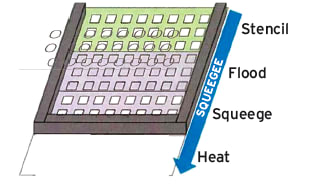
To tailor structural, ballistic and electromagnetic properties within a composite required exploring new manufacturing methods, namely screen printing and micro-dispensing. Screen printing is an additive manufacturing method that utilizes a mesh screen, a flood, and a squeegee, as seen in Figure 1. The mesh screen that was used contains a desired geometrical pattern that was deposited onto the substrate. When the flood is actuated, it deposits ink across the surface of the screen, the screen is then lowered to a snap-off height above the substrate, and the squeegee actuates to deposit the desired pattern. The substrate is then heated to cure the deposited ink. This process allows for a designed pattern to be repeatedly deposited onto multiple substrates in a short period of time.
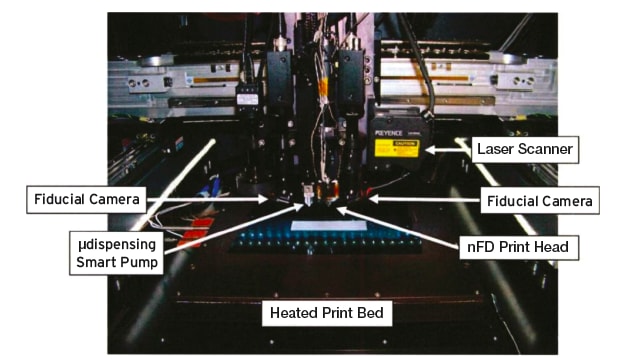
Micro dispensing is a process of additive manufacturing that utilizes a dispensing head to precisely deposit a material. The micro dispensing system that was used in this research was an nScrypt 3Dn-300, pictured in Figure 2. The system is capable of utilizing two different types of dispensing heads for depositing a wide variety of materials. The implementation of two printing heads allows for the printing system to toggle between printing two materials at once. These materials may also be swapped out mid-print in order to incorporate varying properties within one structure.
The results of this research are broken down into three categories based on the nature of the ink used. Specifically, detailed results are provided for high dielectric constant loaded composites, magnetically loaded composites, and resistively loaded composites.
This work was done by Mark S. Mirotznik of University of Delaware for the Office of Naval Research. ONR-0034
This Brief includes a Technical Support Package (TSP).
Advanced Multifunctional Materials for High Speed Combatant Hulls
(reference ONR-0034) is currently available for download from the TSP library.
Don't have an account?
More From SAE Media Group
Aerospace Manufacturing and Machining INSIDER
Can This Self-Healing Composite Make Airplane and Spacecraft Components Last for Centuries?
Tech Briefs
3D-Printed Composites for High-Temperature Uses
Tech Briefs
Fiber-Metal Laminate Manufacturing Technique

Tech Briefs
Self-Healing, Recyclable, Shape Memory Polymers

Aerospace & Defense Tech Briefs
SAE International Issues First Technical Standards for Aerospace Additive Manufacturing

Tech Briefs
Automated Tow/Tape Placement System
Aerospace & Defense Tech Briefs
Improving the Surface Finish of Additive Manufactured Parts
Tech Briefs
Calibration System for Automated Fiber Placement
Aerospace Manufacturing and Machining INSIDER
Researchers Push Limits in High-Temp, Polymer Additive Manufacturing
Aerospace & Defense Tech Briefs
Additive Manufacturing Adoption Up, Growing Rapidly in Aerospace
Aerospace Manufacturing and Machining INSIDER
Thermoplastic Drive Shaft System Developed for Aerospace Applications
Aerospace & Defense Tech Briefs
Metal-Plated, High-Temperature Plastics

Aerospace & Defense Tech Briefs
Quantitative Diagnostics of Multilayered Composite Structures with Ultrasonic Guided Waves
Aerospace & Defense Tech Briefs
Next-Generation Antenna Design
Aerospace & Defense Tech Briefs
‘Nanostitches’ Enable Lighter and Tougher Composite Materials


Aerospace & Defense Tech Briefs
Physics-Guided Neural Network for Regularization and Learning Unbalanced Data Sets
Aerospace & Defense Tech Briefs
Fiber-Reinforced Thermoplastic Composites
Aerospace & Defense Tech Briefs
Unlocking the Potential of 3D-Printed Polymers in Aerospace and Defense
Aerospace & Defense Tech Briefs
Robotic Rotational Molding Creates New Opportunities for Military and Aerospace Applications
Aerospace INSIDER
Technique Enables 3D Printing of Aerospace-Grade Carbon Fiber Composites
Aerospace & Defense Tech Briefs
Additive Manufacturing Utilizing a Novel In-Line Mixing System for Design of Functionally Graded Ceramic Composites
Aerospace & Defense Tech Briefs
Thermal Response of Ultra-High Molecular Weight Polyethylene (UHMWPE) Materials in a Flash Flame Test
Overview
The document is the final technical report for the project titled "Advanced Multifunctional Materials for High Speed Combatant Hulls," conducted by the University of Delaware's Department of Electrical and Computer Engineering and Center for Composite Materials, funded by the Office of Naval Research (ONR). The project aimed to develop innovative materials and manufacturing processes to enhance the performance of small boat combatants, focusing on speed, maneuverability, radar cross-section reduction, and ballistic protection.
The report outlines the methodologies employed in the research, which include the development of advanced materials, additive manufacturing techniques, modeling and simulations, and rigorous testing and validation. Key materials explored in the project include high toughness polymers, ultra-high molecular weight polyethylene (UHPE) fibers, and various conductive and dielectric additives. The use of woven glass fabrics and Kapton films as base materials was also emphasized, showcasing their importance in composite structures.
Significant accomplishments of the project include the creation of high dielectric constant and magnetic inks suitable for screen printing and micro-dispensing, which were validated experimentally. The researchers developed scalable and cost-effective methods for producing structural woven fabrics with specific RF loss properties, which are essential for creating radar-absorbing structures. Additionally, they synthesized armored materials with tailored RF properties, enhancing their potential for military applications.
The report highlights the collaboration with the Naval Surface Warfare Center, Carderock Division, to transition these new materials into practical applications for the Navy. The findings indicate that the developed multifunctional materials can effectively combine structural integrity with integrated radar absorption and enhanced ballistic protection, addressing the evolving needs of modern naval combatants.
Overall, the report presents a comprehensive overview of the research conducted, the methodologies applied, and the innovative materials developed, contributing to the advancement of naval technology and the enhancement of combatant hull performance. The project underscores the potential of additive manufacturing in creating multifunctional materials that meet the demands of contemporary military applications, paving the way for future developments in this field.
Top Stories
INSIDERManufacturing & Prototyping
 How Airbus is Using w-DED to 3D Print Larger Titanium Airplane Parts
INSIDERManned Systems
 FAA to Replace Aging Network of Ground-Based Radars
NewsTransportation
 CES 2026: Bosch is Ready to Bring AI to Your (Likely ICE-powered) Vehicle
NewsSoftware
 Accelerating Down the Road to Autonomy
EditorialDesign
 DarkSky One Wants to Make the World a Darker Place
INSIDERMaterials
 Can This Self-Healing Composite Make Airplane and Spacecraft Components Last...
Webcasts
Defense
 How Sift's Unified Observability Platform Accelerates Drone Innovation
Automotive
 E/E Architecture Redefined: Building Smarter, Safer, and Scalable...
Power
 Hydrogen Engines Are Heating Up for Heavy Duty
Electronics & Computers
 Advantages of Smart Power Distribution Unit Design for Automotive...
Unmanned Systems
 Quiet, Please: NVH Improvement Opportunities in the Early Design...
