




Technique Enables 3D Printing of Aerospace-Grade Carbon Fiber Composites
Researchers from Lawrence Livermore National Laboratory have become the first to 3D print aerospace-grade carbon fiber composites, representing a significant advance in the development of micro-extrusion 3D printing techniques for carbon fiber.
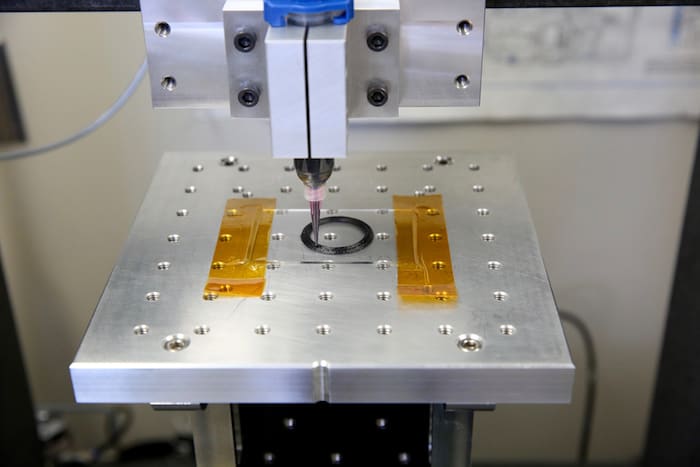
The ability to 3D print offers new degrees of freedom for carbon fiber, enabling control over the parts' mesostructure. The material also is conductive, allowing for directed thermal channeling within a structure. The resultant material could be used to make high-performance airplane wings, satellite components that are insulated on one side and don't need to be rotated in space, or wearables that can draw heat from the body but don't allow it in.
More From SAE Media Group
Aerospace Manufacturing and Machining INSIDER
Can This Self-Healing Composite Make Airplane and Spacecraft Components Last for Centuries?
Aerospace & Defense Tech Briefs
Laser Wire Additive Manufacturing System

Aerospace Manufacturing and Machining INSIDER
Thermoplastic Drive Shaft System Developed for Aerospace Applications
Aerospace Manufacturing and Machining INSIDER
Researchers Push Limits in High-Temp, Polymer Additive Manufacturing

Aerospace Manufacturing and Machining
Aerospace Work Platforms — More than Meets the Eye
Aerospace & Defense Tech Briefs
Improving the Surface Finish of Additive Manufactured Parts
Aerospace INSIDER
Air Force Wind Tunnel Team Takes 3D Printing Program to Next Dimension



Aerospace & Defense Tech Briefs
Metal-Plated, High-Temperature Plastics

Aerospace INSIDER
A New Platform for Developing Advanced Aerospace Metals at Scale

Tech Briefs
Automated Tow/Tape Placement System
Tech Briefs
High-Area Rapid 3D Printing
Aerospace INSIDER
Making Airplane Parts Without the Massive Infrastructure
Aerospace & Defense Tech Briefs
Additive Manufacturing Utilizing a Novel In-Line Mixing System for Design of Functionally Graded Ceramic Composites

Aerospace Manufacturing and Machining INSIDER
How Airbus is Using w-DED to 3D Print Larger Titanium Airplane Parts
Aerospace INSIDER
AFRL, Universities Partner on 3D-Printed Composites
Aerospace & Defense Tech Briefs
Advanced Multifunctional Materials for High Speed Combatant Hulls
Medical Design Briefs
Reshaping Medical Instrument Manufacturing with New Technology
Aerospace Manufacturing and Machining INSIDER
Army Launches $50 Million Advanced Manufacturing Initiative for Aviation and Weapon Systems
Top Stories
INSIDERManufacturing & Prototyping
 How Airbus is Using w-DED to 3D Print Larger Titanium Airplane Parts
INSIDERManned Systems
 FAA to Replace Aging Network of Ground-Based Radars
NewsTransportation
 CES 2026: Bosch is Ready to Bring AI to Your (Likely ICE-powered) Vehicle
NewsSoftware
 Accelerating Down the Road to Autonomy
EditorialDesign
 DarkSky One Wants to Make the World a Darker Place
INSIDERMaterials
 Can This Self-Healing Composite Make Airplane and Spacecraft Components Last...
Webcasts
Defense
 How Sift's Unified Observability Platform Accelerates Drone Innovation
Automotive
 E/E Architecture Redefined: Building Smarter, Safer, and Scalable...
Power
 Hydrogen Engines Are Heating Up for Heavy Duty
Electronics & Computers
 Advantages of Smart Power Distribution Unit Design for Automotive...
Unmanned Systems
 Quiet, Please: NVH Improvement Opportunities in the Early Design...
