




Making Airplane Parts Without the Massive Infrastructure
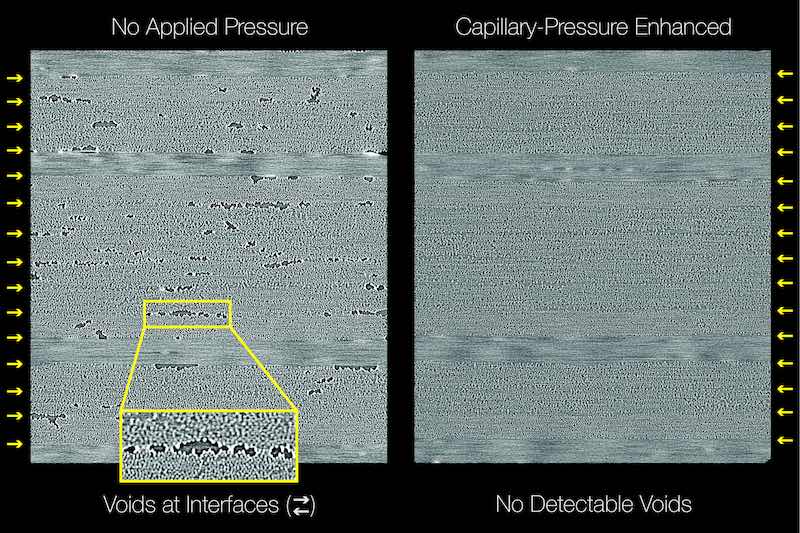
A modern airplane’s fuselage is made from multiple sheets of different composite materials that must be wheeled into warehouse-sized ovens where the layers fuse together to form a resilient, aerodynamic shell.
Engineers have developed a method to produce aerospace-grade composites without enormous ovens and pressure vessels. Instead of placing layers of material inside an oven to cure, the material is wrapped in an ultrathin film of carbon nanotubes (CNTs). When an electric current is applied to the film, the CNTs generated heat, causing the materials within to cure and fuse together.
More From SAE Media Group
Tech Briefs
Fiber-Metal Laminate Manufacturing Technique
Tech Briefs
Thin Heat Shield for Superfast Aircraft
Aerospace & Defense Tech Briefs
‘Nanostitches’ Enable Lighter and Tougher Composite Materials
Tech Briefs
Conductive Carbon Fiber Polymer Composite
Aerospace Manufacturing and Machining INSIDER
Can This Self-Healing Composite Make Airplane and Spacecraft Components Last for Centuries?
Aerospace & Defense Tech Briefs
How Advanced Vacuum Bag Kits Streamline Composite Parts Manufacturing
Aerospace & Defense Tech Briefs
Aerospace Production: Overcoming Challenges in Composite Machining


Tech Briefs
Precision CNT Cutting Mechanism
Medical Design Briefs
3D Printable Polymer Nanocomposite Ink
Aerospace Manufacturing and Machining INSIDER
Thermoplastic Drive Shaft System Developed for Aerospace Applications
Aerospace INSIDER
Researchers Turn to Carbon Nanotubes to Build Better Heat Shields
Automotive Engineering
Linking Embroidery and Carbon Fiber to save Weight and Cost

Aerospace Manufacturing and Machining INSIDER
Nanoscale Materials Could Reduce Manufacturing, Aviation Greenhouse Gasses

Aerospace & Defense Tech Briefs
Hydraulic Testing of Polymer Matrix Composite 102mm Tube Section

Aerospace INSIDER
Nano-Modified Aerospace Composites Have Improved Conductivity
Aerospace & Defense Tech Briefs
Novel Whisker Mitigating Composite Conformal Coat Assessment
Aerospace INSIDER
Carbon Nanotube “Stitches” Strengthen Aircraft Composites
Tech Briefs
Automated Tow/Tape Placement System

Medical Design Briefs INSIDER
Butterfly Wings Inspire Nanobiocomposite Material
Top Stories
NewsSensors/Data Acquisition
 Microvision Aquires Luminar, Plans Relationship Restoration, Multi-industry Push
INSIDERRF & Microwave Electronics
 A Next Generation Helmet System for Navy Pilots
INSIDERWeapons Systems
 New Raytheon and Lockheed Martin Agreements Expand Missile Defense Production
NewsAutomotive
 Ford Announces 48-Volt Architecture for Future Electric Truck
INSIDERAerospace
 Active Strake System Cuts Cruise Drag, Boosts Flight Efficiency
ArticlesTransportation

Webcasts
Aerospace
 Cooling a New Generation of Aerospace and Defense Embedded...
Energy
 Battery Abuse Testing: Pushing to Failure
Power
 A FREE Two-Day Event Dedicated to Connected Mobility
Automotive
 Quiet, Please: NVH Improvement Opportunities in the Early Design Cycle
Electronics & Computers
 Advantages of Smart Power Distribution Unit Design for Automotive &...
Unmanned Systems
 Sesame Solar's Nanogrid Tech Promises Major Gains in Drone Endurance