




Carbon Nanotube “Stitches” Strengthen Aircraft Composites

The newest passenger jets are made primarily from advanced composite materials such as carbon fiber reinforced plastic — extremely light, durable materials. But composite materials are also surprisingly vulnerable: the many layers in composites can break apart due to relatively small impacts. MIT aerospace engineers have found a way to bond composite layers in such a way that the resulting material is substantially stronger and more resistant to damage than other advanced composites.
The researchers embedded tiny “forests” of carbon nanotubes within a glue-like polymer matrix, then pressed the matrix between layers of carbon fiber composites. The nanotubes, resembling tiny, vertically aligned stitches, worked themselves within the crevices of each composite layer, serving as a scaffold to hold the layers together. The team found that, compared with existing composite materials, the stitched composites were 30 percent stronger, withstanding greater forces before breaking apart.
More From SAE Media Group
Tech Briefs
Thin Heat Shield for Superfast Aircraft
Tech Briefs
Fiber-Metal Laminate Manufacturing Technique

Tech Briefs
Continuous Fiber Composite for Use in Gears
Aerospace & Defense Tech Briefs
Thermoplastic Composites to Play Enhanced Role in Next-Generation Aerospace Applications
Aerospace INSIDER
Researchers Turn to Carbon Nanotubes to Build Better Heat Shields
Aerospace & Defense Tech Briefs
Advanced CT Inspection and Data Analysis
Aerospace & Defense Tech Briefs
‘Nanostitches’ Enable Lighter and Tougher Composite Materials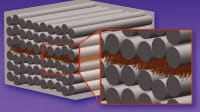

Aerospace & Defense Tech Briefs
Fiber-Reinforced Thermoplastic Composites

Tech Briefs
Products of Tomorrow
Aerospace Manufacturing and Machining INSIDER
Can This Self-Healing Composite Make Airplane and Spacecraft Components Last for Centuries?
Tech Briefs
Compact, Lightweight, CMC-Based Acoustic Liner
Tech Briefs
Sensor Film for Aerospace
Aerospace & Defense Tech Briefs
Using Thermoplastics in Aerospace Applications
Aerospace & Defense Tech Briefs
Composite Repair Engineering Case Studies for U.S. Army Aerostructures
Aerospace Manufacturing and Machining INSIDER
Researchers Push Limits in High-Temp, Polymer Additive Manufacturing
Aerospace & Defense Tech Briefs
Evaluation of the Effects of Hydrogen Peroxide on Common Aircraft Electrical Materials
Tech Briefs
Healable Carbon Fiber Composite
Aerospace INSIDER
AFRL, Universities Partner on 3D-Printed Composites
Aerospace INSIDER
Making Airplane Parts Without the Massive Infrastructure
Tech Briefs
Technique Creates Adaptive Materials
Aerospace INSIDER
Tests Show How Plastic Parts Deform During Flight
Top Stories
NewsSensors/Data Acquisition
 Microvision Aquires Luminar, Plans Relationship Restoration, Multi-industry Push
INSIDERRF & Microwave Electronics
 A Next Generation Helmet System for Navy Pilots
INSIDERWeapons Systems
 New Raytheon and Lockheed Martin Agreements Expand Missile Defense Production
NewsAutomotive
 Ford Announces 48-Volt Architecture for Future Electric Truck
INSIDERAerospace
 Active Strake System Cuts Cruise Drag, Boosts Flight Efficiency
ArticlesTransportation

Webcasts
Aerospace
 Cooling a New Generation of Aerospace and Defense Embedded...
Energy
 Battery Abuse Testing: Pushing to Failure
Power
 A FREE Two-Day Event Dedicated to Connected Mobility
Automotive
 Quiet, Please: NVH Improvement Opportunities in the Early Design Cycle
Electronics & Computers
 Advantages of Smart Power Distribution Unit Design for Automotive &...
Unmanned Systems
 Sesame Solar's Nanogrid Tech Promises Major Gains in Drone Endurance