




Transparent Display System Could Provide Heads-Up Data
Transparent displays have a variety of potential applications — such as the ability to see navigation or dashboard information while looking through the windshield of a car or plane, or to project video onto a window or a pair of eyeglasses. A number of technologies have been developed for such displays, but all have limitations.
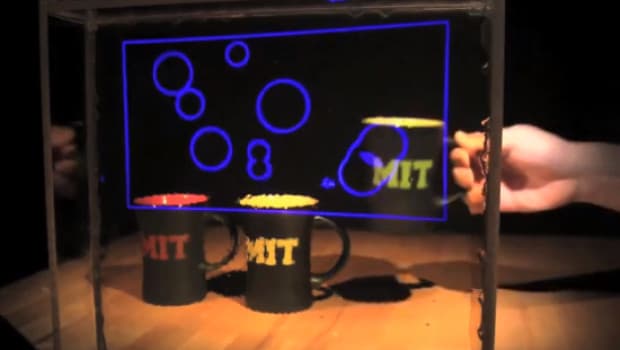
Now, researchers at MIT have come up with a new approach that can have significant advantages over existing systems, at least for certain kinds of applications: a wide viewing angle, simplicity of manufacture, and potentially low cost and scalability.
The secret to the new system: Nanoparticles are embedded in the transparent material. These tiny particles can be tuned to scatter only certain wavelengths, or colors, or light, while letting all the rest pass right through. That means the glass remains transparent enough to see colors and shapes clearly through it, while a single-color display is clearly visible on the glass.
Such displays might be used, for example, to project images onto store windows while still allowing passersby to see clearly the merchandise on display inside, or to provide heads-up windshield displays for drivers or pilots, regardless of viewing angle.
More From SAE Media Group
Aerospace & Defense Tech Briefs
Frequency Agile Plasmonic Antennas and Sensors


Aerospace & Defense Tech Briefs
Transparent Display Technology
Aerospace & Defense Tech Briefs
Design of New Piezoelectric Composites Using Nanocellulose
Photonics & Imaging Technology INSIDER
Nano-Particles Used to Increase Power, Improve Eye Safety of Fiber Lasers
Aerospace & Defense Tech Briefs
Photonic Microwave Generation Using On-Chip Optical Frequency Combs
Photonics & Imaging Technology INSIDER
Unique Nanodisk Holds Major Potential for Future of Photonic Research
Photonics & Imaging Technology
New Blue Light Technique Could Enable Advances in Understanding Nanoscale Technologies
Aerospace INSIDER
Liquid Crystals Could Deflect Laser Pointer Attacks on Aircraft
Tech Briefs
Levitating Objects with Light

Photonics & Imaging Technology
Rice ‘Metalens’ Could Disrupt Vacuum UV Market

Photonics & Imaging Technology INSIDER
World's Smallest Photon Achieved in Dielectric Nanocavity
Photonics & Imaging Technology
Using Magnets to Toggle Nanolasers Leads to Better Photonics

Photonics & Imaging Technology INSIDER
Infrared Imaging by Ultrathin Nanocrystal Layers
Tech Briefs
High-Color-Purity 3D Printing
Aerospace & Defense Tech Briefs
Fast Reacting Nano-Composite Energetic Materials: Synthesis and Combustion Characterization
Aerospace Manufacturing and Machining INSIDER
Hybrid Nanomaterials Hold Promise for Improved Ceramic Composites
Photonics & Imaging Technology INSIDER
New Metasurface Design Can Control Optical Fields in Three Dimensions


Tech Briefs
Solid-State Carbon Dioxide Sensor
Aerospace & Defense Tech Briefs
MOVPE Growth of LWIR AlInAs/GaInAs/InP Quantum Cascade Lasers: Impact of Growth and Material Quality on Laser Performance

Sensor Technology
Nano Flashlight Enables New Applications of Light

Photonics & Imaging Technology
ZERODUR: The Highly Technical Glass-Ceramic
Top Stories
INSIDERManufacturing & Prototyping
 How Airbus is Using w-DED to 3D Print Larger Titanium Airplane Parts
INSIDERManned Systems
 FAA to Replace Aging Network of Ground-Based Radars
NewsTransportation
 CES 2026: Bosch is Ready to Bring AI to Your (Likely ICE-powered) Vehicle
NewsSoftware
 Accelerating Down the Road to Autonomy
EditorialDesign
 DarkSky One Wants to Make the World a Darker Place
INSIDERMaterials
 Can This Self-Healing Composite Make Airplane and Spacecraft Components Last...
Webcasts
Defense
 How Sift's Unified Observability Platform Accelerates Drone Innovation
Automotive
 E/E Architecture Redefined: Building Smarter, Safer, and Scalable...
Power
 Hydrogen Engines Are Heating Up for Heavy Duty
Electronics & Computers
 Advantages of Smart Power Distribution Unit Design for Automotive...
Unmanned Systems
 Quiet, Please: NVH Improvement Opportunities in the Early Design...
