




Development of High Quality 4H-SiC Thick Epitaxy for Reliable High Power Electronics Using Halogenated Precursors
New approaches to synthesizing SiC epitaxial layers could improve electronics performance.
Development of robust semiconductor devices with high energy efficiency and reliability is a key objective towards 'Energy Conversion and Power Management ' for naval system applications. The goal of this research is to create the fundamental knowledge needed for the development of novel approaches to synthesize high-quality, thick SiC epitaxial layers (> 100μm) for reliable high voltage (≥10kV) / high power (>100 kW) electronics for navy ship applications.
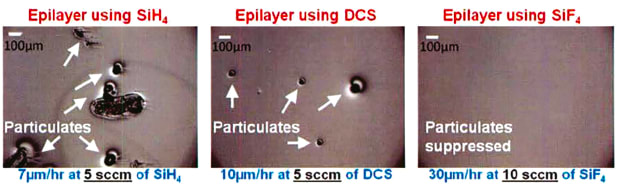
This program focuses on (a) developing innovative solutions to the current main limitation in SiC homoepitaxy — reduction/ elimination of device-killing defects; (b) gaining understanding of the chemical vapor deposition processes in SiC epitaxy, specifically related to precursor gas decomposition dynamics and subsequent parasitic deposition of Si, C and SiC on the gas injector tube walls; and (c) achieving both high growth rate and high quality epitaxial films in a cost-effective manner.
This research investigated the epitaxial growth of thick films using halogenated precursors: chlorine-based dichlorosilane (DCS) and fluorine-based tetrafluorosilane (TFS). Growth using DCS is extensively studied, showing high growth rate (>25μm/h), excellent doping control (n+, n-, SI, p-), good epilayer morphology (RMS<2nm for 4° SiC) and low defect densities (BPD, IGSF densities 0≈5.6cm-2. Extensive study of dichlorosilane provides evidence that even chlorosilane gases are not the best solution to eliminate Si droplet formation and suppress parasitic deposition, which subsequently degrades crystal quality. The understanding gained from this research led to the first use of fluorinated silicon precursor with much stronger bonds to grow SiC epitaxy. Tetrafluorosilane (TFS, SiF4) has been utilized for the first time to completely eliminate Si droplet formation and suppress parasitic deposition by 80%. The ability of TFS to suppress particulates enables long duration, high quality thick epitaxy in the cleanest reactor environment. Epitaxial film growth rate, the influence of C/Si ratio of the precursor gases on doping concentration and crystal quality, growth process conditions, etc., have been investigated.
High quality, thick epitaxy (120 μm) was demonstrated on 8° substrate at a growth rate of 30μm/h using TFS. Excellent control of the uniformities of doping level and morphology makes TFS especially suitable for large wafer and multiwafer CVD growth to achieve SiC devices with excellent performance uniformity. In terms of epilayer quality including morphology, roughness, crystallinity, polytype inclusion, BPD density, etc., epigrowth using TFS is found to be superior to the growth using DCS or silane gases. Defect free epilayer growth (≈0 BPD density) was achieved by a two-step epilayer growth by growing a buffer layer epi-eutectic etch-regrowth process using DCS precursor. High quality on-axis epilayers were grown using TFS at low flow rates (5 sccm) with increased step flow growth at high C/Si ratio offering the potential for defect free epilayers, a significant breakthrough SiC technology.
Ni/4H-SiC Schottky diodes fabricated on DCS-grown and TFS-grown epilayers show similar barrier heights (>1.6eV) and ideality factors (<1.1). The tightest distribution of Schottky parameters is reported for Ni/SiC Schottky system fabricated on TFS-grown epilayer.
This work was done by Tangali S. Sudarshan of the University of South Carolina for the Office of Naval Research. NRL-0068
This Brief includes a Technical Support Package (TSP).

Development of High Quality 4H-SiC Thick Epitaxy for Reliable High Power Electronics Using Halogenated Precursors
(reference NRL-0068) is currently available for download from the TSP library.
Don't have an account?
More From SAE Media Group
Tech Briefs
SiC-Based Microstructures for Sensors
Electronics & Sensors INSIDER
Researchers Create First Functional Semiconductor Made from Graphene
Tech Briefs
Metallization for SiC Semiconductors
Aerospace & Defense Tech Briefs
Future Advances in Electronic Materials and Processes - Flexible Hybrid Electronics
Tech Briefs
Ultra-Wide-Bandgap Power Electronics
Aerospace & Defense Tech Briefs
Molecular Engineering for Mechanically Resilient and Stretchable Electronic Polymers and Composites

Aerospace INSIDER
A New Quantum Materials Research System
Tech Briefs
Turning Diamond into Metal
Electronics & Sensors INSIDER
New Method Gives Robust Transistors
Electronics & Sensors INSIDER
MIT Team Takes a Major Step Toward Fully 3D-Printed Active Electronics
Tech Briefs
Organic Material for Printed Electronics
Tech Briefs
Silicon Carbide npnp Thyristors
Tech Briefs
Susceptor-Coating Materials for Growth of 4H-SiC
Automotive Engineering
Moving Targets: How Improvements to SiC, GaN Power Electronics Will Redefine EV
Electronics & Sensors INSIDER
MIT Engineers Grow “High-Rise” 3D Chips
Electronics & Sensors INSIDER
Scientists Create Superconducting Semiconductor Material
Tech Briefs
Lighter Radiation Shielding for Electronics

Aerospace & Defense Tech Briefs
Silicon Microsphere Fabrication
Aerospace & Defense Tech Briefs
Dynamics of Epitaxy on Nano-Sized Semiconductor Surfaces
Aerospace & Defense Tech Briefs
Design Guidelines for Military and Aerospace PCBs
Aerospace & Defense Tech Briefs
Heterogeneous Integration Technology
Tech Briefs
Enhanced Material Stable Enough for Solar Cells
Tech Briefs
Electronics Withstand Extreme Heat
Aerospace & Defense Tech Briefs
Gallium Nitride High-Power Electronics
Overview
The document is a final technical report detailing research conducted under grant number N00014-10-1-0530, awarded by the Office of Naval Research (ONR) to the University of South Carolina. The primary focus of the research is the development of high-quality 4H-Silicon Carbide (SiC) thick epitaxy, which is crucial for reliable high-power electronics.
The report highlights the innovative use of halogenated precursors, specifically chlorine-based dichlorosilane (DCS) and fluorine-based tetrafluorosilane (TFS), in the chemical vapor deposition (CVD) process for epitaxial growth. Notably, TFS (SiF4) is utilized for the first time in this context, demonstrating its effectiveness in completely eliminating the formation of silicon droplets, a common issue that can degrade the quality of the epitaxial layers. This advancement allows for the suppression of parasitic deposition, thereby enabling the growth of high-quality SiC layers.
The research findings indicate that Schottky diodes fabricated on TFS-grown epilayers exhibit superior performance characteristics, including high barrier heights and low ideality factors. These improvements are significant for the development of high-power electronic devices, which require materials that can withstand high voltages and temperatures while maintaining efficiency.
The report is structured to provide a comprehensive overview of the research objectives, methodologies, and results. It includes sections on the experimental setup, the results of the epitaxial growth processes, and the performance metrics of the fabricated devices. The authors, led by Dr. Tangali S. Sudarshan, emphasize the importance of these findings in advancing the field of semiconductor technology, particularly for applications in high-power electronics.
In conclusion, this report not only documents the successful application of halogenated precursors in SiC epitaxy but also sets the stage for future research and development in the area of high-performance electronic materials. The findings contribute to the ongoing efforts to enhance the reliability and efficiency of power electronic devices, which are critical in various industrial and military applications. The research is approved for public release, indicating its potential impact on the broader scientific and engineering communities.
Top Stories
INSIDERDefense
 New Raytheon and Lockheed Martin Agreements Expand Missile Defense Production
NewsAutomotive
 Ford Announces 48-Volt Architecture for Future Electric Truck
INSIDERManufacturing & Prototyping
 Active Strake System Cuts Cruise Drag, Boosts Flight Efficiency
ArticlesTransportation
 Accelerating Down the Road to Autonomy
INSIDERMaterials
 How Airbus is Using w-DED to 3D Print Larger Titanium Airplane Parts
Road ReadyTransportation

Webcasts
Electronics & Computers
 Cooling a New Generation of Aerospace and Defense Embedded...
Power
 Battery Abuse Testing: Pushing to Failure
Connectivity
 A FREE Two-Day Event Dedicated to Connected Mobility
Automotive
 Quiet, Please: NVH Improvement Opportunities in the Early Design Cycle
Transportation
 Advantages of Smart Power Distribution Unit Design for Automotive &...
Aerospace
 Sesame Solar's Nanogrid Tech Promises Major Gains in Drone Endurance