




A New Quantum Materials Research System
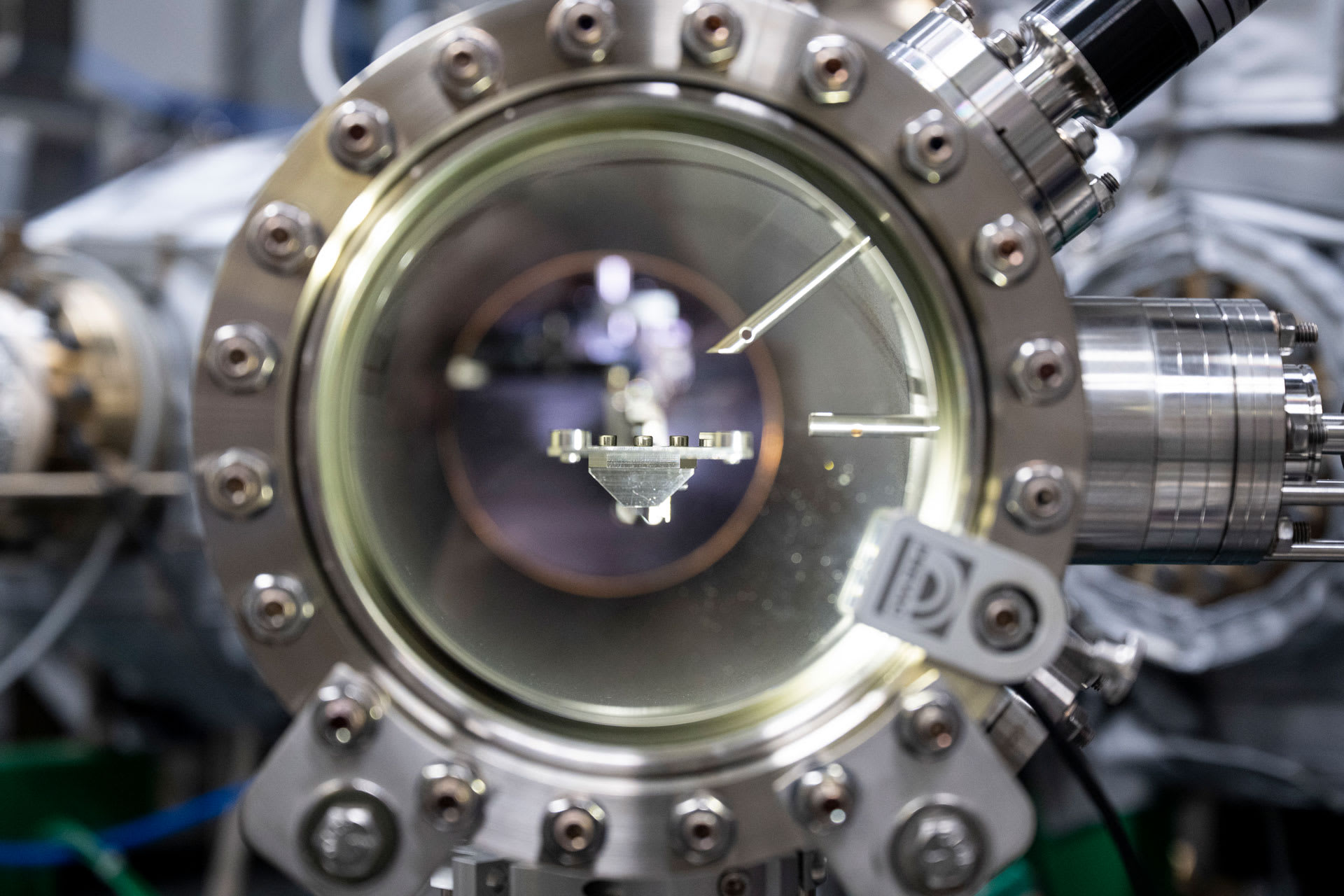
Scientists at the U.S. Naval Research Laboratory (NRL) have a powerful new tool to accelerate discovery in quantum materials for advanced electronics. The laboratory recently completed installation of a state-of-the-art “cluster system” that allows researchers to grow and analyze materials at the atomic level, all without ever removing samples from its ultra-clean environment.
“This system is really exciting for us,” said Connie Li, Ph.D., NRL Research Scientist. “It’s like Christmas came early. For the first time, we can grow materials one atomic layer at a time and immediately study their structure and electronic properties, all within the same setup.”
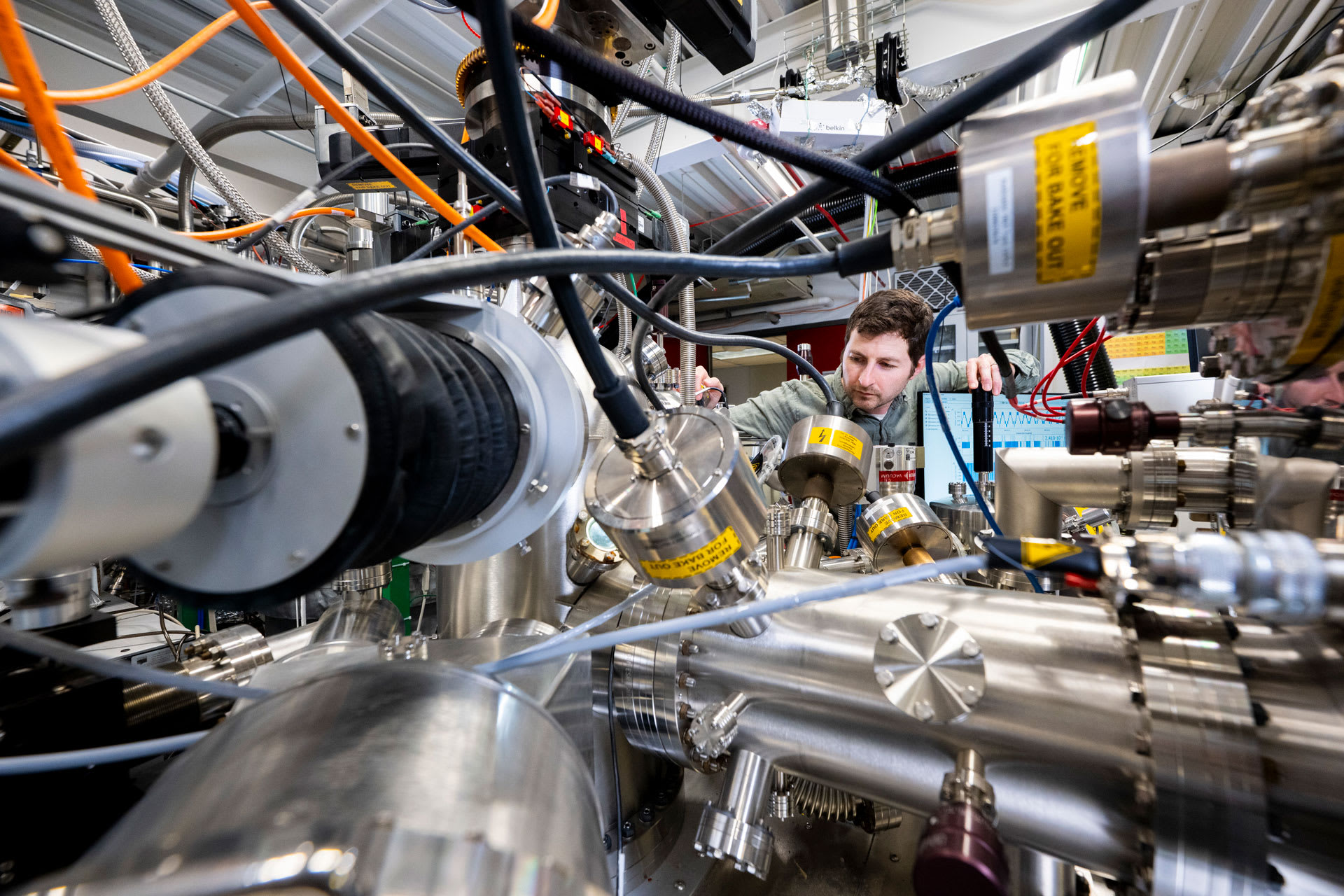
The cluster system integrates multiple growth and characterization techniques under one roof, connected by a central interface chamber where a robotic transfer arm moves samples between chambers while maintaining ultra-high vacuum. This allows researchers to:
- Grow new materials using molecular beam epitaxy, a method that deposits materials with atomic precision.
- Characterize their properties in situ using powerful imaging and spectroscopy techniques, including scanning tunneling microscopy, which can visualize individual atoms, and angle-resolved photoemission spectroscopy that can map electronic band structures.
- Fabricate nanoscale functional devices by layering different materials, including magnetic and electronic films, onto newly developed structures.
Traditionally, researchers had to remove samples from one instrument and ship them to specialized facilities, risking contamination and slowing progress. With NRL’s new cluster system, those steps are eliminated.
“Now we can stop in the middle of a growth process, check the surface of a material atom by atom, and then continue refining it,” Li explained. “That makes our work cleaner, faster, and far more precise than before.”
The research focuses on quantum materials, which exhibit unusual properties rooted in quantum mechanics. These include superconductors, which can carry electricity with zero energy loss, and topological insulators, which conduct only on their surfaces and are resilient against defects. Such materials have the potential to revolutionize Navy and Department of War technologies in areas like memory storage, advanced sensors, and energy-efficient electronics.
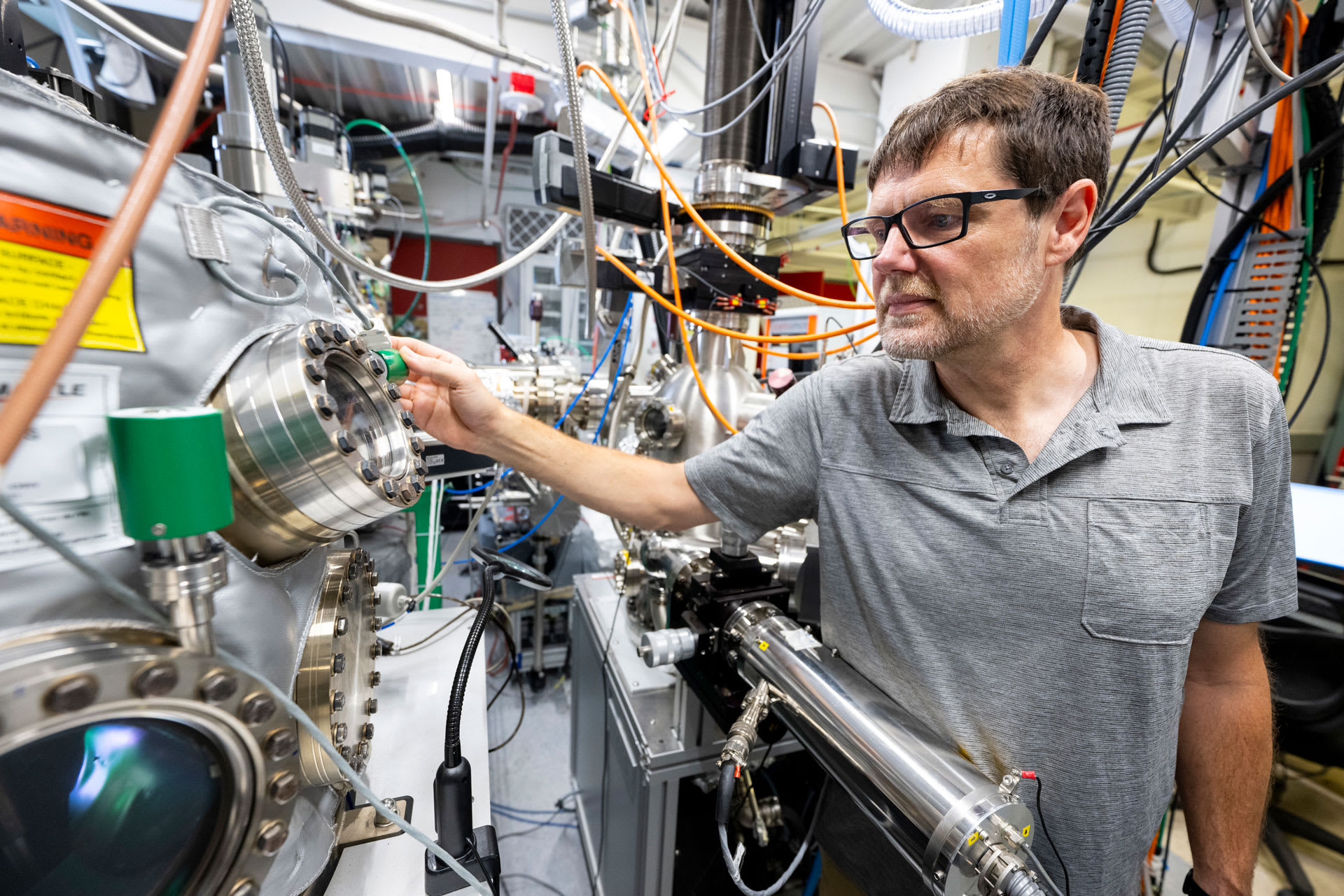
“This system gives us the ability to make and study new materials for the next generation of electronics, beyond what current silicon-based technology can do,” said Olaf van ‘t Erve, Ph.D., NRL research scientist who’s also working on the system.
The installation, has now reached operational status. NRL researchers say the system will greatly accelerate discoveries and shorten the path from fundamental science to future real-world applications.
More From SAE Media Group
Embedded Technology INSIDER
Ferroelectric Materials Could Revolutionize Data-Driven Devices
Electronics & Sensors INSIDER
A New Material That Could Change Electronics
Tech Briefs
Studying Superconductors
Embedded Computing INSIDER
Scientists Find Twisting 3-D Electron Raceway in Nanoscale Crystal Slices
Electronics & Sensors INSIDER
New Photonic Effect Could Speed Drug Development

Electronics & Sensors INSIDER
Scientists Create Superconducting Semiconductor Material
Aerospace & Defense Tech Briefs
Fabrication and Electrical Characterization of Correlated Oxide Field Effect Switching Devices for High Speed Electronics
Tech Briefs
Superconductivity in a Nickel Oxide Material
Tech Briefs
Cell-Sized Robots Sense Their Environment
Tech Briefs
Quantum Switch Turns Metals into Insulators
Aerospace & Defense Tech Briefs
Epitaxial Growth of Rhenium with Sputtering
Electronics & Sensors INSIDER
Researchers Create First Functional Semiconductor Made from Graphene
Photonics & Imaging Technology INSIDER
Addition of Tin Boosts Nanoparticle’s Photoluminescence
Test & Measurement INSIDER
New Method Makes Ultrasensitive Conductivity Measurements

Electronics & Sensors INSIDER
Advanced Microelectronics: Why A Next-Gen Semiconductor Doesn’t Fall to Pieces
Aerospace & Defense Tech Briefs
Matrix-Free Assisted Laser Desorption Ionization Using Metal-Organic Frameworks


Electronics & Sensors INSIDER
Novel Approach to Advanced Electronics and Data Storage with Ferroelectricity
Aerospace & Defense Tech Briefs
Reconfigurable Electronics Based on Multiferroics and Nanomagnetism
Electronics & Sensors INSIDER
Careful Heating Unlocks Unprecedented Sensitivity to Pressure in Semiconductor Materials
Medical Design Briefs
New Products and Services

Tech Briefs
New Class of Two-Dimensional Materials
Aerospace & Defense Tech Briefs
Coating Technology Enables Effective Missile Countermeasures
Photonics & Imaging Technology
Compact MEMS-Based NIR Spectroscopy for Mobile Applications
Tech Briefs
Rolled 2D Heterostructures
Top Stories
NewsSensors/Data Acquisition
 Microvision Aquires Luminar, Plans Relationship Restoration, Multi-industry Push
INSIDERRF & Microwave Electronics
 A Next Generation Helmet System for Navy Pilots
INSIDERWeapons Systems
 New Raytheon and Lockheed Martin Agreements Expand Missile Defense Production
NewsAutomotive
 Ford Announces 48-Volt Architecture for Future Electric Truck
INSIDERAerospace
 Active Strake System Cuts Cruise Drag, Boosts Flight Efficiency
ArticlesTransportation

Webcasts
Aerospace
 Cooling a New Generation of Aerospace and Defense Embedded...
Energy
 Battery Abuse Testing: Pushing to Failure
Power
 A FREE Two-Day Event Dedicated to Connected Mobility
Automotive
 Quiet, Please: NVH Improvement Opportunities in the Early Design Cycle
Electronics & Computers
 Advantages of Smart Power Distribution Unit Design for Automotive &...
Unmanned Systems
 Sesame Solar's Nanogrid Tech Promises Major Gains in Drone Endurance