




Matrix-Free Assisted Laser Desorption Ionization Using Metal-Organic Frameworks
Matrix-assisted laser desorption/ionization (MALDI) is a soft ionization technique that is widely applied in the characterization of large biomolecules using various mass spectrometry (MS) analyzers, specifically, time-of-flight (TOF) analyzers. The MALDI process involves the deposition of an analyte solution onto a metal substrate before the addition of a matrix. The matrix/analyte dry spot is exposed to a UV laser, and the laser energy that is absorbed by the matrix/analyte is converted into heat energy that initiates charge transfer, which results in the desorption of the matrix and analyte molecules in ionized form. The positive ions are then accelerated through a vacuum into MS analyses.
The MALDI process, however, lacks guiding systematic principles, which has resulted in mostly empirical work. For example, there is no universal matrix that can be used in the MALDI-MS analysis of biomolecules. Hundreds of compounds were assessed with several analytes and were given qualitative ratings. These variables were the products of differences in charge transfer efficiency between the matrix and analytes because of chemical and structural factors.
This problem represents an urgent analytical need that can advance the MALDI process toward mechanistic understanding. Metal-organic frameworks (MOFs) are an emerging class of porous materials that have been studied in multiple areas, including gas storage, sensing, air purification, and catalysis. MOFs are typically synthesized from metal oxide secondary building units (SBUs) connected by organic linkers to form a reticulated, porous network. MOFs are used because of their versatility and thermal stability.
The unique physical and chemical properties of MOFs provide the potential to serve as MALDI matrixes that are capable of ionizing a wide range of analytes. However, because of their structural complexity, an attempt was made to determine the existence of any interaction between the analytes and the MOFs when they were mixed together. Low-frequency Raman spectroscopy (LFRS) was used to determine the inter- and intramolecular changes between free MOFs. In addition, LFRS was used to investigate the reactions that resulted from mixing analytes in an amorphous environment.
LFRS is a developing technique that concurrently provides vibrational spectra for tested compounds in the terahertz and normal Raman spectral regions, which are indicative of any potential physical and chemical changes in a given analyte. In the case of MOFs, LFRS can be used to investigate the binding properties of MOFs with the analytes of interest and to determine the nature of such binding.
Currently, there are two different mechanisms that explain the ionization process in MALDI-MS analysis. The first mechanism is based on the coupled chemical and physical dynamics model, which involves charge transfer during the excitation stage of a matrix/analyte mixture, resulting from exposure to laser power. The second mechanism is based on a cluster model, which involves a combination of proton and intracluster charge transfer during the desolvation step of the MALDI process. Accordingly, an experimental approach for MOF/analyte interaction during the MALDI process was designed to determine the ionization model that governs the ionization step and determine the basic elements that contribute to the MALDI ionization process of the MOF/analyte mixtures. This base knowledge will aid in the development of efficient matrix-free desorption substrates for MS analyses.
MOF materials have demonstrated superior homogenous and heterogeneous catalysis characteristics that will be transcribed to the MALDI process. Moreover, the diversity of MOFs can be envisioned to act as a selective desorption surface for specific groups of analytes without reliance on the addition of external reagents.
The overall goal of this project was to study the mechanism of ionization and to determine the influence of factors that affect the charge-transfer process during the MALDI-MS ionization. It also addressed the binding affinity issue between MOFs and analytes using the LFRS technique to research inter- and intramolecular changes between the MOF crystalline and amorphous states with different analytes. These analytes were classified as acidic or basic compounds. Once the basic properties of the MOF/analyte mixture are understood, it will be possible to determine how to design MOFs that can enhance the ionization efficiency for a wide range of compounds during MALDI-MS analysis.
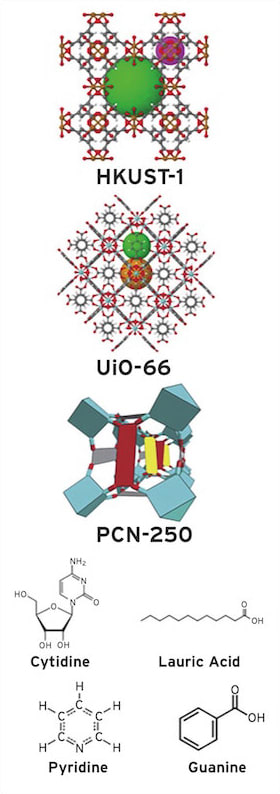
This research addressed the potential intra- and intermolecular changes for MOF/analyte mixtures using LFRS and MALDI-MS techniques. The MOFs used in the LFRS technique were UiO-66-COOH and UiO-66-NH2, and the analytes were pyridine, benzoic acid, cytidine, lauric acid, and guanine. More MOFs than those tested by the LFRS technique were used for the MALDI-MS analyses. Most of the MOFs were obtained from internal sources, either through synthesis or by leveraging from already-funded projects that utilize MOFs. The structures for some of the MOFs and analytes are shown in the accompanying figure.
This work was done by Rabih E.Jabbour; Gregory Peterson; Jared DeCoste (ECBC); and Yousef Jabaji (UMBC); for the Army Research, Development and Engineering Command. ARDEC-0005
This Brief includes a Technical Support Package (TSP).
Matrix-Free Assisted Laser Desorption Ionization Using Metal-Organic Frameworks
(reference ARDEC-0005) is currently available for download from the TSP library.
Don't have an account?
More From SAE Media Group
Medical Design Briefs
OPO Lasers Spur Advances in Mass Spectrometry Diagnostics
Tech Briefs
Miniature Mass Spectrometer
Tech Briefs
Nanoscale Pillars Act as Memory Foam
Medical Design Briefs
Optical Design Considerations for Additive Manufacturing
Tech Briefs
In-Situ Chemical Analysis of Material Surfaces
Tech Briefs
Real-Time Airborne Particle Analyzer
Electronics Tech Briefs
A Commercially Viable Asymmetric Ion Trap for Environmental Analysis

Tech Briefs
Facility Focus: Ames Laboratory
Tech Briefs
Correlation Spectrometer
Medical Design Briefs
Biosensor Measures Extracellular Hydrogen Peroxide
Aerospace & Defense Tech Briefs
Fabrication and Electrical Characterization of Correlated Oxide Field Effect Switching Devices for High Speed Electronics
Tech Briefs
Portable Acousto-Optic Spectrometers
Aerospace & Defense Tech Briefs
pH-Dependent Spin State Population and ¹⁹F NMR Chemical Shift Via Remote Ligand Protonation in An Iron(II) Complex
Tech Briefs
Ultrasensitive Vapor Detection System
Photonics & Imaging Technology
Compact MEMS-Based NIR Spectroscopy for Mobile Applications
Sensor Technology
Optical Sensor for Unknown Gas Detection

Sensor Technology
Portable Electrochemical Sensing System

Battery & Electrification Technology
Designing Safer, Higher-Performance Lithium Batteries
Electronics & Sensors INSIDER
New Photonic Effect Could Speed Drug Development
Photonics Tech Briefs
MALDI and Biotech Push Nitrogen Laser Development

Aerospace & Defense Tech Briefs
Hydraulic Testing of Polymer Matrix Composite 102mm Tube Section
Overview
The document titled "Matrix-Free Assisted Laser Desorption Ionization Using Metal-Organic Frameworks" presents a research report authored by Rabih E. Jabbour, Gregory Peterson, Jared DeCoste, and Yousef Jabaji. The work was conducted under project number PE 0601102A Project VR9, spanning from October 2016 to September 2018, and was approved for public release.
The primary focus of the report is on the development and application of matrix-free assisted laser desorption ionization (MALDI) techniques utilizing metal-organic frameworks (MOFs). Traditional MALDI methods often require the use of a matrix to assist in the desorption and ionization of analytes, which can complicate the analysis and limit the types of samples that can be effectively analyzed. This research aims to overcome these limitations by employing MOFs, which are porous materials composed of metal ions coordinated to organic ligands, to facilitate the desorption and ionization processes without the need for a matrix.
The report details the experimental methodologies employed, including the synthesis of specific MOFs and their characterization. It also discusses the performance of these MOFs in various analytical applications, highlighting their potential advantages over conventional matrices, such as improved sensitivity, reduced background noise, and the ability to analyze a wider range of compounds.
Additionally, the document acknowledges the contributions of various individuals and organizations involved in the research, including Dr. A. Way Fountain for his guidance, and Drs. Ashish Tripathi and Erik Emmons for their technical support. The research was conducted at the U.S. Army Edgewood Chemical Biological Center (ECBC) and involved collaboration with the U.S. Army Medical Research Institute of Chemical Defense.
The findings of this report are significant for advancing the field of mass spectrometry and analytical chemistry, particularly in applications related to chemical and biological defense. The use of MOFs in MALDI techniques could lead to more efficient and effective analytical methods, enhancing the ability to detect and analyze complex samples in various fields, including environmental monitoring, pharmaceuticals, and biodefense.
In conclusion, this report provides valuable insights into innovative approaches in laser desorption ionization, showcasing the potential of metal-organic frameworks to transform analytical practices and improve the detection of a wide array of substances.
Top Stories
NewsRF & Microwave Electronics
 Microvision Aquires Luminar, Plans Relationship Restoration, Multi-industry Push
INSIDERAerospace
 A Next Generation Helmet System for Navy Pilots
INSIDERDesign
 New Raytheon and Lockheed Martin Agreements Expand Missile Defense Production
INSIDERMaterials
 How Airbus is Using w-DED to 3D Print Larger Titanium Airplane Parts
NewsPower
 Ford Announces 48-Volt Architecture for Future Electric Truck
ArticlesAR/AI

Webcasts
Electronics & Computers
 Cooling a New Generation of Aerospace and Defense Embedded...
Automotive
 Battery Abuse Testing: Pushing to Failure
Power
 A FREE Two-Day Event Dedicated to Connected Mobility
Unmanned Systems
 Quiet, Please: NVH Improvement Opportunities in the Early Design Cycle
Automotive
 Advantages of Smart Power Distribution Unit Design for Automotive &...
Energy
 Sesame Solar's Nanogrid Tech Promises Major Gains in Drone Endurance