




Gold-Based Nanoparticle Liquids for Electronic Applications
These liquids may be useful as self-healing, electrically conductive lubricants.
Electrically conductive, solventless nanoparticle liquids, consisting of gold nanoparticles chemically functionalized with large organic molecular groups, have been investigated for potential utility in electronic and electrical applications. These and other solventless nanoparticle liquids, including electrically nonconductive ones, have been topics of recent research directed toward understanding and exploiting their unusual properties. The most obvious unusual property is that a collection of nanoparticles of this type can flow in a liquid-like fashion, notwithstanding the absence of free solvent molecules. By modifying the attractive and repulsive forces between the nanoparticles through modifications of the surface chemistry of the organic ligands, the properties of the resulting nanoparticle liquids can be tailored for specific applications.
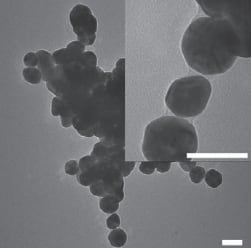
The nanoparticle liquids were chemically characterized by x-ray photoelectron spectroscopy, transmission electron microscopy, zeta-potential measurements, inductively-coupled-plasma atomic-emission spectroscopy, and nuclear magnetic resonance. These characterizations were performed to contribute to understanding of the effects of the chemical synthesis and treatment processes and thereby to enable improvement of these processes.
Mechanical tests were performed to study the potential utility of nanoparticle liquids as electrically conductive lubricants in relay switches in micro-electromechanical systems. For these tests, the nanoparticle liquids were spin-coated to an average thickness of 2 to 3 nm (amounting to sub-monolayer coverage) on gold substrates. In the test of each such coated substrate, a ball was pressed onto the substrate with a controllable, reproducible force, and the resulting contact resistance was measured as the ball was slid across the surface in a cyclic motion at a frequency of 5 Hz. For comparison, the same tests were performed on uncoated gold substrates. The results of these tests were interpreted as demonstrating that the gold-nanoparticle coatings increased the durabilities (quantified in terms of numbers of cycles until failure) by factors ranging from about 10 to about 103.
It is speculated that a nanoparticle-liquid coat of the type tested can reconfigure itself through fluid-like motion and thereby can heal itself when it is damaged by rubbing in use as an electrically conductive lubricant. More specifically, it is speculated that as such a lubricant in a relay-switch contact becomes worn out through mechanical deformation of the nanoparticles and ashing of the carbonaceous coats on the nanoparticles, the undamaged portions of the lubricant can flow into the damaged areas and thereby heal the coat.
This work was done by Robert I. MacCuspie, Andrea M. Elsen, Steve Patton, J. David Jacobs, Steve Diamanti, Michael Arlen, Andrey A. Voevodin, and Richard A. Vaia of the Air Force Research Laboratory.
AFRL-0054
This Brief includes a Technical Support Package (TSP).
Gold-Based Nanoparticle Liquids for Electronic Applications
(reference AFRL-0054) is currently available for download from the TSP library.
Don't have an account?
More From SAE Media Group
Photonics & Imaging Technology
New Electron Microscopy Technique Offers First Look at Previously Hidden Processes
Aerospace & Defense Tech Briefs
Abrasion Testing of Products Containing Nanomaterials
Aerospace & Defense Tech Briefs
Cluster-Assembled Soft Magnets for Power Electronics Applications
Photonics & Imaging Technology
New Electron Microscopy Technique Offers First Look at Previously Hidden Processes

Medical Design Briefs
New Thermofluidic Improves Lab-On-a-Chip Applications
Aerospace & Defense Tech Briefs
Templated Synthesis of Aluminum Nanoparticles for Stable Energetic Materials
Battery & Electrification Technology
Designing Safer, Higher-Performance Lithium Batteries
Aerospace & Defense Tech Briefs
Self-Lubrication of Hot YSZ-Ag-Mo Nanocomposite Coatings
Tech Briefs
Scaling Up Nano for Sustainable Manufacturing

Tech Briefs
Creating 2D All-Organic Perovskites
Battery & Electrification Technology
Emerging Plasma FIB-SEM Techniques Advancing Battery Innovation
Tech Briefs
Janus Particles Improve Paints and Coatings
Tech Briefs
Nanoscale Pillars Act as Memory Foam
Tech Briefs
Nano-Sized Actuator Lifts Many Times its Weight
Tech Briefs
Synthesizing Complex Optical Materials
Medical Design Briefs
Understanding Titanium’s Biocompatibility
Aerospace & Defense Tech Briefs
Matrix-Free Assisted Laser Desorption Ionization Using Metal-Organic Frameworks
Battery & Electrification Technology
Diagnosing a Dud May Lead to a Better Battery
Tech Briefs
Copolyimide Surface-Modifying Coating
Photonics & Imaging Technology
Deformation Fingerprints Will Help Researchers Identify, Design Better Metallic Materials
Overview
The document titled "Nanoparticle Liquids for Reconfigurable Electronic Materials" discusses the innovative use of high inorganic volume fraction, solventless nanoparticle liquids in various applications, particularly in the field of reconfigurable electronic materials. Authored by a team from the Air Force Research Laboratory, the paper emphasizes the potential of these materials to enhance the performance and longevity of electronic devices.
Nanoparticle liquids are characterized by their ability to flow like liquids while containing solid nanoparticles. This unique property arises from the presence of large organic ligands that are chemically and electrostatically bound to the nanoparticles, allowing for tailored interactions between them. The optimization of these interactions can lead to the development of materials with specific desired properties, making them suitable for various applications.
One significant application highlighted in the document is the use of conductive lubricants in Micro-Electro-Mechanical Systems (MEMS). These lubricants can improve relay switch performance, which is crucial for the reliability of MEMS devices. The ability of the conductive nanoparticles to reconfigure themselves and fill voids in damaged areas is particularly noteworthy, as it can significantly extend the lifespan of devices that may otherwise fail due to local defects.
The research also points to the growing interest in solventless solid nanoparticles that exhibit liquid-like behavior, which represents a shift in material science. The document references work by Giannelis and colleagues, who have explored metal oxide and metal nanoparticle liquids that do not contain free solvent, yet maintain the ability to flow. This advancement opens new avenues for the design and application of electronic materials.
Overall, the paper presents a compelling case for the potential of nanoparticle liquids in creating reconfigurable electronic materials. By leveraging the unique properties of these materials, researchers and engineers can develop more resilient and efficient electronic devices, ultimately contributing to advancements in technology and materials science. The findings underscore the importance of continued research in this area, as it holds promise for future innovations in various fields, including electronics, MEMS, and beyond.
Top Stories
NewsRF & Microwave Electronics
 Microvision Aquires Luminar, Plans Relationship Restoration, Multi-industry Push
INSIDERAerospace
 A Next Generation Helmet System for Navy Pilots
INSIDERDesign
 New Raytheon and Lockheed Martin Agreements Expand Missile Defense Production
INSIDERMaterials
 How Airbus is Using w-DED to 3D Print Larger Titanium Airplane Parts
NewsPower
 Ford Announces 48-Volt Architecture for Future Electric Truck
ArticlesAR/AI

Webcasts
Electronics & Computers
 Cooling a New Generation of Aerospace and Defense Embedded...
Automotive
 Battery Abuse Testing: Pushing to Failure
Power
 A FREE Two-Day Event Dedicated to Connected Mobility
Unmanned Systems
 Quiet, Please: NVH Improvement Opportunities in the Early Design Cycle
Automotive
 Advantages of Smart Power Distribution Unit Design for Automotive &...
Energy
 Sesame Solar's Nanogrid Tech Promises Major Gains in Drone Endurance