




Self-Lubrication of Hot YSZ-Ag-Mo Nanocomposite Coatings
Diffusion of silver to surfaces plays a major part in high-temperature lubrication.
An experimental study has been performed to learn about the physical and chemical mechanisms of self-lubrication of coatings that comprise nanostructured composites of yttria-stabilized zirconia (YSZ), silver, and molybdenum. These and other YSZ-based nanocomposite coatings have received increasing attention in recent years because they offer a combination of hardness, toughness, resistance to wear, and low-friction C properties that make them attractive for reducing wear and friction and increasing the lifetimes of hot, sliding components of mechanical systems. In addition to the excellent mechanical and thermal stability of the basic YSZ ceramic material, the nanocomposite structures of these coatings, consisting of combinations of amorphous and crystalline phases, provide a “chameleon” surface adaptation, in which different phases turn into lubricants in response to different test environments, contact loads, sliding speeds, and temperatures. Moreover, proper sizing of nanocrystalline grains can restrict crack sizes and create large volumes of grain boundaries, thereby increasing the toughness and contact-load-bearing capabilities of these coatings.
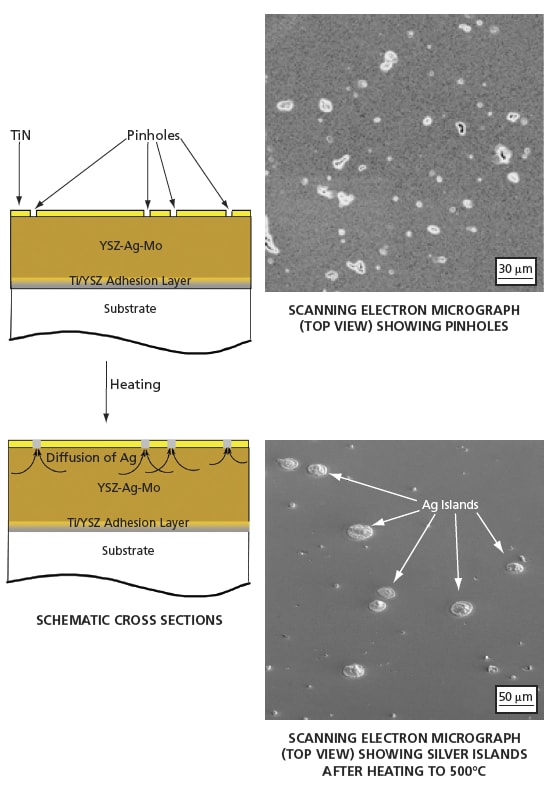
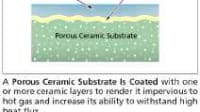
The YSZ-Ag-Mo composite coatings for the present experimental study were deposited on steel and nickel-alloy substrates in a hybrid process that included deposition of 100-nm-thick titanium adhesion layers by use of a filtered titanium arc plasma, followed by pulsed-layer deposition of YSZ from a YSZ target. Ag and Mo were added to the coatings by magnetron sputtering from Ag and Mo targets. All of the coatings were grown to a thickness of about 2 μm. In some cases, the coating was formed as two 1-μm-thick YSZ-Ag-Mo layers, and a 100-nm-thick TiN diffusion-barrier layer was deposited between the YSZ-Ag-Mo layers by introducing a flow of nitrogen into the deposition chamber during operation of the filtered titanium arc plasma source. In other cases, TiN barrier layers containing pinholes were deposited on the surfaces of YSZ-Ag-Mo coatings to limit through-the-thickness diffusion of silver (see figure).
In the study, the focus was on the evolution of microstructure, diffusion of silver, and contact surface oxidation processes in sliding contact at high temperature in air. The microstructures of the coatings were determined by x-ray diffraction and transmission electron microscopy. Coefficients of friction were measured by use of a high-temperature ball-on-disk tribometer. The wear scar surfaces and coating cross-sections were studied by use of scanning electron, transmission electron, scanning transmission electron, and focused ion beam microscopes, which provided the information on spatial distributions of chemical compositions, including distributions of silver and molybdenum along with microstructural features.
The study revealed different “chameleon”- like high-temperature- adaptive lubrication mechanisms in the nanocomposite coatings. Coefficients of friction of about 0.4 or less were found to be maintained at all temperatures from 25 to 700 °C. The as deposited coatings were found to include silver nanograins embedded in amorphous/ nanocrystalline YSZ-Mo matrices. At high temperatures, heating-induced diffusion and coalescence of silver were found to result in microstructural and chemical changes that included formation of silver films on surfaces with silver depleted YSZ-Mo layers left underneath. Crystallization of zirconia matrices was found to occur simultaneously with diffusion of silver to surfaces when the coatings were heated. It was confirmed that the diffusion of silver to, and coalescence of silver on, the surfaces of YSZ-Ag-Mo nanocomposite coatings plays an important part in high-temperature lubrication.
Silver was determined to be an effective lubricant at temperatures below 500 °C, and coalescence of silver on surfaces was found to isolate molybdenum inside the composites from ambient oxygen. At temperatures above 500 °C, the silver surface layers were found to be rapidly removed from wear tracks and, hence, the reactive molybdenum inside the silver- depleted YSZ-Mo layers was exposed to ambient air. Contact tribochemistry was found to result in the formation, in wear tracks, of molybdenum oxides, which provided lubrication at 700 °C.
In the cases of specimens containing the internal TiN barrier layers, these layers were found to preserve lubricants underneath, thereby providing for continuous replenishment of lubricants. The TiN layers were also found to force subsurface silver to diffuse laterally toward wear scars, once the TiN layers were breached by wear. This behavior affords an adaptive response, which includes on-demand supply of lubricant from storage volumes inside YSZ-Ag- Mo composites to surface contact areas. The YSZ-Ag-Mo coatings that contained the internal TiN barrier layers were found to maintain coefficients of friction of approximately 0.4 during more than 25,000 cycles, while the monolithic YSZ-Ag-Mo coatings lasted fewer than 5,000 cycles. The specimens having TiN surface layers with pinholes were found to have wear lifetimes greater than 50,000 cycles.
This work was done by J. J. Hu of the Air Force Research Laboratory, and C. Muratore, and A.A. Voevodin of UES, Inc. For more information, download the Technical Support Package (free white paper) at www.defensetechbriefs.com/tsp under the Materials category. AFRL-0023
This Brief includes a Technical Support Package (TSP).
Self-Lubrication of Hot YSZ-Ag-Mo Nanocomposite Coatings
(reference AFRL-0023) is currently available for download from the TSP library.
Don't have an account?
More From SAE Media Group

Aerospace & Defense Tech Briefs
Abrasion Testing of Products Containing Nanomaterials
Medical Design Briefs
Functional PVD Coatings Improve Medical Device Performance and Life
Automotive Engineering
Lightweight Steel on a (Cold) Roll
Tech Briefs
Microscopy Technique Works at Extreme Heat

Aerospace & Defense Tech Briefs
Templated Synthesis of Aluminum Nanoparticles for Stable Energetic Materials
Air Force Research Laboratory Technology Horizons
Ceramic Matrix Composites Research

Tech Briefs
Aluminum Electroplating Using Bromide Salts
Photonics & Imaging Technology
Deformation Fingerprints Will Help Researchers Identify, Design Better Metallic Materials
Tech Briefs
Nanocomposite Strain Gauges Having Small TCRs
Aerospace & Defense Tech Briefs
Gold-Based Nanoparticle Liquids for Electronic Applications
Aerospace & Defense Tech Briefs
Continuous Carbon Nanofibers for Structural Composites
Battery & Electrification Technology
Emerging Plasma FIB-SEM Techniques Advancing Battery Innovation
Aerospace & Defense Tech Briefs
Plasma Electrolytic Oxidation: The Future of Lightweight Designs in Aerospace and Defense

Aerospace & Defense Tech Briefs
Processing and Characterization of Polycrystalline YAG (Yttrium Aluminum Garnet) Core-Clad Fibers
Aerospace & Defense Tech Briefs
Cluster-Assembled Soft Magnets for Power Electronics Applications
Aerospace & Defense Tech Briefs
GOx/CNT/Silica Composites for Bioelectrodes
Overview
The document titled "Silver Diffusion and High-Temperature Lubrication Mechanisms of YSZ-Ag-Mo Based Nanocomposite Coatings" is a preprint authored by J.J. Hu, C. Muratore, and A.A. Voevodin, published in May 2006. It presents research on the development and characterization of Yttria-Stabilized Zirconia (YSZ) nanocomposite coatings that incorporate silver (Ag) and molybdenum (Mo) to enhance lubrication properties at high temperatures.
The study addresses the challenges associated with high-temperature lubrication, particularly in aerospace and industrial applications where materials are subjected to extreme conditions. The authors investigate the mechanisms of silver diffusion within the YSZ matrix and its impact on the lubrication performance of the coatings. The research highlights the potential of YSZ-Ag-Mo coatings to provide a low-friction interface, which is crucial for extending the lifespan of components operating under high thermal stress.
Key findings indicate that the incorporation of silver into the YSZ matrix significantly improves the wear resistance and lubrication efficiency of the coatings. The study establishes a foundational understanding of the interactions between the different components of the nanocomposite, including the role of TiN (Titanium Nitride) barrier interlayers and porous TiN surface masks. These structures are designed to optimize the performance of the coatings by enhancing their mechanical properties and thermal stability.
The research is supported by the Air Force Office of Scientific Research (AFOSR), which underscores the importance of this work in advancing materials science for military and aerospace applications. The document also includes acknowledgments for financial support and outlines the methodologies used in the experiments, although specific experimental details are not provided in the excerpts.
Overall, this preprint contributes to the field of high-temperature lubrication by offering insights into the design and performance of advanced nanocomposite coatings. The findings have implications for improving the durability and efficiency of mechanical systems that operate under harsh conditions, paving the way for future research and development in this area.
Top Stories
NewsRF & Microwave Electronics
 Microvision Aquires Luminar, Plans Relationship Restoration, Multi-industry Push
INSIDERAerospace
 A Next Generation Helmet System for Navy Pilots
INSIDERDesign
 New Raytheon and Lockheed Martin Agreements Expand Missile Defense Production
INSIDERMaterials
 How Airbus is Using w-DED to 3D Print Larger Titanium Airplane Parts
NewsPower
 Ford Announces 48-Volt Architecture for Future Electric Truck
ArticlesAR/AI

Webcasts
Electronics & Computers
 Cooling a New Generation of Aerospace and Defense Embedded...
Automotive
 Battery Abuse Testing: Pushing to Failure
Power
 A FREE Two-Day Event Dedicated to Connected Mobility
Unmanned Systems
 Quiet, Please: NVH Improvement Opportunities in the Early Design Cycle
Automotive
 Advantages of Smart Power Distribution Unit Design for Automotive &...
Energy
 Sesame Solar's Nanogrid Tech Promises Major Gains in Drone Endurance