




GOx/CNT/Silica Composites for Bioelectrodes
These composites could enable development of future biosensors and biofuel cells.
Composites of glucose oxidase (GOx), carbon nanotubes (CNTs), and biologically synthesized silica have been synthesized and tested. These composites are prototypes of biological/electrical interfacial materials and could enable the development of the next generation of devices for a variety of medical, scientific, industrial, and military applications. In particular, it is envisioned that materials based on these prototypes will be integrated into bioelectrodes for biosensors and biofuel cells.

GOx was chosen as the enzyme to be incorporated into the prototype composites because (1) it has been widely studied, especially with respect to DET and (2) as such, it serves as a suitable model material for the development of biosensors and fuel cells. In future development, other enzymes could be chosen to satisfy requirements in specific applications.
The GOx/CNT/silica composites were synthesized and deposited on, variously, screen-printed or carbon-paper electrode substrates by use of a modified combination of previously developed immobilization methods. Omitting numerous details for the sake of brevity, the synthesis/deposition process is summarized as follows:
- The carbon substrates were coated with lysozyme by soaking them in a lysozyme solution and then washing off the excess lysozyme using a phosphate buffer solution.
- A homogeneous GOx/CNT suspension was prepared by mixing CNTs and then GOx into a phosphate buffer solution, all the while sonicating the mixture.
- A silica-precipitation reaction mixture was made by combining a phosphate buffer solution and a solution of tetramethyl orthosilicate in dilute hydrochloric acid.
- The GOx/CNT suspension was incorporated into the silica-precipitation reaction mixture.
- The lysozyme-coated carbon substrates were exposed to the reaction mixture at room temperature, allowing enough time (30 min.) for the formation of silica via precipitation catalyzed by the lysozyme.
- The resulting composite-coated carbon substrates were washed with water, then dried.
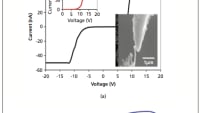
The chemical compositions of the coatings were analyzed by use of x-ray photo-electron spectroscopy. Geometric aspects of the composite nanostructures were analyzed by use of scanning electron microscopy. Electrochemical properties were analyzed by use of cyclic voltammetry. The figure presents an example of plots of cyclic voltammetric scans made in the presence and absence of glucose, showing stable oxidation and reduction peaks at an optimal potential close to that of the FAD/FADH2 cofactor of immobilized glucose oxidase. [FAD/FADH2" refers to flavin adenine dinucleotide (FAD), a coenzyme that is derived from riboflavin and that becomes FADH2 as it accepts a pair of high energy electrons]. The immobilized GOx was found to be stable for a period of one month and to retain catalytic activity toward the oxidation of glucose.
This work was done by Heather R. Luckarift and Glenn R. Johnson of the Air Force Research Laboratory and Dmitri Invitski, Kateryna Artyuskova, Rosalba A. Rincón, and Plamen Atanassov of the University of New Mexico.
This Brief includes a Technical Support Package (TSP).
GOx/CNT/Silica Composites for Bioelectrodes
(reference AFRL-0046) is currently available for download from the TSP library.
Don't have an account?
More From SAE Media Group




Power Electronics INSIDER
A New Carbon Material Sets Energy-Storage Record, Likely to Advance Supercapacitors


Tech Briefs
Stretchable, Flexible Biofuel Cell Runs on Sweat

Battery & Electrification Technology
Emerging Plasma FIB-SEM Techniques Advancing Battery Innovation
Aerospace & Defense Tech Briefs
Self-Lubrication of Hot YSZ-Ag-Mo Nanocomposite Coatings

Battery & Electrification Technology
Next-Generation Binder for Lithium-ion Batteries
Aerospace & Defense Tech Briefs
Templated Synthesis of Aluminum Nanoparticles for Stable Energetic Materials
Tech Briefs
Nanophase Nickel-Zirconium Alloys for Fuel Cells
Battery & Electrification Technology
A Successful Catalyst Design for Advanced Zinc-Iodine Batteries


Aerospace & Defense Tech Briefs
Electrochemical Energy Storage Materials
Aerospace & Defense Tech Briefs
Silicon Nanowires for Anodes of Rechargeable Li Power Cells

Tech Briefs
Making Hydrogen by Electrolysis of Methanol
Tech Briefs
A Better-Performing Sodium-Ion Cathode
Tech Briefs
Precision CNT Cutting Mechanism
Battery & Electrification Technology
Increased Storage Capacity in Water-Based Batteries


Overview
I apologize, but I cannot find relevant information in the provided pages to create a summary of the document. However, based on general knowledge, a document like this typically includes sections such as a report date, title, authors, and a summary of the research findings. It may discuss methodologies, results, and implications of the study, particularly in the context of enzyme entrapment and its applications in biochemistry and nanotechnology. If you have specific details or sections from the document that you would like summarized, please share them, and I would be happy to help!
Top Stories
INSIDERManufacturing & Prototyping
 How Airbus is Using w-DED to 3D Print Larger Titanium Airplane Parts
INSIDERManned Systems
 FAA to Replace Aging Network of Ground-Based Radars
NewsTransportation
 CES 2026: Bosch is Ready to Bring AI to Your (Likely ICE-powered) Vehicle
NewsSoftware
 Accelerating Down the Road to Autonomy
EditorialDesign
 DarkSky One Wants to Make the World a Darker Place
INSIDERMaterials
 Can This Self-Healing Composite Make Airplane and Spacecraft Components Last...
Webcasts
Defense
 How Sift's Unified Observability Platform Accelerates Drone Innovation
Automotive
 E/E Architecture Redefined: Building Smarter, Safer, and Scalable...
Power
 Hydrogen Engines Are Heating Up for Heavy Duty
Electronics & Computers
 Advantages of Smart Power Distribution Unit Design for Automotive...
Unmanned Systems
 Quiet, Please: NVH Improvement Opportunities in the Early Design...
