




Cold Sprayed Coatings with Dual Nanoparticle Reinforcements for Wear and Corrosion Protection
As a form of additive manufacturing, the use of cold spray has made significant strides since different-sized particles were explored in the process. There is proof that micron-sized particles down to nanoparticles enhance the mechanical material properties of a substrate in wear resistance.

Ships and the components onboard ships experience high degrees of stress from sea motion, operational loads, and frequent operational changes. As such, excessive component wear, protective coating deterioration, and complete mechanical failure is not uncommon.
When this occurs, repair is based on a timeline that accounts for the degree of mission impact, availability of parts, and operational requirements. Often repair or replacement is limited by what personnel can perform locally. This can result in delaying repair or replacement of deficient components (sometimes for years) until operational requirements can support a shipyard maintenance period.
Having degraded or broken components fosters an environment where personnel live with deficiencies and contributes to overall ship degradation. Therefore, providing the ship or unit with more tools to enable the repair of components on station is vital to supporting the overall Department of Defense mission.
Frequently sailors use paint onboard ships to place a nonreactive barrier between bare metal and a corrosive at-sea environment. This is very helpful for reducing general corrosion, but paint can chip or delaminate, exposing a metal surface and resulting in localized corrosion if the exposed metal is not repainted. In addition, paint has minimal use for wear or impact applications. In the event of high wear against a painted surface, the topcoat can easily be worn away, often requiring a reapplication of the paint coat.
Physical Vapor Deposition (PVD) and Chemical Vapor Deposition (CVD) are two methods of depositing coatings uniformly around a substrate within a closed environment. It is possible to obtain a high degree of controllability of thickness, including nanometric dimensions. It is understood that PVD and CVD have lower application rates when compared to other surface modification technologies and generally do not provide coatings as thick as some other treatments, like thermal spraying a large area with coatings over 100 μm. While both coating methods can be easily performed in a lab environment with the right equipment, they are not suitable for performing in-situ on a ship. Fully enclosing an installed part is usually not realistic and accessing tight spaces make either PVD or CVD less than an ideal choice for coating or repairing a component.
Plasma spray coatings use molten metal particles to impact a substrate, which then cool and solidify rapidly. High temperatures result in microstructure phase changes and subsequent residual stresses once the coatings cool down. These “quenching stresses” can result in tens of MPa residual stresses for ceramic reinforcements that can result in extensive splat cracking. High residual stresses may affect the margin to yield stress that some other coating methods may not inherently produce because they do not reach the high temperatures resulting from plasma spray. In addition, plasma spray processes require temperatures above 2000K for the particles in-flight. On a ship where there is limited electrical power, this can unduly burden the turbine generators from the high-energy draw.
Cold spray is a low energy method that could be employed on ships to repair failed or degraded components and minimize the number of material deficiencies onboard the ship. When lead times for replacement parts are excessive (>12 months), a cold sprayed coating of the same or similar material could be applied to reduce downtime and repair costs. Additionally, cold spray can also be used to provide protective coatings to prevent material deterioration from corrosion or mechanical wear. To support the use of this technology aboard ships, further research must be conducted to determine the mechanical properties and corrosion resistance of various application-compatible cold spray coatings.
Cold spray can be performed under a range of pressures, with high pressure normally resulting in a coating with better overall adhesion and a harder coating. Additionally, multiple reinforcements may have a synergistic effect, enhancing the properties of the base coating more than any one reinforcement alone. Starting with a high-pressure process would be a proof of concept for dual particle reinforcement, and future testing could closer simulate ship limitations and capabilities as a feasible possibility to repairing and manufacturing components.
This work was done by Travis Norrell for the Naval Postgraduate School. For more information, download the Technical Support Package (free white paper) below. NPS-0021
This Brief includes a Technical Support Package (TSP).
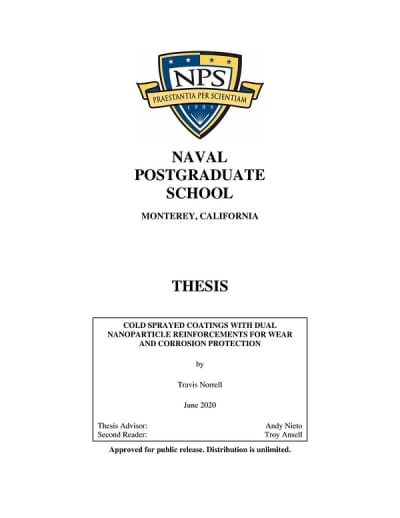
Cold Sprayed Coatings with Dual Nanoparticle Reinforcements for Wear and Corrosion Protection
(reference NPS-0021) is currently available for download from the TSP library.
Don't have an account?
More From SAE Media Group

Aerospace & Defense Tech Briefs
Improving Component Life in Abrasive, Corrosive Aerospace Environments
Tech Briefs
Fiber-Metal Laminate Manufacturing Technique
Aerospace & Defense Tech Briefs
Remanufacturing Reimagined: How Selective Electroplating Extends Service Life and Reduces the Cost of Aerospace Components


Aerospace & Defense Tech Briefs
Hybrid Ultra-Low VOC and Non-HAP Rain Erosion Coatings

Tech Briefs
Corrosion-Inhibiting Self-Expanding Foam
Tech Briefs
Copolyimide Surface-Modifying Coating
Automotive Engineering
Tata Steel Europe Innovates to Retain the Automotive Materials Lead
Tech Briefs
Janus Particles Improve Paints and Coatings
Aerospace & Defense Tech Briefs
Novel Whisker Mitigating Composite Conformal Coat Assessment
Automotive Engineering
Lightweight Steel on a (Cold) Roll
Tech Briefs
Wear-Resistant Platinum Gold Alloy
Off-Highway Engineering
NASA Highlights Material and Coating Technology Ready for Commercial Applications
Tech Briefs
Zinc-Silicate Coating Blocks Corrosion

Aerospace Manufacturing and Machining
Does Your Coating Thickness Meet Spec?
Tech Briefs
Extrans Permeation Measurement System

Tech Briefs
Precision CNT Cutting Mechanism
Aerospace & Defense Tech Briefs
Evaluation of Additively Manufactured Ultrahard Steels
Aerospace & Defense Tech Briefs
Designing Sensory and Adaptive Composite Materials
Aerospace & Defense Tech Briefs
Plasma Electrolytic Oxidation: The Future of Lightweight Designs in Aerospace and Defense
Overview
The document is a master's thesis titled "Cold Sprayed Coatings with Dual Nanoparticle Reinforcements for Wear and Corrosion Protection," authored by Travis Norrell and submitted to the Naval Postgraduate School in June 2020. The research focuses on the application of cold spray technology to develop advanced coatings that enhance the wear and corrosion resistance of materials, which is critical in various industrial and military applications.
Cold spraying is a solid-state coating process that involves the acceleration of powder particles to high velocities, allowing them to impact and bond to a substrate without melting. This technique offers several advantages, including the ability to create dense coatings with minimal thermal distortion, which is particularly beneficial for protecting components subjected to harsh environments.
The thesis investigates the incorporation of dual nanoparticle reinforcements into cold sprayed coatings. Nanoparticles are known for their unique properties, such as increased surface area and enhanced mechanical characteristics, which can significantly improve the performance of coatings. By combining different types of nanoparticles, the research aims to optimize the protective qualities of the coatings against wear and corrosion.
The document outlines the methodology used in the experiments, including the selection of materials, preparation of nanoparticle-reinforced powders, and the cold spray process parameters. It also discusses the characterization techniques employed to evaluate the microstructure, mechanical properties, and performance of the coatings, such as hardness tests, wear resistance assessments, and corrosion tests.
The findings of the research demonstrate that the addition of dual nanoparticles can lead to improved wear and corrosion resistance compared to traditional coatings. The results indicate that the optimized coatings exhibit enhanced mechanical properties, making them suitable for applications in environments where durability and longevity are paramount.
In conclusion, this thesis contributes to the field of materials science and engineering by exploring innovative approaches to enhance the performance of protective coatings through the use of cold spray technology and nanoparticle reinforcements. The insights gained from this research could pave the way for the development of more effective coatings, ultimately benefiting industries that rely on high-performance materials. The views expressed in the thesis are those of the author and do not reflect the official policy or position of the Department of Defense or the U.S. Government.
Top Stories
NewsRF & Microwave Electronics
 Microvision Aquires Luminar, Plans Relationship Restoration, Multi-industry Push
INSIDERAerospace
 A Next Generation Helmet System for Navy Pilots
INSIDERDesign
 New Raytheon and Lockheed Martin Agreements Expand Missile Defense Production
INSIDERMaterials
 How Airbus is Using w-DED to 3D Print Larger Titanium Airplane Parts
NewsPower
 Ford Announces 48-Volt Architecture for Future Electric Truck
ArticlesAR/AI

Webcasts
Electronics & Computers
 Cooling a New Generation of Aerospace and Defense Embedded...
Automotive
 Battery Abuse Testing: Pushing to Failure
Power
 A FREE Two-Day Event Dedicated to Connected Mobility
Unmanned Systems
 Quiet, Please: NVH Improvement Opportunities in the Early Design Cycle
Automotive
 Advantages of Smart Power Distribution Unit Design for Automotive &...
Energy
 Sesame Solar's Nanogrid Tech Promises Major Gains in Drone Endurance