




Nanoparticle AlxMoyOz/Al Thermites
These thermites are relatively insensitive, but burn relatively rapidly once ignited.
Research on the microstructures, chemical compositions, and reactivities of thermites that consist of or contain mixtures of MoO3 and Al particles has led to development of a process for making thermites that consist of or contain mixtures of AlxMoyOz and Al nanoparticles. The reactivities of the AlxMoyOz/Al thermites can be tailored through choices of ingredients at critical process steps. The findings of this and related research and development efforts may lead to the use of AlxMoyOz/Al thermites as components of insensitive weapon ignition systems.
In previous research, it had been found that MoO3/Al thermites in which Al is structured at the nanoscale have thermal sensitivities two orders of magnitude greater and combustion rates much higher than those of MoO3/Al thermites in which Al is structured at the microscale. Taking a different approach, the research reported here was oriented toward tailoring reactivity through modification of the compositions and structures of the molybdenum trioxide particles.
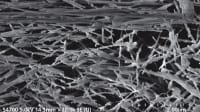
The term "AlxMoyOz" as used here signifies, more specically, a mixture of nanometer-sized phases that contain alumina (Al2O3) associated with molybdenum oxides (MoOu where 2<u<3). The process for making the AlxMoyOz includes a sol-gel subprocess in which agar is used as an agent for structuring aluminum paramolybdate (APM), which, as explained below, serves as a molybdenum oxide precursor. The product of this subprocess is an agar/APM composite gel (see figure).
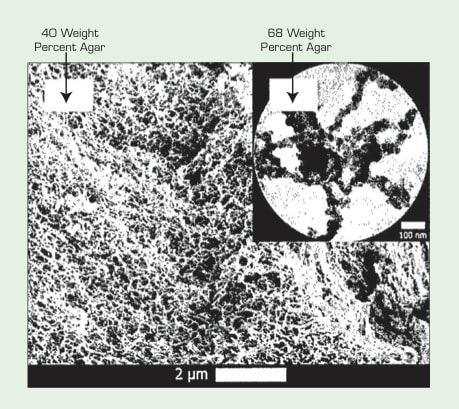
AlxMoyOz/Al thermites have been found to be very insensitive to mechanical and thermal stresses. On the other hand, they can be easily ignited by focused laser beams. Their ignition delay times are no more than a few milliseconds. The rates of combustion of these thermites lie between 12 and 60 times those of thermites comprising Al nanoparticles mixed with micron-sized MoO3 particles.
This work was done by M. Comet and D. Spitzer of the Institut Franco-Allemand de Recherches de Saint-Louis. For more information, download the Technical Support Package (free white paper) at www.defensetechbriefs.com/tsp under the Materials category. ISL-0001
This Brief includes a Technical Support Package (TSP).
Nanoparticle AlxMoyOz/Al Thermites
(reference ISL-0001) is currently available for download from the TSP library.
Don't have an account?
More From SAE Media Group
Aerospace & Defense Tech Briefs
Templated Synthesis of Aluminum Nanoparticles for Stable Energetic Materials
Aerospace & Defense Tech Briefs
Fast Reacting Nano-Composite Energetic Materials: Synthesis and Combustion Characterization
Aerospace & Defense Tech Briefs
Reactive, Multifunctional, Micellar, Composite Nanoparticles for Destruction of Bio-Agents
Tech Briefs
Using 3D Printing to Strengthen Jet Engines


Photonics & Imaging Technology
Deformation Fingerprints Will Help Researchers Identify, Design Better Metallic Materials
Defense INSIDER
Scientists Explore Nanoparticles for Future Weapon Systems
Tech Briefs
Advanced Carbon Aerogels for Energy Applications



Tech Briefs
Copolyimide Surface-Modifying Coating

Medical Design Briefs
New Thermofluidic Improves Lab-On-a-Chip Applications
Tech Briefs
3D Printing Ultrastrong Materials
Tech Briefs
Method Recovers Metals from Electronic Waste
Aerospace & Defense Tech Briefs
‘First of Its Kind’ Composite Material to Help Space Vessels Travel Longer Distances
Tech Briefs
Aerogel-Reinforced Composites
Overview
The document titled "Elaboration and Characterization of Nano-Sized AlxMoyOz/Al Thermites," authored by M. Comet and D. Spitzer, presents research conducted at the Institut franco-allemand de recherches de Saint Louis (ISL). The paper was presented at the 33rd International Pyrotechnics Seminar in July 2006 and focuses on a new method for controlling the reactivity of thermites composed of molybdenum trioxide (MoO3) and aluminum (Al).
The authors describe a novel sol-gel process that allows for the synthesis of nano-sized mixed AlxMoyOz phases. This method enables the adjustment of the energetic properties of the resulting thermites by physically mixing these phases with nano-sized aluminum (Al 50-P). The resulting nanothermites exhibit significant advantages, including insensitivity to mechanical and thermal stresses, while still being easily ignitable with a laser beam. The nano-structuring of the oxidative phase is shown to decrease sensitivity, shorten ignition delay times, and dramatically increase combustion rates.
The research highlights the potential of these metastable interstitial composites (MICs) as components for insensitive weapon ignition systems. The ignition delay times for the nanothermites do not exceed a few milliseconds, and their combustion rates are reported to be twelve to sixty times faster than those of traditional thermites composed of micron-sized MoO3 particles.
The synthesis process involves using agar as a structuring agent for a molybdenum oxide precursor, leading to the formation of composite gels. After the removal of agar and subsequent thermal oxidative treatment, the gels convert into nano-sized molybdenum oxide phases. The authors emphasize that the energetic characteristics of the nanothermites can be fine-tuned by adjusting the synthesis parameters, particularly the ratio of the components used.
In conclusion, the document provides a comprehensive overview of the innovative approaches to synthesizing and characterizing nano-sized thermites, emphasizing their promising applications in military and pyrotechnic fields. The findings suggest that these materials could significantly enhance the safety and performance of ignition systems, paving the way for further research and development in the area of energetic materials.
Top Stories
NewsSensors/Data Acquisition
 Microvision Aquires Luminar, Plans Relationship Restoration, Multi-industry Push
INSIDERRF & Microwave Electronics
 A Next Generation Helmet System for Navy Pilots
INSIDERWeapons Systems
 New Raytheon and Lockheed Martin Agreements Expand Missile Defense Production
NewsAutomotive
 Ford Announces 48-Volt Architecture for Future Electric Truck
INSIDERAerospace
 Active Strake System Cuts Cruise Drag, Boosts Flight Efficiency
ArticlesTransportation

Webcasts
Aerospace
 Cooling a New Generation of Aerospace and Defense Embedded...
Energy
 Battery Abuse Testing: Pushing to Failure
Power
 A FREE Two-Day Event Dedicated to Connected Mobility
Automotive
 Quiet, Please: NVH Improvement Opportunities in the Early Design Cycle
Electronics & Computers
 Advantages of Smart Power Distribution Unit Design for Automotive &...
Unmanned Systems
 Sesame Solar's Nanogrid Tech Promises Major Gains in Drone Endurance