




Formation and Characterization of Gold Nanoparticles
Nanowires have applications in LEDs, lasers, and biochemical sensors.
One-dimensional nanowires are of increasing interest due to their size, physical properties, and other applications in opto-electronics. For example, nanowires have already been used in light-emitting diodes and lasers, photo-detectors, resonant tunneling diodes, field-effect and single-electron transistors, and biochemical sensors. In addition, nanowires are useful because they can be grown almost dislocation-free due to their nano dimension. When dislocation- free nanowires nucleated on the substrate merge to form a continuous film, voids are left underneath, which act as sinks for dislocations, allowing other structures to be grown stress-free on top of the nano-engineered buffer layer.
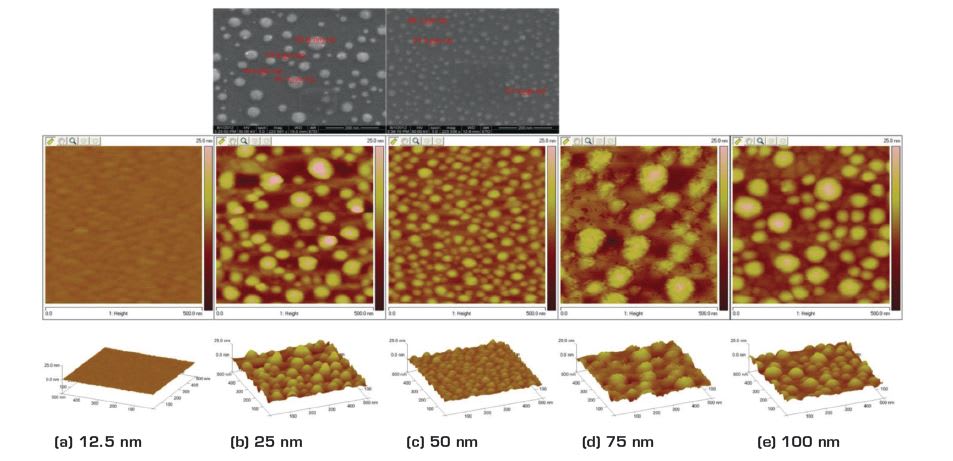
To grow nanowires that would eventually merge into a continuous film, the nanoparticles in this project had to be as large and as close together as possible. MBE was used to grow the gold nanoparticles. The influence of the relative thickness of the initial layer of gold, the annealing temperature, and the annealing time on the size, density, diameter, and height of the gold particles were investigated.
Atomic force microscopy (AFM) and scanning electron microscopy (SEM) were both used to characterize these gold nanoparticles due to their high resolution and precise measurement capabilities. Because of the SEM’s relatively quick scanning rate, it was used to first confirm that nanoparticles were indeed present, while the AFM was used to provide three-dimensional images and the dimensions of the nanoparticles.
Fabrication of gold particles on Si was conducted using a DCA MBE system equipped with a 3.25" substrate heater. Three-inch Si(100) nominal wafers were used as substrates. The samples were quickly heated to 1050 °C to remove the oxide layer, and then quickly cooled under an As4 flux to 500 °C. Finally, the sample was cooled to the nucleation temperature of 230 °C without any flux. After oxide desorption, a thin gold film was deposited and annealed to form nanoparticles. The temperature of the gold effusion cell was set to 1250 °C for a flux of approximately 0.125 nm/s. The time of deposition, annealing temperature, and annealing time were varied. RHEED was used to observe the process in situ. After annealing, some samples were studied using SEM, and all samples were studied with AFM to look at the size and number density of the particles.
Changing the thickness of the initial layer, the annealing temperature, and annealing time had some influence on the size of the nanoparticles, but did not clearly influence the density. The annealing time seemed to have the greatest effect, while the annealing temperature has the smallest effect. In general, annealing for longer times yields smaller particles with a smaller size distribution. However, the exact relationship between the growth parameters and the resulting properties is unclear. Further runs with thicker layers and at higher and lower annealing temperatures and times could be helpful in illuminating the overall trend. For the purpose of forming nanobridges, it was desired that the nanoparticles be as dense and large as possible. Thus, an initial layer 100-nm thick yielded the largest nanoparticles, while annealing at 530 °C and 10 or 15 minutes yielded the densest particles.
This work was done by Glenna R. Yu, Hans M. Guo, and Yuanping Chen of the Army Research Laboratory. ARL-0155
This Brief includes a Technical Support Package (TSP).
Evaluating a Data Clustering Approach for Lifecycle Facility Control
(reference ARL-0155) is currently available for download from the TSP library.
Don't have an account?
More From SAE Media Group
Aerospace & Defense Tech Briefs
Epitaxial Growth of Rhenium with Sputtering
Aerospace & Defense Tech Briefs
Abrasion Testing of Products Containing Nanomaterials
Aerospace & Defense Tech Briefs
Templated Synthesis of Aluminum Nanoparticles for Stable Energetic Materials

Electronics & Sensors INSIDER
Researchers Create First Functional Semiconductor Made from Graphene
Tech Briefs
Synthesizing Complex Optical Materials

Electronics & Sensors INSIDER
Novel Nanowire Fabrication Technique Paves Way for Next Generation Spintronics
Photonics & Imaging Technology
New Electron Microscopy Technique Offers First Look at Previously Hidden Processes

Tech Briefs
Method Sprays Extremely Thin Wires on 3D Objects
Tech Briefs
Stable Polymeric Ink with High Conductivity
Power Electronics INSIDER
Improved GaN-Based Semiconductor Devices for Power Electronics



Photonics & Imaging Technology
Measuring Surface Roughness with an Atomic Force Microscope
Photonics & Imaging Technology
New Blue Light Technique Could Enable Advances in Understanding Nanoscale Technologies
Photonics & Imaging Technology
Material Advances for LED Quantum Dot Efficiency
Tech Briefs
Organic Material for Printed Electronics
Aerospace & Defense Tech Briefs
Cluster-Assembled Soft Magnets for Power Electronics Applications
Medical Design Briefs
Convergence Nanoparticles for Multi-Modal Biomedical Imaging
Aerospace INSIDER
A New Quantum Materials Research System
Tech Briefs
Integrating Fragile 2D Materials into Devices
Electronics & Sensors INSIDER
Graphene-Based Electronics
Tech Briefs
High-Temperature SMAs for Actuator Applications
Tech Briefs
Organic Carbon-Nitride Semiconductor
Aerospace & Defense Tech Briefs
Reconfigurable Electronics Based on Multiferroics and Nanomagnetism
Overview
The document titled "Evaluating a Data Clustering Approach for Life-Cycle Facility Control" discusses the integration of data from various building automation systems to enhance facility management and performance monitoring. With a growing emphasis on sustainability and efficient resource consumption, the need for effective monitoring systems has become increasingly critical. The authors highlight that building monitoring systems often operate as closed-loop systems for security, fire safety, water, electrical, and HVAC (Heating, Ventilation, and Air-Conditioning), but without proper planning, the complexity and volume of data can overwhelm users.
The study emphasizes the importance of comparing planned versus actual results in terms of cost, risk, and quality control within facility engineering. A structured specification of building space requirements and mechanisms for detecting divergent system and occupant behaviors are essential for effective commissioning, energy efficiency, and maintenance. The U.S. federal government, as a significant player in the capital facility industry, aims to minimize its facility footprint based on current building utilization, necessitating quantifiable metrics for accurate reporting.
The authors propose a model that connects sensor data with various building models—geometrical, functional, structural, and managerial. This integration allows for the comparison of expected and actual resource utilization, facilitating better decision-making. They developed an algorithm to categorize daily utilization data, which can be compared to expected schedules, thus providing insights into resource usage patterns.
The document also discusses the unexpected findings regarding the variation in sensor readings, particularly noting that the main office lighting level sensor exhibited low variation due to the influence of ambient light. In contrast, cooling and air handling units showed substantial variation due to seasonal temperature changes.
Overall, the research presents a promising approach to data clustering that enhances the ability to monitor and manage building resources effectively. By improving data integration and analysis, the proposed methods can lead to better anomaly detection, resource management, and ultimately contribute to the sustainability goals of modern facilities. The findings underscore the necessity of continuous commissioning and the potential for advanced data analytics in optimizing building operations.
Top Stories
INSIDERManufacturing & Prototyping
 How Airbus is Using w-DED to 3D Print Larger Titanium Airplane Parts
INSIDERManned Systems
 FAA to Replace Aging Network of Ground-Based Radars
NewsTransportation
 CES 2026: Bosch is Ready to Bring AI to Your (Likely ICE-powered) Vehicle
NewsSoftware
 Accelerating Down the Road to Autonomy
EditorialDesign
 DarkSky One Wants to Make the World a Darker Place
INSIDERMaterials
 Can This Self-Healing Composite Make Airplane and Spacecraft Components Last...
Webcasts
Defense
 How Sift's Unified Observability Platform Accelerates Drone Innovation
Automotive
 E/E Architecture Redefined: Building Smarter, Safer, and Scalable...
Power
 Hydrogen Engines Are Heating Up for Heavy Duty
Electronics & Computers
 Advantages of Smart Power Distribution Unit Design for Automotive...
Unmanned Systems
 Quiet, Please: NVH Improvement Opportunities in the Early Design...
