




Racecar with Composite-Intensive Suspension Gets Track Tested in 2015
The tangy yellow-colored 1986 Honda CRX emblazoned with SANLUIS Rassini on its hood uses a patents-pending rear suspension as a replacement to its most recent setup of coil-over-springs and a straight axle with a Mumford linkage for lateral control.

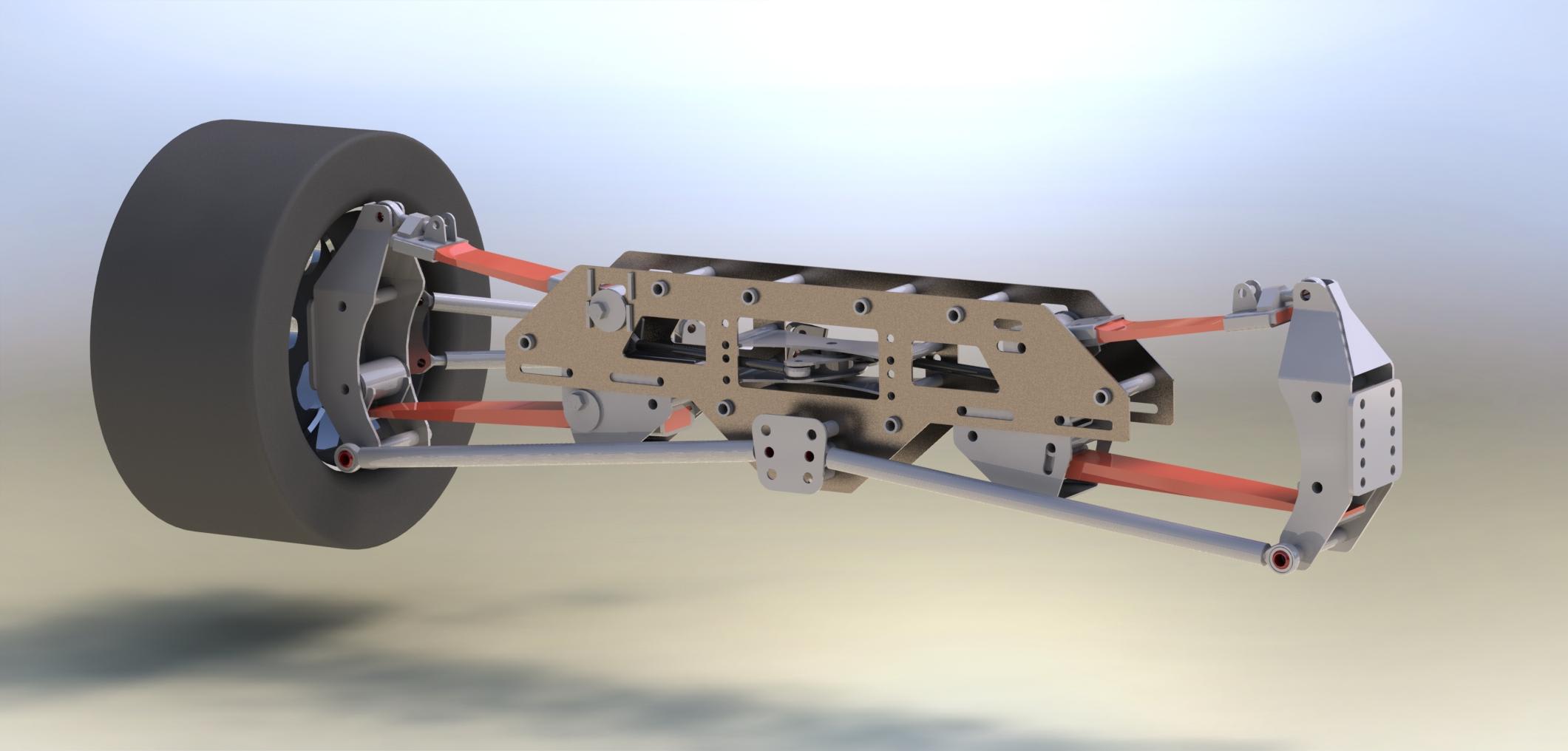
“We’ve converted it to a dual-cantilever thermoplastic spring in the rear. It’s very similar to a double-wishbone geometry. The thermoplastic upper control arms are coupled with what’s very similar to a Watt’s linkage. That means during a two-wheel bump, the rear wheels move together. But when the car goes into roll, the coupling linkage locks the arms and those arms flex to add roll stiffness,” Jonathan Spiegel, Polystrand Inc.’s Senior Engineer, told Automotive Engineering.
The racecar will compete in the Sports Car Club of America’s (SCCA) Grand Touring Lite (GTL) 2015 race season on various tracks in the U.S. Project GTL partners are Polystrand, PPG Fiber Glass, the University of Alabama at Birmingham (UAB), and SANLUIS Rassini.
Polystrand provided the thermoplastic composite material. PPG supplied the continuous fibers for reinforcement of the thermoplastic material. UAB conducted materials property evaluation and molded the glass-reinforced springs and upper control arms, while SANLUIS Rassini handled suspension modeling, fabrication work, as well as final rear suspension assembly.


The racecar will compete against other purpose-built, highly modified series production sports cars, starting in the spring of 2015.
“We’ll be putting the rear suspension system under a real torture test. If we run the minimum number of SCCA’s GTL races, the suspension will experience several thousand miles of racing. Each race means continual high-stress on these lightweight, recyclable components,” said Spiegel, who designed the racecar’s suspension layout.
Bob Friedrichs, SANLUIS Rassini’s Vice President Engineering Suspension Group North America, noted that “the development of the GTL project in collaboration with Polystrand and PPG is an important one. It allows for testing of new continuous fiber thermoplastic technology for suspension springs and provides us with a lot of [vehicle] limit handling data in a short period of time.”
Spiegel estimates that the front-wheel-drive racecar shed more than 100 lb (45 kg) by replacing its all-steel rear suspension with a configuration featuring glass-reinforced nylon 6 springs and upper control arms attached to a steel subframe.
“The suspension loads are now fed directly into the frame structure rather than being in the unibody, so the car no longer needs all that supporting structure. In a production car that supporting structure would take up rear-passenger compartment volume and trunk space,” said Spiegel. “The prototype suspension not only reduces the mass but we can put what mass there is down lower, so that will help with the car’s handling.”
For SANLUIS Rassini, the world’s largest designer and manufacturer of leaf springs for light-duty vehicles, developing lightweight suspension components for future production applications is important. According to Friedrichs, “A commercially viable composites-intensive suspension for passenger cars would absolutely be a game changer.”
Weight savings between 30-40% are possible. “The implication that would have on lightweighting and CAFE standards would be huge,” Friedrichs noted.
More From SAE Media Group
Automotive Engineering
2021 Toyota Supra 2.0
Automotive Engineering
ZF's CEO Talks About Lightweight Vehicle Applications
Motion Design
Self-Contained Wheel Unit
Automotive Engineering
2026 Toyota RAV4 Review: All Hybrid, All the Time
Off-Highway Engineering
Yanmar CE Adds to Growing Compact Track Loader Segment
Automotive Engineering
2015 Mondeo Launch Shows Flexibility, Challenges of One Ford Strategy
Automotive Engineering
2020 Chevrolet Corvette Stingray Coupe
Automotive Engineering
Gearing Up Drive Axle Innovations
Autonomous Vehicle Engineering
AV Powers Bring May Flowers
Automotive Engineering
Suppliers Struggling to Keep Pace with Faster Product Cycles, Says IHS
Automotive Engineering
2024 Lexus GX Ready for Off-Road Adventure with New Platform, E-KDSS
Off-Highway Engineering
Workhorse Group Unveils W-15 E-REV Fleet Truck and Partners with Ryder
Automotive Engineering
Toyota Stretches SUV Line-Up with World Debut of Grand Highlander
Automotive Engineering
Lighter Volvo XC90 Is Engineered for "Premium Cool"
Off-Highway Engineering
REE’s P7 Brings Advanced Suspension Control to Medium-Duty Trucks
Automotive Engineering
Aluminum: Toward 50% Body Content
Automotive Engineering
2019 Vehicle Technology Review

Automotive Engineering
Wrecking Ball
Automotive Engineering
Mid-engine History of The Future
Off-Highway Engineering
EV Startup Prepares to Enter Commercial Market with Novel EAxle
Automotive Engineering
OEMs Deny Suppliers the Limelight
Off-Highway Engineering
Heavy Planetary Axles
Automotive Engineering
A Rebel’s Guide to Chassis Engineering
Automotive Engineering
Ford Approved for Hands-Off Driving on German Autobahn
Automotive Engineering
Returning Jeep to the Midsize-pickup Market
Automotive Engineering
2019 Ford Ranger XL STX
Automotive Engineering
2026 Nissan Sentra Review: Putting the Pieces Together
Off-Highway Engineering
ZM Trucks Starts Production in Fontana, California
Automotive Engineering
2026 Nissan Leaf First Drive: Fun and More Efficient
Top Stories
INSIDERManufacturing & Prototyping
 How Airbus is Using w-DED to 3D Print Larger Titanium Airplane Parts
INSIDERManned Systems
 FAA to Replace Aging Network of Ground-Based Radars
NewsTransportation
 CES 2026: Bosch is Ready to Bring AI to Your (Likely ICE-powered) Vehicle
NewsSoftware
 Accelerating Down the Road to Autonomy
EditorialDesign
 DarkSky One Wants to Make the World a Darker Place
INSIDERMaterials
 Can This Self-Healing Composite Make Airplane and Spacecraft Components Last...
Webcasts
Defense
 How Sift's Unified Observability Platform Accelerates Drone Innovation
Automotive
 E/E Architecture Redefined: Building Smarter, Safer, and Scalable...
Power
 Hydrogen Engines Are Heating Up for Heavy Duty
Electronics & Computers
 Advantages of Smart Power Distribution Unit Design for Automotive...
Unmanned Systems
 Quiet, Please: NVH Improvement Opportunities in the Early Design...
