




Returning Jeep to the Midsize-pickup Market
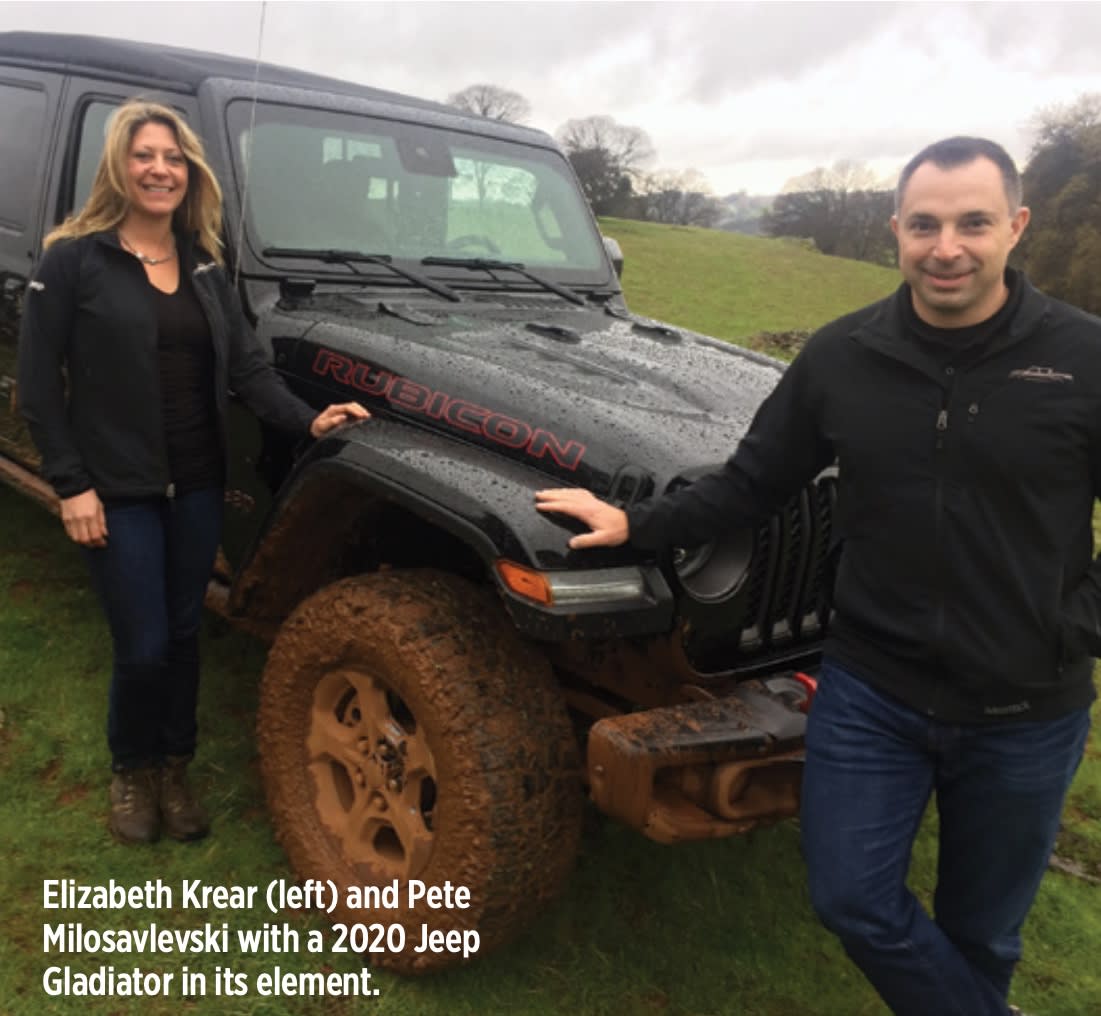
The engineering program for the 2020 Jeep Gladiator was managed in the company’s dual-responsibility style that seats approximately equal authority in the Chief Engineer and a “Model Responsible” executive/engineer who brings an additional perspective — and responsibilities — to the effort.
During the Gladiator’s early-spring media introduction, SAE editorial director Bill Visnic spoke with Elizabeth Krear, Gladiator Model Responsible - Jeep Engineering and Pete Milosavlevski, Chief Engineer, about the program’s development targets and priorities, the importance of the Gladiator’s connection to the iconic Wrangler—and the challenge of returning after 27 years to a midsize-pickup market segment facing capable and well-established competitor models.
Krear most recently served as chief engineer for the highly-regarded Ram 1500 pickup; among other projects, Milosavlevski worked on the Dodge Dart, the 2009 Ram and the Promaster/Promaster City commercial vans. They are respectively referenced as EK and PM in the following text.
Once the Gladiator program was green-lighted to be based on the Wrangler, what was the most significant development aspect when you knew you were going to adapt an existing platform?
PM: It’s finding a balance between not compromising offroad capability while making a viable mid-sized truck in the segment. So increased payload, increased towing, now we’re talking about an increased gross vehicle rating [target] that the vehicle has to survive.
And so with that, we’re talking about structural enhancements to the frame, frame changes, rear-suspension changes, rear axle changes—and then figuring out exactly where to locate the pickup points, optimize it in a way that’s going to be more than competitive.
EK: Pete’s describing how we establish it, but it’s even a step further: the objectives were to be best-in-class. The objectives were to be the most capable offroad truck.
Elizabeth, Pete mentioned you are sometimes a “cost hammer” for him — because you have to say “Wait a minute, you know we can’t do this, we can’t do that.”
PM: (Laughs) I said it in a ‘positive’ way! I look at it as neutral, because everybody [in the development program] is kind of a cost hammer.
EK: We’re checks-and-balances. At the end of the day, I own the metrics, he owns the metrics. Pete owns the technical metrics, but I own all the metrics. So if one of those [technical] metrics isn’t met, then one of mine doesn’t match. But — he doesn’t ‘own’ the financial metric! In the end, we always want what’s best for the customer.
Wait — the best thing for the buyer is something that’s $20,000, not $35,000, right?
EK: It’s a different customer, the customer who buys the $20,000 truck; that truck’s not going to be able to do that [rigorous offroad) course you’re going to do today.
PM: We want the best thing for our customers, and our customer will pay a little more because they get a special product. They get a product that there’s nothing like out there. Like a removable top, the capability that you get with standard four-wheel drive, the look, the feel, it’s just different. So, it’s like with anything else — I’ll pay a premium for certain things that I’m really enthusiastic about.
Is there something beyond this, something you didn’t get to do with the Gladiator configuration?
PM: If you’re referring to the size of the box, cab sizes, cab selection — the 5-foot box meets the needs of 80% of the customers out there. And that’s what we’ve catered to initially; we don’t talk about future product, but anything’s possible, though, depending on how customers react to it. The frame’s definitely adaptable.
EK: There’s always the possibility to do more, but that’s definitely a “brand” call and where the market is going. Engineers can always engineer anything!
More From SAE Media Group
Automotive Engineering
2019 Ford Ranger XL STX
Automotive Engineering
Toyota Stretches SUV Line-Up with World Debut of Grand Highlander
Off-Highway Engineering
Yanmar CE Adds to Growing Compact Track Loader Segment
Automotive Engineering
2019 Subaru Ascent Premium
Automotive Engineering
2026 Toyota RAV4 Review: All Hybrid, All the Time
Off-Highway Engineering
Workhorse Group Unveils W-15 E-REV Fleet Truck and Partners with Ryder
Automotive Engineering
2021 Toyota Supra 2.0
Aerospace & Defense Tech Briefs
Heavy Dump Truck
Off-Highway Engineering
First Drive: Drifting in the Electric 2027 Mercedes GLC 400
Automotive Engineering
2020 Chevrolet Corvette Stingray Coupe
Automotive Engineering
Gearing Up Drive Axle Innovations
Automotive Engineering
2019 Vehicle Technology Review
Off-Highway Engineering
Komatsu Targets Productivity, Operator Comfort With New WA480-8 Wheel Loader
Automotive Engineering
OEMs Deny Suppliers the Limelight
Automotive Engineering
Flex4 System Leads Magna's Wave of New Fuel-Saving Technologies
Automotive Engineering
TRD Spells Capability for Toyota’s Latest Tundra
Automotive Engineering
2025 Ram 1500 REV Driving Range Would Jump to Head of Class
Automotive Engineering
2024 Lexus GX Ready for Off-Road Adventure with New Platform, E-KDSS
Autonomous Vehicle Engineering
AV Powers Bring May Flowers
Automotive Engineering
Optimizing EV Platforms for Pickup Trucks
Automotive Engineering
Ford Puts More ‘Super’ into the All-New 2023 Super Duty
Automotive Engineering
Ford Refines Interior, Exterior on 2025 Explorer
Automotive Engineering
Wrecking Ball
Automotive Engineering
2018 Ram ProMaster 2500
Off-Highway Engineering
AxleTech Develops Electric Independent Suspension Concept for Vehicles Up to 58,000-lb GCWR
Automotive Engineering
Suppliers Struggling to Keep Pace with Faster Product Cycles, Says IHS
Automotive Engineering
Racecar with Composite-Intensive Suspension Gets Track Tested in 2015
Motion Design
Self-Contained Wheel Unit
Off-Highway Engineering
BharatBenz Delivers 50,000th Truck less Than Five Years After Market Launch
Automotive Engineering
Pickup Shocker!
Top Stories
INSIDERManufacturing & Prototyping
 How Airbus is Using w-DED to 3D Print Larger Titanium Airplane Parts
INSIDERManned Systems
 FAA to Replace Aging Network of Ground-Based Radars
NewsTransportation
 CES 2026: Bosch is Ready to Bring AI to Your (Likely ICE-powered) Vehicle
NewsSoftware
 Accelerating Down the Road to Autonomy
EditorialDesign
 DarkSky One Wants to Make the World a Darker Place
INSIDERMaterials
 Can This Self-Healing Composite Make Airplane and Spacecraft Components Last...
Webcasts
Defense
 How Sift's Unified Observability Platform Accelerates Drone Innovation
Automotive
 E/E Architecture Redefined: Building Smarter, Safer, and Scalable...
Power
 Hydrogen Engines Are Heating Up for Heavy Duty
Electronics & Computers
 Advantages of Smart Power Distribution Unit Design for Automotive...
Unmanned Systems
 Quiet, Please: NVH Improvement Opportunities in the Early Design...
