




Defense Tech Briefs - December 2009
Inside this issue
Overview
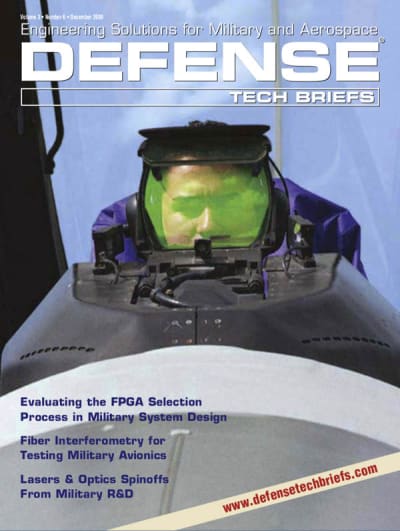
The December 2009 issue of Defense Tech Briefs, Volume 3, Number 6, presents a collection of articles that delve into various advancements and technologies relevant to military applications. This issue highlights the importance of innovation in defense systems and explores several key areas of research and development.
Key Articles and Topics
-
Evaluating the FPGA Selection Process in Military System Design: This article discusses the critical role of Field Programmable Gate Arrays (FPGAs) in military systems. FPGAs are essential for their flexibility and reconfigurability, allowing military designers to adapt systems to meet evolving operational requirements. The article outlines the selection process for FPGAs, emphasizing factors such as performance, power consumption, and cost. It also addresses the challenges faced in integrating FPGAs into existing military architectures and the importance of thorough evaluation to ensure optimal performance in mission-critical applications.
-
Fiber Interferometry for Testing Military Avionics: Another significant feature of this issue is the exploration of fiber interferometry as a testing method for military avionics. The article explains how fiber interferometry can provide precise measurements of various parameters, such as displacement and vibration, which are crucial for the reliability of avionics systems. This non-destructive testing technique offers advantages over traditional methods, including higher sensitivity and the ability to monitor systems in real-time. The implications of this technology for enhancing the safety and performance of military aircraft are discussed, highlighting its potential to reduce maintenance costs and improve operational readiness.
Lasers & Optics Spinoffs from Military R&D: The issue also covers the advancements in lasers and optics that have emerged from military research and development. This article showcases various applications of laser technology in defense, including targeting, communication, and surveillance. It highlights how innovations initially developed for military purposes have found applications in civilian sectors, leading to advancements in fields such as medicine and telecommunications. The article emphasizes the dual-use nature of military R&D and its impact on technological progress across multiple industries.
Additional Features
The magazine includes a user-friendly navigation guide, allowing readers to easily access different sections and articles. The digital format enhances the reading experience, providing tools for zooming in and out, as well as a search function to quickly locate specific topics of interest.
Conclusion
The December 2009 issue of Defense Tech Briefs serves as a valuable resource for professionals in the defense sector, offering insights into cutting-edge technologies that are shaping the future of military operations. By focusing on FPGAs, fiber interferometry, and advancements in lasers and optics, this issue underscores the importance of continuous innovation in enhancing the capabilities and effectiveness of military systems. The articles not only inform readers about current trends and technologies but also inspire further exploration and development in the field of defense technology.
Overall, this issue reflects the ongoing commitment to advancing military technology through research and development, ensuring that armed forces remain equipped to meet the challenges of modern warfare.
Features
-
Tech Transfer Reports
-
Articles
Fiber Interferometry for Testing Military Avionics
Evaluating the FPGA Selection Process in Military System Design
Tech Briefs
-
Electronics & Computers
Wireless Network Cocast: Location-Aware Cooperative Communications with Linear Network Coding
High Assurance Virtualization Engine (HAVEN)
Memory-Based, Structured, Application-Specific Integrated Circuit (ASIC)
-
Information Sciences
Optimized Robust Adaptive Networks in Supervisory Control and Data Acquisition Systems
Evolvable Approaches to Software Verification and Validation
-
Materials
Characterization of High-Temperature Polymer Thin Films for Power Conditioning Capacitors
RF Polymer Composites for Electromagnetic Systems
Modeling Defects in Transparent Ceramics to Improve Military Armor
Validation of Hazardous Air Pollutant (HAP)-Free Torque Seal Inspection Lacquer
-
Mechanics & Machinery
-
Photonics
Solid-State, High-Energy Lasers Based on Rare-Earth Doped Gallium Nitride
Analysis of Analog Photonic Links Employing Multiple-Channel (Arrayed) Receivers
Photonic Recirculating Delay Line for Analog-to-Digital Conversion
Design and Development of a Package for a Diluted Waveguide Electro-Absorption Modulator
Products
Top Stories
INSIDERDefense
 New Raytheon and Lockheed Martin Agreements Expand Missile Defense Production
NewsAutomotive
 Ford Announces 48-Volt Architecture for Future Electric Truck
INSIDERManufacturing & Prototyping
 Active Strake System Cuts Cruise Drag, Boosts Flight Efficiency
ArticlesTransportation
 Accelerating Down the Road to Autonomy
INSIDERMaterials
 How Airbus is Using w-DED to 3D Print Larger Titanium Airplane Parts
Road ReadyTransportation

Webcasts
Electronics & Computers
 Cooling a New Generation of Aerospace and Defense Embedded...
Power
 Battery Abuse Testing: Pushing to Failure
Connectivity
 A FREE Two-Day Event Dedicated to Connected Mobility
Automotive
 Quiet, Please: NVH Improvement Opportunities in the Early Design Cycle
Transportation
 Advantages of Smart Power Distribution Unit Design for Automotive &...
Aerospace
 Sesame Solar's Nanogrid Tech Promises Major Gains in Drone Endurance