




Design and Development of a Package for a Diluted Waveguide Electro-Absorption Modulator
The modulators improve the transmission of RF signals on optical fibers.
Externally coupled electroabsorption modulators (EAMs) are commonly used in order to transmit RF signals on optical fibers. Recently, an alternative device design with diluted waveguide structures was developed. Bench tests show benefits of lower propagation loss, higher power handling (100 mW), and higher normalized slope efficiency. Bench tests were performed in order to characterize the optical coupling of the EAM. The photo current maximum was offset from the optical power output maximum. The transmissions vs. bias voltage curves were measured, and an XY scanner was used to record the mode field of the light exiting from the EAM waveguide in each position. The Beam Propagation Method was used to simulate the mode field and the coupling efficiency. Based on the bench tests and simulation results, a design including mechanical, optical, and RF elements was developed.
The device studied is a dilute core waveguide (DCW) electroabsorption modulator (EAM). It has a similar structure as that of a high-saturation-power waveguide photodetector. The DCW EAM was designed to enhance the optical power handling and provide a greater spur-free dynamic range relative to a more conventional EAM design. The approach used to achieve this goal was to reduce the optical confinement factor at the electroabsorption (EA) layer in order to enhance the dynamic range and the maximum power of the EAM. This approach has some effects on the assembly methods that must be utilized to form a low-loss packaged device.
A dilute waveguide EAM device was designed in an effort to increase the maximum power and the dynamic range of the device. This design of the DCW EAM was intended to spatially separate the region of maximum photocurrent and photointensity. Using an optical test setup with a lensed fiber test method, it was shown that the axes of maximum photocurrent and photointensity are separated by a distance of ~0.4 um. Using these observations, an assembly process was developed for the DCW EAM.
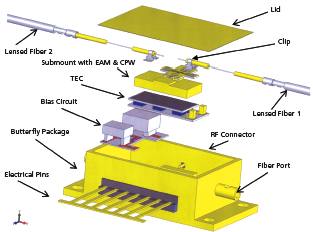
This work was done by Reinhard Erdmann, Richard J. Michalak, and Rebecca Bussjager of the Air Force Research Laboratory; Songsheng Tan, Nancy Stoffel, Charles Shick, Terrance McDonald, and Al Whitbeck of Infotonics Technology Center; and Ivan Shubin and Paul K. L. Yu of the University of California at San Diego. For more information, download the Technical Support Package (free white paper) at www.defensetechbriefs.com/tsp under the Photonics category. AFRL-0133
This Brief includes a Technical Support Package (TSP).
Design and Development of a Package for a Diluted Waveguide Electro-Absorption Modulator
(reference AFRL-0133) is currently available for download from the TSP library.
Don't have an account?
More From SAE Media Group

Photonics Tech Briefs
Tunable Filter Made From Three Coupled WGM Resonators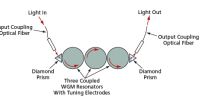
Tech Briefs
Sensitive Optical Receivers for Space
Photonics & Imaging Technology
Ultra-Broadband Photonic Chip Boosts Optical Signals
Photonics Tech Briefs
Optoelectronic Oscillators Based on Fiber-Optic Resonators
Photonics & Imaging Technology
Optical Signal Amplifying Technique
Aerospace & Defense Tech Briefs
Heterodyne RF/Optical Links Utilizing Integrated Photonics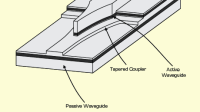
Photonics & Imaging Technology
A First-Of-Its-Kind Integrated Optical Isolator
Photonics Tech Briefs
A High-Repetition-Rate Optical Communications Source
Tech Briefs
Programming Light on a Chip
Photonics Tech Briefs
Closed-Loop Microsphere Laser for Optoelectronic Oscillator

Photonics Tech Briefs
Fiber-Optic Phase-Locked Loop Sensitive to Local Strain Only
Photonics & Imaging Technology
Photonic Microwave Generation Using On-Chip Optical Frequency Combs
Photonics & Imaging Technology
Researchers Demonstrate Noise-Free Communication with Structured Light
Photonics Tech Briefs
Whispering-Gallery-Mode Tunable Narrow-Band-Pass Filter
Photonics Tech Briefs
Compact Packaging of Photonic Millimeter-Wave Receiver


Photonics Tech Briefs
Integrated Miniature Arrays of Optical Biomolecule Detectors
Photonics Tech Briefs
Silicon Modulator Brings Optical Computing A Step Closer

Photonics Tech Briefs
Fiber Optic Communications Systems
Aerospace & Defense Tech Briefs
Photonic Recirculating Delay Line for Analog-to-Digital Conversion

Photonics Tech Briefs
Optoelectronic Contract Manufacturing Starts Before Design — Not After
Aerospace & Defense Tech Briefs
Photonic Analog-to-Digital Converters
Photonics & Imaging Technology
New Device Modulates Visible Light with the Smallest Footprint and Lowest Power Consumption
Overview
The document presents a conference paper detailing the design and development of a package for a diluted waveguide electro-absorption modulator (EAM). Authored by a team including Songsheng Tan, Nancy Stoffel, and others, the research focuses on enhancing the performance of EAMs, which are critical components in optical communication systems.
The paper outlines the motivation behind the project, emphasizing the need for improved modulation techniques in fiber-optic links. The authors discuss the challenges associated with traditional modulators, such as high insertion loss and limited bandwidth, which can hinder the efficiency of data transmission. The proposed diluted waveguide EAM aims to address these issues by leveraging advanced materials and design strategies.
Key findings include a summary of insertion loss measurements before and after assembly, with specific data provided for various modules tested at wavelengths of 1550 nm and 1570 nm. The results indicate a significant reduction in insertion loss, showcasing the effectiveness of the new packaging design. For instance, the final test results at 1550 nm show insertion losses ranging from 5.4 dB to 8.7 dB, which is a notable improvement over previous designs.
The document also includes references to related works, highlighting the collaborative nature of the research and its grounding in existing literature. The authors cite several studies that have contributed to the understanding of high-speed, high-saturation photodetectors and modulators, reinforcing the relevance of their work within the broader context of optical technology advancements.
Figures and tables within the paper provide visual representations of the data collected during testing, including photo current and intensity curves, which illustrate the performance characteristics of the EAM. The paper concludes with a discussion of the implications of these findings for future research and development in optical communication systems, suggesting that the advancements made could lead to more efficient and reliable data transmission methods.
Overall, this document serves as a comprehensive overview of the innovative approaches taken in the design and development of a diluted waveguide EAM, contributing valuable insights to the field of photonics and optical communications.
Top Stories
NewsRF & Microwave Electronics
 Microvision Aquires Luminar, Plans Relationship Restoration, Multi-industry Push
INSIDERAerospace
 A Next Generation Helmet System for Navy Pilots
INSIDERDesign
 New Raytheon and Lockheed Martin Agreements Expand Missile Defense Production
INSIDERMaterials
 How Airbus is Using w-DED to 3D Print Larger Titanium Airplane Parts
NewsPower
 Ford Announces 48-Volt Architecture for Future Electric Truck
ArticlesAR/AI

Webcasts
Electronics & Computers
 Cooling a New Generation of Aerospace and Defense Embedded...
Automotive
 Battery Abuse Testing: Pushing to Failure
Power
 A FREE Two-Day Event Dedicated to Connected Mobility
Unmanned Systems
 Quiet, Please: NVH Improvement Opportunities in the Early Design Cycle
Automotive
 Advantages of Smart Power Distribution Unit Design for Automotive &...
Energy
 Sesame Solar's Nanogrid Tech Promises Major Gains in Drone Endurance