




Aerospace & Defense Technology - May 2016
Inside this issue
Overview
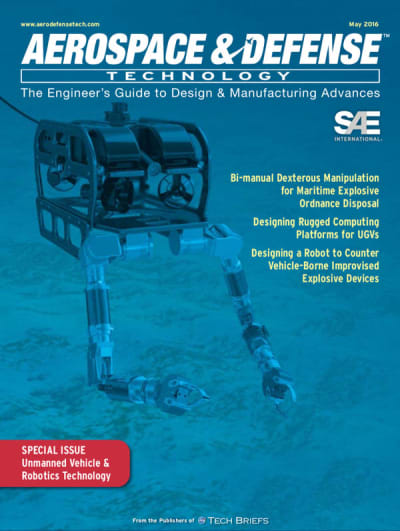
The May 2016 issue of Aerospace & Defense Technology presents a comprehensive overview of the latest advancements and innovations in the aerospace and defense sectors, focusing on unmanned vehicles and robotics technology. This issue is particularly significant as it highlights the growing importance of these technologies in modern military and civilian applications.
One of the key features of this issue is the exploration of bi-manual dexterous manipulation for maritime explosive ordnance disposal (EOD). The article discusses the challenges faced by EOD teams in handling explosives in maritime environments and how advanced robotic systems can assist in these high-risk operations. The use of dexterous robotic arms allows for more precise manipulation of explosives, reducing the risk to human operators and increasing the efficiency of EOD missions.
Another highlight is the coverage of rugged computing platforms designed for unmanned ground vehicles (UGVs). As UGVs become more prevalent in military operations, the need for reliable and durable computing systems is paramount. The article details the specifications and capabilities of these rugged platforms, which are engineered to withstand harsh environmental conditions while providing real-time data processing and communication capabilities. This technology is crucial for enhancing the operational effectiveness of UGVs in various missions, including reconnaissance, surveillance, and logistics support.
The issue also delves into innovative designs aimed at countering vehicle-borne improvised explosive devices (VBIEDs). With the increasing threat of VBIEDs in conflict zones, the defense industry is focusing on developing advanced detection and neutralization systems. The article outlines various approaches, including the integration of sensors and artificial intelligence to improve threat detection and response times. These advancements are essential for ensuring the safety of military personnel and civilians in areas where VBIEDs are a significant risk.
In addition to these feature articles, the magazine includes a variety of regular sections that provide insights into industry trends, technological advancements, and expert opinions. The editorial team, led by Joseph T. Pramberger and Linda L. Bell, emphasizes the importance of staying informed about the rapid developments in aerospace and defense technology. The magazine serves as a valuable resource for professionals in the field, offering in-depth analysis and expert commentary on the latest innovations.
The issue also highlights the role of NASA in advancing aerospace technology. It discusses how NASA's research and development efforts contribute to the broader aerospace community, particularly in areas such as robotics and autonomous systems. The collaboration between NASA and private industry is fostering innovation and driving the development of new technologies that have applications beyond traditional aerospace.
Furthermore, the magazine addresses the challenges and opportunities presented by the integration of unmanned systems into existing military frameworks. As unmanned vehicles become more sophisticated, military organizations must adapt their strategies and training programs to effectively incorporate these technologies into their operations. The articles provide insights into how defense agencies are approaching this integration, including the need for updated protocols and the importance of human-robot interaction.
The issue also features case studies and success stories from various defense contractors and technology providers. These real-world examples illustrate how cutting-edge technologies are being implemented in the field, showcasing the tangible benefits of innovation in enhancing operational capabilities. Readers gain a deeper understanding of how these advancements are transforming the landscape of defense and security.
In summary, the May 2016 issue of Aerospace & Defense Technology offers a rich exploration of the latest trends and technologies in unmanned vehicles and robotics. Through feature articles, expert commentary, and case studies, the magazine provides valuable insights into the challenges and opportunities facing the aerospace and defense industries. As the demand for advanced technologies continues to grow, this issue serves as a crucial resource for professionals seeking to stay informed and engaged in the rapidly evolving landscape of aerospace and defense technology.
Features
-
Application Briefs
Predator Mission Aircrew Training Systems
-
Articles
Using SWaP-C Reductions to Improve UAS/UGV Mission Capabilities
Designing Rugged Computing Platforms for UGVs
Bi-manual Dexterous Manipulation for Maritime Explosive Ordnance Disposal
Applying UUV Advances to Safeguard Harbors and Littoral Waters
Designing a Robot to Counter Vehicle-Borne Improvised Explosive Devices
Tech Briefs
-
Machinery & Automation
Autonomous Underwater Munitions and Explosives of Concern Detection System
Power-Line UAV Modeling and Simulation
Design of a Multi-Segmented Magnetic Robot for Hull Inspection
A Modular Approach to Video Designation of Manipulation Targets for Mobile Manipulators
Top Stories
INSIDERDefense
 New Raytheon and Lockheed Martin Agreements Expand Missile Defense Production
NewsAutomotive
 Ford Announces 48-Volt Architecture for Future Electric Truck
INSIDERManufacturing & Prototyping
 Active Strake System Cuts Cruise Drag, Boosts Flight Efficiency
ArticlesTransportation
 Accelerating Down the Road to Autonomy
INSIDERMaterials
 How Airbus is Using w-DED to 3D Print Larger Titanium Airplane Parts
Road ReadyTransportation

Webcasts
Electronics & Computers
 Cooling a New Generation of Aerospace and Defense Embedded...
Power
 Battery Abuse Testing: Pushing to Failure
Connectivity
 A FREE Two-Day Event Dedicated to Connected Mobility
Automotive
 Quiet, Please: NVH Improvement Opportunities in the Early Design Cycle
Transportation
 Advantages of Smart Power Distribution Unit Design for Automotive &...
Aerospace
 Sesame Solar's Nanogrid Tech Promises Major Gains in Drone Endurance