




Applying UUV Advances to Safeguard Harbors and Littoral Waters
Advances in unmanned underwater vehicles (UUVs) are providing government agencies and commercial organizations with new capabilities across a variety of mission requirements. However, many underwater vehicles only address specific criteria or support well-defined (and limited) niches. As an example, the Naval Sea Systems Command’s (NAVSEA) Littoral Battlespace Sensing (LBS) system includes the LBS-G long-endurance glider to collect oceanographic data, but also needs the LBS-AUV for military applications.
Requirements for Littoral Areas
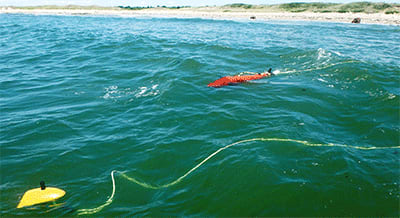 The total U.S. shoreline is 95,471 miles according to the National Oceanic and Atmospheric Administration (NOAA), which is nearly the same distance as circling the equator four times. America’s diverse shoreline includes busy ports, towering bridges carrying commuters, powerful rivers, and various estuaries. Despite these geographical differences along the coastline, UUVs and related underwater systems all require the following capabilities to be effective in shallow water missions:
- High maneuverability (to navigate around piers, bridges, oil rigs, etc.);
- Payload flexibility and capacity (to transport and use sonar for example);
- Near real-time data acquisition and/or transmission;
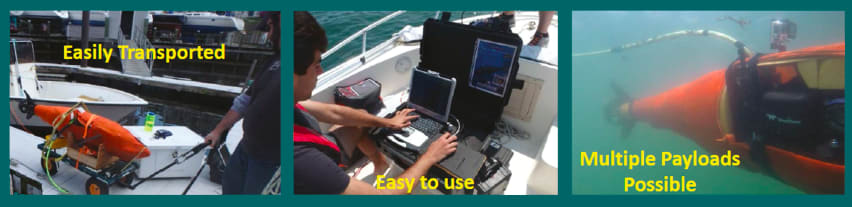
- Portability (easy to transport and deploy rapidly);
- Intuitive operator controls.
Typical operations in these shoreline areas include:
- Bathymetry studies;
- Contraband detection;
- Environmental monitoring;
- Harbor/port security;
- Search and rescue;
- Ship inspection;
- Submerged infrastructure inspection.
Reverse Engineering 20 Million Years of Evolution
The U.S. Department of Homeland Security (DHS) Science & Technology Directorate (S&T) sponsored Boston Engineering to develop a UUV to strengthen the capability to search, inspect, and operate in harsh environments and constricted underwater areas. The Bluefin Tuna, and other pelagic fishes like it, exhibit remarkable swimming performance in all areas: high-speed burst swimming (30-50 knots), high maneuverability (180 degree turns in a single body length), and efficiency (routinely migrate for long distances to 25,000 miles). Boston Engineering’s BIOSwimmer UUV is based on this model to deliver a unique and tactically-relevant intersection of speed, maneuverability, and endurance.
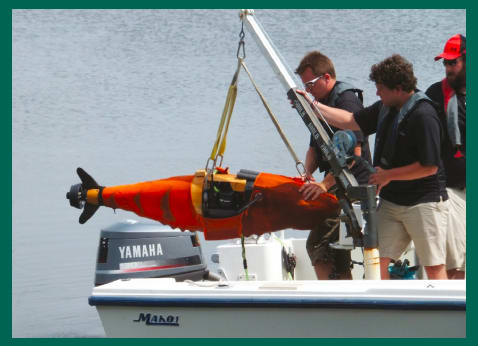
The BIOSwimmer includes a tow-body-based antenna that operators can use to communicate with the UUV while it is underwater. If the antenna is removed, the BIOSwimmer can collect and store data while it is underwater, and download its results after the mission.
Alternatives for Shallow Water Missions
In addition to UUVs, the most common maritime robotics used in littoral waters are remotely operated vehicles (ROVs) and autonomous unmanned vehicles (AUVs). Here’s an overview of their capabilities in this environment.
Torpedo-shaped AUVs such as Hydroid’s REMUS 100 and Bluefin Robotics’ Bluefin-12 have been used to conduct wide area surveys by scanning back and forth in a “lawn mower” pattern underwater. While this may be suitable for covering large areas of water, such vehicles can have some difficulty turning in tight areas, which can become a severe limitation when navigating objects in shallow waters or adjusting its operational swimming patterns for other missions. Holding position relative to a diver is also very difficult with these systems.
Demonstration Results
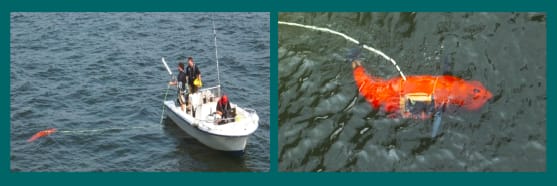
We estimate that port security is enhanced by BIOSwimmer’s ability to: inspect an additional 20 percent of a ship versus a competitive AUV, scan three times the number of ships in a harbor during an eight-hour shift vs. an ROV, and provide ease of use (such as launching in
This article was written by Michael Rufo, Director of Boston Engineering’s Advanced Systems Group (ASG) (Waltham, MA). For more information, Click Here .
More From SAE Media Group
Aerospace & Defense Tech Briefs
UUV Developments for Defense and Commercial Applications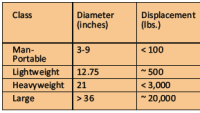
Aerospace & Defense Tech Briefs
Underwater Drone Technology
Aerospace & Defense Tech Briefs
Soft Robotic Fish Swims Alongside Real Ones in Coral Reefs
Aerospace & Defense Tech Briefs
Developing Object Detection Systems for Autonomous Underwater Vehicles
Aerospace & Defense Tech Briefs
Underwater Security System
Aerospace & Defense Tech Briefs
Connectivity in Robotic Systems
Aerospace & Defense Tech Briefs
Interoperability Standards Pave the Way for Modular Robotic Manipulators
Aerospace & Defense Tech Briefs
Investigation of Requirements and Capabilities of Next-Generation Mine Warfare Unmanned Underwater Vehicles
Aerospace & Defense Tech Briefs
Using Underwater Robotics for Autonomous Deep-Sea Exploration
Aerospace & Defense Tech Briefs
Autonomous Underwater Munitions and Explosives of Concern Detection System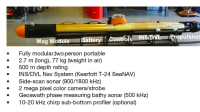
Aerospace & Defense Tech Briefs
XPONENTIAL 2018 – An AUVSI Experience
Aerospace Manufacturing and Machining INSIDER
Meeting the Demands of Defense Production and Sustainment Through Additive Manufacturing
Aerospace & Defense Tech Briefs
Portable Diver Detection Sonar System
Aerospace & Defense Tech Briefs
Navy to Evaluate Three Large Displacement Unmanned Underwater Vehicle Prototypes
Aerospace & Defense Tech Briefs
Underwater Acoustic Communication System
Aerospace & Defense Tech Briefs
Development and Testing of a New Version of MBUD for Cued Classification of Marine UXO
Aerospace & Defense Tech Briefs
Enabling Off-the-Shelf Autonomous Naval Warfare
Aerospace & Defense Tech Briefs
Experimental Assessment of Entanglement for an Unmanned Underwater Vehicle with an Open, Three-Bladed Propeller
Aerospace & Defense Tech Briefs
Hybrid Auxiliary Propulsion System
Aerospace & Defense Tech Briefs
XPONENTIAL 2019 – An AUVSI Experience
Tech Briefs
Flimmer: The Flying, Swimming Drone
Aerospace & Defense Tech Briefs
Designing Future Autonomous Underwater Vehicles
Aerospace & Defense Tech Briefs
Development of a Vision-Based Situational Awareness Capability for Unmanned Surface Vessels
Aerospace & Defense Tech Briefs
Controlling the Seas: Introducing a New Concept in Autonomous Surface/Underwater Vehicles
Aerospace & Defense Tech Briefs
XPONENTIAL: An AUVSI Experience
Aerospace & Defense Tech Briefs
Rebar Tying Robot
Aerospace & Defense Tech Briefs
3D Printing Parts for Ships, Submarines and Underwater Vehicles
Top Stories
NewsRF & Microwave Electronics
 Microvision Aquires Luminar, Plans Relationship Restoration, Multi-industry Push
INSIDERAerospace
 A Next Generation Helmet System for Navy Pilots
INSIDERDesign
 New Raytheon and Lockheed Martin Agreements Expand Missile Defense Production
INSIDERMaterials
 How Airbus is Using w-DED to 3D Print Larger Titanium Airplane Parts
NewsPower
 Ford Announces 48-Volt Architecture for Future Electric Truck
ArticlesAR/AI

Webcasts
Electronics & Computers
 Cooling a New Generation of Aerospace and Defense Embedded...
Automotive
 Battery Abuse Testing: Pushing to Failure
Power
 A FREE Two-Day Event Dedicated to Connected Mobility
Unmanned Systems
 Quiet, Please: NVH Improvement Opportunities in the Early Design Cycle
Automotive
 Advantages of Smart Power Distribution Unit Design for Automotive &...
Energy
 Sesame Solar's Nanogrid Tech Promises Major Gains in Drone Endurance