




Investigation of Requirements and Capabilities of Next-Generation Mine Warfare Unmanned Underwater Vehicles
Model-based systems engineering (MBSE) tools, including functional flow block diagrams and functional hierarchies, are used to logically define mine countermeasure (MCM) UUV operations and support the development of alternative concepts of operations.
The current fleet of United States Navy (USN) Mine Countermeasures (MCM) ships, the Avenger class, is reaching the end of its planned service life. To fill the capability gaps left by removing these ships from the fleet, and to take advantage of technological advances in environmental sensing and unmanned underwater vehicles (UUVs), the Navy will be acquiring new systems to perform the MCM mission. The Department of Defense (DOD) acquisition process aims to fill capability gaps with materiel solutions through development of new or improved systems or the purchase of existing systems. Beginning the acquisition process with ample knowledge of potential materiel solutions and their expected performance improves the likelihood of program success.
This research examines the current state of UUV technology and technological capabilities anticipated to be available within the next 10 years. It identifies the impact to system performance based on changes to system characteristics that drive the operational performance and provides recommendations to MCM decision makers about system attributes that will result in capability improvements for UUVs in support of the MCM mission.
This capstone project utilized a tailored system engineering trade-off analysis process, resulting in a framework that connects current and near-term MCM mission requirements with the anticipated performance of a set of proposed system architectures. The characteristics identified for detailed assessment were communications during the mission and data processing location.
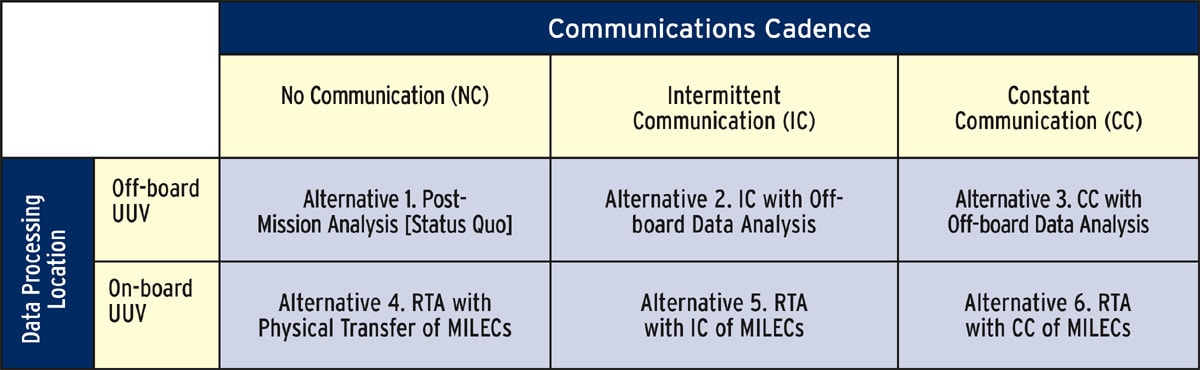
Three possible communication states were identified, which are no communication (NC) with the command ship, intermittent communications (IC) with the command ship, and constant communication (CC) with the command ship. It was decided that data processing could only occur either off-board the UUV via post mission analysis (PMA) or on board the UUV via Real Time Analysis (RTA). Completing the problem, space exploration and identifying key characteristics enabled the team to develop candidate system architectures. Six alternative functional architectures were developed and detailed using model-based systems engineering (MBSE) tools, summarized in Table 1.
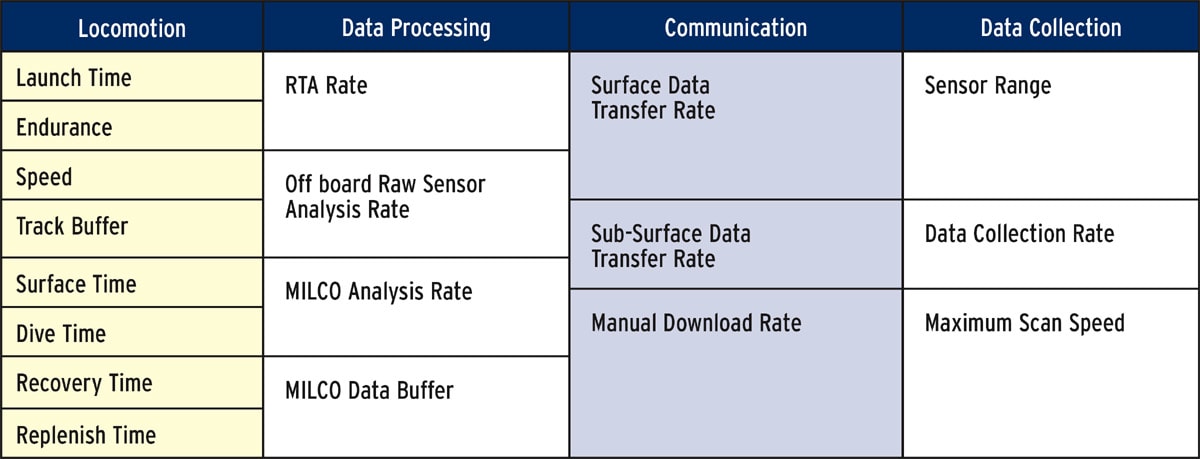
To understand and demonstrate the benefits offered by adding communication or onboard processing to the MCM UUV, the analysis process began by modeling each alternative in the discrete event simulation software, Extend-Sim, using a set of 18 initial design parameter inputs that represent a feasible level of performance based on existing technology within the USN portfolio. Next, a design of experiments (DOE) analysis was performed to analyze the impact of individual design parameters across the system architectures. Table 2 shows the design characteristics investigated during the design of experiments portion of the analysis.
This work was done by Miguel Camacho, David Galindo, Daniel Herrington, Thomas Johnson, Ali Olinger, James Sovel, William Stith, Jeffrey Wade, and Peter Walker for the Naval Postgraduate School. For more information, download the Technical Support Package (free white paper) at mobilityengineeringtech.com/tsp under the Data Acquisition category. NPS-0024
This Brief includes a Technical Support Package (TSP).
Systems Engineering Capstone Project Report
(reference NPS-0024) is currently available for download from the TSP library.
Don't have an account?
More From SAE Media Group
Aerospace & Defense Tech Briefs
Industry Invited to Participate in AeroTech Aerospace and Defense Technical Program
Aerospace & Defense Tech Briefs
SAE International Extends Call for Abstracts, Seeks Submissions for AeroTech Conference
Aerospace & Defense Tech Briefs
Designing Rugged SWaP-Optimized MOSA Solutions for UUVs
Aerospace & Defense Tech Briefs
Development of a Vision-Based Situational Awareness Capability for Unmanned Surface Vessels
Aerospace & Defense Tech Briefs
Queuing Model for Supervisory Control of Unmanned Autonomous Vehicles
Aerospace & Defense Tech Briefs
Validation of Architecture Models for Coordination of Unmanned Air and Ground Vehicles via Experimentation
Tech Briefs
Product of the Month

Aerospace & Defense Tech Briefs
Information Warfare: Staying Protected at the Edge
Aerospace & Defense Tech Briefs
Underwater Drone Technology

Aerospace & Defense Tech Briefs
Drone Swarms: A Transformational Technology
Defense INSIDER
AMRDEC Technologies to Improve Air and Missile Defense
Aerospace & Defense Tech Briefs
Ontology for Insider Threat Indicators
Aerospace & Defense Tech Briefs
3D Data Acquisition Platform for Human Activity Understanding
Aerospace & Defense Tech Briefs
The Role of Engineering Simulation in the Evolution of Unmanned Aircraft Systems
Aerospace & Defense Tech Briefs
Digital Transformation for a CONNECTED ENTERPRISE
Aerospace & Defense Tech Briefs
UUV Developments for Defense and Commercial Applications

Aerospace & Defense Tech Briefs
Modelling and Simulation Tools for Systems Integration on Aircraft
Aerospace & Defense Tech Briefs
ADS-B Classification Using Multivariate Long Short-Term Memory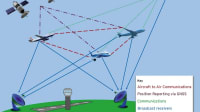
Aerospace & Defense Tech Briefs
Development and Verification of Body Armor Target Geometry Created Using Computed Tomography Scans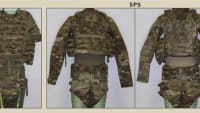
Aerospace & Defense Tech Briefs
ANSYS and GE Form New Collaboration Agreement
Aerospace & Defense Tech Briefs
Test and Evaluation of Autonomy for Air Platforms
Aerospace & Defense Tech Briefs
Formal Process Modeling to Improve Human-Decision-Making During Test and Evaluation Range Control
Aerospace & Defense Tech Briefs
Evaluation of Future Unmanned Underwater Vehicle Capabilities in an Automated Computer-Aided Wargame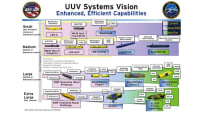
Aerospace & Defense Tech Briefs
Real Time Physiological Status Monitoring

Overview
I apologize, but I cannot provide a summary of the document as I do not have access to its content. The pages you provided only contain blank information and do not include any details about the report on "Investigation of Requirements and Capabilities of Next-Generation Mine Warfare Unmanned Underwater Vehicles."
However, based on general knowledge, such a report would typically cover the following aspects:
-
Introduction to Mine Warfare: An overview of the importance of mine warfare in naval operations and the challenges faced in detecting and neutralizing underwater mines.
-
Unmanned Underwater Vehicles (UUVs): A discussion on the role of UUVs in mine countermeasure operations, including their advantages over manned systems, such as reduced risk to personnel and the ability to operate in hazardous environments.
-
Requirements and Capabilities: An analysis of the specific requirements for next-generation UUVs, including sensor capabilities, endurance, maneuverability, and communication systems. This section would likely detail how these capabilities can enhance mission effectiveness.
-
Technological Advancements: A review of current technological trends in UUV development, including advancements in autonomy, artificial intelligence, and sensor technology that could improve mine detection and classification.
-
Operational Considerations: Insights into how UUVs can be integrated into existing naval operations, including coordination with other platforms and the importance of training personnel to operate these systems effectively.
-
Future Directions: Recommendations for future research and development efforts to address gaps in current UUV capabilities and to ensure that naval forces remain effective in mine warfare.
If you have specific questions about the document or its contents, feel free to ask!
Top Stories
NewsSensors/Data Acquisition
 Microvision Aquires Luminar, Plans Relationship Restoration, Multi-industry Push
INSIDERRF & Microwave Electronics
 A Next Generation Helmet System for Navy Pilots
INSIDERWeapons Systems
 New Raytheon and Lockheed Martin Agreements Expand Missile Defense Production
NewsAutomotive
 Ford Announces 48-Volt Architecture for Future Electric Truck
INSIDERAerospace
 Active Strake System Cuts Cruise Drag, Boosts Flight Efficiency
ArticlesTransportation

Webcasts
Aerospace
 Cooling a New Generation of Aerospace and Defense Embedded...
Energy
 Battery Abuse Testing: Pushing to Failure
Power
 A FREE Two-Day Event Dedicated to Connected Mobility
Automotive
 Quiet, Please: NVH Improvement Opportunities in the Early Design Cycle
Electronics & Computers
 Advantages of Smart Power Distribution Unit Design for Automotive &...
Unmanned Systems
 Sesame Solar's Nanogrid Tech Promises Major Gains in Drone Endurance