




UUV Developments for Defense and Commercial Applications
Autonomous Undersea Vehicles (AUVs), also commonly referred to as Unmanned Undersea Vehicles (UUVs), have a history dating back to 1957 with the Special Purpose Underwater Research Vehicle (SPURV) developed by the University of Washington's Applied Physics Laboratory. Academia and special government programs drove the early decades of research but advancements were slow. Throughout the 1960s, 1970s, and 1980s, more explosive growth came for the Remotely Operated Undersea Vehicle (ROV) market which had two primary advantages: they were operated via a tether that provided power for the vehicle and man-in-the-loop control.
In the late 1980s and early 1990s, advancements were made under the Massachusetts Institute of Technology’s Sea Grant AUV Laboratory in the design of lower cost, autonomous vehicles that leveraged available technologies in commercial computer processing coupled with lower power ROV sensors. In 1997, Bluefin Robotics spun out of the MIT AUV Laboratory to focus on commercial development of AUVs. Several competing firms also were formed in this time-frame, giving the primary, commercially-spurred market between 15 and 20 years of experience. Several of the large US defense contractors such as Boeing, Lockheed Martin, and Northrop Grumman predated this period for AUV development, but their focus was primarily defense and the US Navy’s budgets dropped steeply in the early 2000s for AUV development. The 2000s saw slow but steady growth across the markets which included US and International Defense, Scientific, and Commercial.
The growing demands are illustrated by the many new US and international AUV providers that have entered the market in addition to numerous academic institutions in the past 5 years. At the time of this article, the Autonomous Undersea Vehicles Application Center (AUVAC) catalogs 185 different AUVs from 74 different companies or institutions.
Environmental Challenges

Some of the environmental challenges are much more daunting than space. hours (almost 2000 miles in range) with a heavyweight class AUV. As more large AUVs enter service and become more common, these payload volumes and endurances will extend even further.
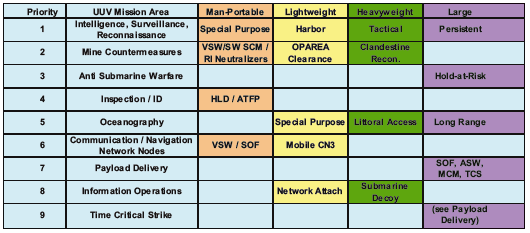
The Navy prioritized missions to be accomplished by AUVs shown in Table 2 from the Master Plan. They also mapped how these mission areas would be satisfied by vehicle class. These missions would likely be considered common for other nations developing AUVs for defense applications.
Current Developments
With the growth of the AUV market in the past several years, there has been a healthy mix of production and development efforts in both commercial and defense. One unique class of vehicle that has emerged is a hybrid AUV/ROV that combines the traditional AUV capabilities with thin fiber optic tethers that allow for real-time data transfer and manual intervention similar to ROVs (Figure 2).
In 2011, Bluefin Robotics was awarded the production contract for the Mk19 Hull UUV Localization System (HULS). This provided an AUV capability to the Navy for inspection of ship hulls for mines or contraband that removed the need to deploy dive teams to inspect ships. The coverage rates were better than what divers could do in turbid waters and the robot could ensure complete coverage of the ship hull. The tether provided real-time access to the streaming sonar imagery in the event the vehicle identified a threat so that divers could then respond. It also provided for manual control of the vehicle to allow the support diver to more thoroughly investigate a target remotely. Bluefin is currently working on adding manipulation to this platform, leveraging the tether for remote operation.

This concept has parallels in ground robotics where explosive ordnance teams utilize the robot for mine neutralization, thereby taking the technician out of harm’s way. This class of vehicle has commercial applications for ship hull inspection and critical harbor infrastructure. In addition, Bluefin has a significantly larger (1-ton) system in final testing for much deeper rated (4,000m) inspection and light intervention.
The small AUV market is an area of growing interest, particularly for defense and scientific applications. For defense, these vehicles can provide low-cost countermeasure capabilities for torpedo defense and mine neutralization. Additionally, the small diameters (3 to 5 inches typical) provide less drag, thereby reducing the propulsion requirements for either fast-moving, or low-speed, greater persistence applications. With lower power processing advancements, these systems will be more and more capable as the personal electronics markets advance.
Bluefin has recently completed design updates to both its man-portable and lightweight class vehicles, improving the operating depths, navigational accuracies, and payload flexibility of these systems. Both the commercial and defense markets for these classes of vehicles are growing with numerous programs being released.
The heavyweight AUV space has seen significant growth in the past several years, both in defense and commercial applications. For defense, Bluefin is completing initial development testing of Lack of line of sight to satellites makes precision navigation and high bandwidth communications to the vehicles much more difficult, if not impossible. And the pressure extremes can be formidable when operating at depth. The oceans cover 70% of the Earth’s surface with an average depth of over 12,000 feet (3,600 m). An AUV depth rating to 20,000 feet (6,000 m) allows it to operate on the majority of the ocean floor except for the trenches, which extend to the deepest place on the planet – Challenger Deep in the Mariana Trench, at nearly 36,000 feet (11,000 m). The pressure at 20,000 feet is over 9,000 pounds per square inch (psi), and nearly 16,000 psi at Challenger Deep. Considering, for scale, that the average SUV weighs 4000 lbs, this pressure is equivalent to multiple SUVs stacked on every square inch of vehicle surface at depth.
AUV Applications and Classes

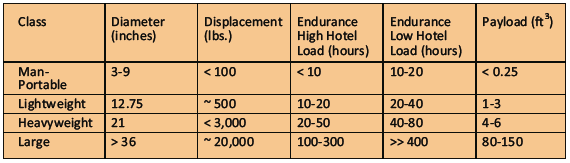
In an effort to provide industry guidance and drive commonality of systems and purpose, the US Navy published a series of UUV Master Plans that focused industry on 4 vehicle classes based on size and prioritized mission areas. Table 1 provides the AUV classes from the US Navy Master Plan for typical torpedo shaped AUVs. Endurance, payload volume, and vehicle complexity/capability commonly increase with vehicle size.
Most of the world’s AUVs, whether designed for commercial purposes or defense, can be categorized into these basic vehicle classes, but typical endurances and payload sizes can vary from what was published in the UUV Master Plan. For example, the heavyweight Knifefish UUV under development by Bluefin for the Littoral Combat Ship’s Mine Warfare Mission Package has a payload of over 30 ft3. And the Naval Research Laboratory’s Reliant UUV (the precursor to Knifefish) recently completed a 109 hour mission from Boston to New York (310 miles). Straightforward concepts exist to extend this demonstrated capability to ~600 DARPA’s Distributed Agile Submarine Hunting (DASH) program with a deep rated UUV with extended persistence. Additionally, Bluefin was awarded the vehicle design effort for the Knifefish UUV which will be entering sea testing this summer. Commercially, Bluefin supported global operations from commercial survey, to the hunt for Amelia Earhart, to under-ice operations in the arctic. A recently delivered 4,500m rated commercial heavyweight AUV employs a synthetic aperture sonar with a 1000m swath. This class of AUVs will see increasing applications as more advanced energy technologies are integrated to extend their persistence further.
On the large vehicle front, Bluefin is supporting its parent company Battelle and partner, the Columbia Group, in the development of Proteus Large UUV (Figure 3). This vehicle is a dual mode vehicle that can operate with divers or fully autonomously. Bluefin provides the autonomy, navigation, mission planning and subsea pressure tolerant batteries to this vehicle which has over 300 hours of in-water testing and operation accumulated as of this printing.
This article was written by Jeff Smith, CEO, Bluefin Robotics (Quincy, MA). For more information, Click Here .
More From SAE Media Group
Aerospace & Defense Tech Briefs
Underwater Drone Technology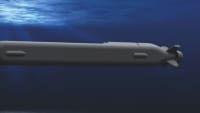
Aerospace & Defense Tech Briefs
Applying UUV Advances to Safeguard Harbors and Littoral Waters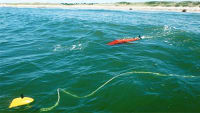
Aerospace & Defense Tech Briefs
Investigation of Requirements and Capabilities of Next-Generation Mine Warfare Unmanned Underwater Vehicles
Aerospace & Defense Tech Briefs
Connectivity in Robotic Systems
Aerospace & Defense Tech Briefs
Developing Object Detection Systems for Autonomous Underwater Vehicles
Aerospace & Defense Tech Briefs
Navy to Evaluate Three Large Displacement Unmanned Underwater Vehicle Prototypes
Aerospace & Defense Tech Briefs
Bi-manual Dexterous Manipulation for Maritime Explosive Ordnance Disposal
Aerospace & Defense Tech Briefs
Mil-Aero Design Embraces Intelligent Application-Ready ATCA Platforms
Aerospace Manufacturing and Machining INSIDER
Meeting the Demands of Defense Production and Sustainment Through Additive Manufacturing
Aerospace & Defense Tech Briefs
Underwater Security System
Aerospace & Defense Tech Briefs
Designing Future Autonomous Underwater Vehicles
Aerospace & Defense Tech Briefs
Enabling Off-the-Shelf Autonomous Naval Warfare
Aerospace & Defense Tech Briefs
Soft Robotic Fish Swims Alongside Real Ones in Coral Reefs
Aerospace & Defense Tech Briefs
Controlling the Seas: Introducing a New Concept in Autonomous Surface/Underwater Vehicles
Tech Briefs
Flimmer: The Flying, Swimming Drone
Aerospace & Defense Tech Briefs
Autonomous Underwater Munitions and Explosives of Concern Detection System
Aerospace & Defense Tech Briefs
Portable Diver Detection Sonar System
Aerospace & Defense Tech Briefs
Interoperability Standards Pave the Way for Modular Robotic Manipulators
Aerospace & Defense Tech Briefs
Undersea Communications Between Submarines and Unmanned Undersea Vehicles in a Command and Control Denied Environment
Aerospace & Defense Tech Briefs
Development of a Vision-Based Situational Awareness Capability for Unmanned Surface Vessels

Aerospace & Defense Tech Briefs
DoD to Deploy Thousands of Low Cost Autonomous Systems Under Replicator Program
Aerospace & Defense Tech Briefs
Using Underwater Robotics for Autonomous Deep-Sea Exploration
Aerospace & Defense Tech Briefs
Autonomous Undersea Vehicle Completes 100-Hour Demonstration
Aerospace & Defense Tech Briefs
Playing Defense — Uncertain Regulations Stall the Implementation of Counter-UAS Technology in The U.S.
Aerospace & Defense Tech Briefs
Cellular Satellites: Joint Communications with Integrated Acquisition
Aerospace INSIDER
Boeing to Develop New Space Force Nuclear Communications Satellites
Aerospace & Defense Tech Briefs
Revolutionizing the Waves: A Breakthrough in Surf Observation Technology for Sailors and Marines
Top Stories
NewsSensors/Data Acquisition
 Microvision Aquires Luminar, Plans Relationship Restoration, Multi-industry Push
INSIDERRF & Microwave Electronics
 A Next Generation Helmet System for Navy Pilots
INSIDERWeapons Systems
 New Raytheon and Lockheed Martin Agreements Expand Missile Defense Production
NewsAutomotive
 Ford Announces 48-Volt Architecture for Future Electric Truck
INSIDERAerospace
 Active Strake System Cuts Cruise Drag, Boosts Flight Efficiency
ArticlesTransportation

Webcasts
Aerospace
 Cooling a New Generation of Aerospace and Defense Embedded...
Energy
 Battery Abuse Testing: Pushing to Failure
Power
 A FREE Two-Day Event Dedicated to Connected Mobility
Automotive
 Quiet, Please: NVH Improvement Opportunities in the Early Design Cycle
Electronics & Computers
 Advantages of Smart Power Distribution Unit Design for Automotive &...
Unmanned Systems
 Sesame Solar's Nanogrid Tech Promises Major Gains in Drone Endurance