




Evaluation of Future Unmanned Underwater Vehicle Capabilities in an Automated Computer-Aided Wargame
Using a model-based systems engineering (MBSE) approach in a computer-aided wargame to explore the effects of advanced UUV capabilities as both an asset in the future U.S. naval fleet and as an alternative to the dwindling submarine force.

In fiscal year 2016, the Senate Armed Services Committee ordered the Navy to increase its fleet to 355 ships. However, the lack of construction facilities impedes this endeavor. Rear Admiral Brian Luther, deputy assistant secretary of the Navy for budgets, estimated that the objective of 355 ships will not come to fruition until the 2050s. As a result, the U.S. Navy is exploring potential fleet restructuring options.
There is very high interest in supplementing traditionally manned naval assets with unmanned systems. One such system is the unmanned underwater vehicle (UUV). With top-level interest in both fleet and unmanned systems, the Office of Naval Research (N9) requested a method and process to test future capabilities of UUVs and an experimentation environment or tool to conduct such investigations. Moreover, UUVs have traditionally operated to support mine warfare and minor surveillance missions, so their impact in other roles is not understood.
The aim of this research was to use a model-based systems engineering (MBSE) approach in a computer-aided wargame, specifically the Joint Theater Level Simulation-Global Operations (JTLS-GO), to explore the effects of advanced UUV capabilities as an asset in the future U.S. naval fleet and as an alternative to the dwindling submarine force.
The MBSE approach is a multi-step process that explores the whole project from beginning to end. This approach led to the development of an advanced UUV concept and vignette, or concept of operations (CONOP), from Cobra Gold 2018 (CG18), a six-nation (PACOM sponsored) command post exercise (CPX). Creation of the vignette permitted the iterative examination of CG18 to identify capability shortfalls that the UUVs could address.
In this case, the vignette focused on interactions between an enemy (Sonoran) task force against an allied task force, including the USS Benfold (DDG-65) and RSS Endurance (LS-207). The results of the real exercise included casualties sustained by the aforementioned ships. These casualties were due to lack of situational awareness and lack of offensive firepower. These issues presented an opportunity and motivation for UUV injection into the simulation to augment sensors and firepower. Afterward, the process of identifying and establishing the operational requirements and the constraints of the new capabilities ensued.
The new simulated UUV design must be able to provide additional offense and reconnaissance capabilities. Measuring how well the UUVs performed and what attributes to vary led to the development of the measures of effectiveness (MOE) and measures of performance (MOP). These measures helped direct the formulation of the design of experiments (DOE), which guided the experimentation and assessment of the notional UUVs.
The MOEs included detection effectiveness and enemy attrition. The performance factors (attributes) of interest consisted of UUV speed, number of UUVs (UUV fleet composition), and sonar type (active or passive). The DOE involved the testing of these factors at three different values (levels). The combination of the factors at varying levels led to an experimentation with 18 design points.
The JTLS-GO model is an event-driven wargaming simulation designed by Rolands and Associates that serves to test multi-sided joint campaigns and operations. The program tests several layers of warfare including political, strategic, operational, and tactical levels. Although JTLS-GO is useful for simulating engagements, its functionality is to train headquarters staff to command and control units more efficiently. Thus, testing futuristic concepts using JTLS-GO alone is not feasible as it requires significant resources.
To capitalize the human response and results from CG18, the original JTLS-GO simulation program was transformed into an automated computer-aided wargaming (CAW) simulation with the help of the NPS Simulation Experiments and Efficient Designs (SEED) center. This transformation permitted multiple, repetitive simulations of future capabilities for statistical analysis. In all, 540 simulation runs were made, utilizing 810 hours of computer time.
This work was done by Lieutenant Herman Wong for the Naval Postgraduate School.For more information, download the Technical Support Package (free white paper) below. NPS-0023
This Brief includes a Technical Support Package (TSP).
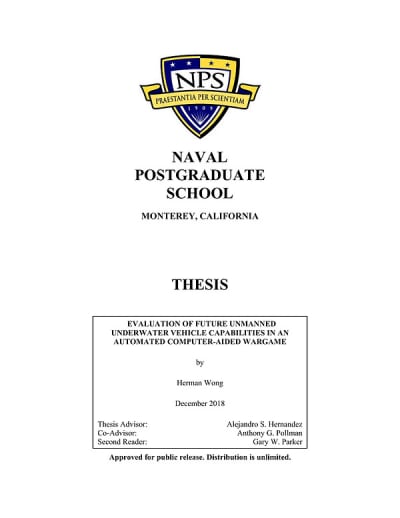
Evaluation of Future Unmanned Underwater Vehicle Capabilities in an Automated Computer-Aided Wargame
(reference NPS-0023) is currently available for download from the TSP library.
Don't have an account?
More From SAE Media Group
Aerospace & Defense Tech Briefs
Unmanned Aerial Vehicles
Aerospace & Defense Tech Briefs
Enabling Off-the-Shelf Autonomous Naval Warfare
Aerospace & Defense Tech Briefs
Weapon Fire Control System
Aerospace & Defense Tech Briefs
Investigation of Requirements and Capabilities of Next-Generation Mine Warfare Unmanned Underwater Vehicles
Aerospace & Defense Tech Briefs
Mk 18 Unmanned Underwater Vehicle Systems

Aerospace & Defense Tech Briefs
Autonomous Air Defense Production
Aerospace & Defense Tech Briefs
Embracing the Digital Transformation in Aerospace & Defense
Aerospace & Defense Tech Briefs
Underwater Drone Technology
Aerospace & Defense Tech Briefs
Counter-Drone Technology
Aerospace & Defense Tech Briefs
Assessing the Effectiveness of a Combat UGV Swarm in Urban Operations
Aerospace & Defense Tech Briefs
Digital Twins: How The Digital Replica Concept Is Used By Robotic Systems
Aerospace & Defense Tech Briefs
Navy Lasers, Railgun, and Hypervelocity Projectile: Background and Issues for Congress
Aerospace & Defense Tech Briefs
Sonobuoy Dispensing & Remote Processing System
Aerospace & Defense Tech Briefs
Revolutionizing the Waves: A Breakthrough in Surf Observation Technology for Sailors and Marines
Aerospace & Defense Tech Briefs
Anti-Drone Remote Weapon System
Aerospace INSIDER
New Drones and Software Selected for DoD's Replicator 1.2
Aerospace & Defense Tech Briefs
A New Approach to Counter-UAS Technology
Aerospace & Defense Tech Briefs
British Army Completes First Test of Drone Killing Radio Frequency Weapon

Defense INSIDER
Innovation Shaping the Future Battlespace
Aerospace & Defense Tech Briefs
Torpedo Transducer Array/Nose Shell Assembly
Aerospace & Defense Tech Briefs
Drone Control System
Aerospace & Defense Tech Briefs
F/A-18 Infrared Search and Rescue System
Overview
The document is a master's thesis titled "Evaluation of Future Unmanned Underwater Vehicle Capabilities in an Automated Computer-Aided Wargame," authored by Herman Wong and submitted to the Naval Postgraduate School in December 2018. The thesis explores the evolving role of unmanned underwater vehicles (UUVs) in naval operations, particularly in the context of automated wargaming simulations.
The research addresses the increasing complexity of maritime warfare and the necessity for advanced technologies to maintain strategic advantages. UUVs are highlighted as critical assets that can enhance naval capabilities in various domains, including surveillance, reconnaissance, and mine detection. The thesis emphasizes the importance of integrating UUVs into existing naval frameworks to improve operational effectiveness and decision-making processes.
Wong's work involves a detailed evaluation of UUV capabilities through the lens of a computer-aided wargame, which serves as a simulation tool to assess potential scenarios and outcomes in naval engagements. The automated wargame allows for the analysis of UUV performance in real-time, providing insights into their effectiveness in various mission profiles and operational environments.
The thesis also discusses the implications of UUV technology on fleet architecture and operational strategies. As the U.S. Navy seeks to modernize its fleet, the integration of UUVs is seen as a vital component in addressing emerging threats and challenges in maritime security. The research underscores the need for continued investment in UUV development and the importance of adapting naval strategies to leverage these advanced systems effectively.
In conclusion, Wong's thesis contributes to the understanding of how UUVs can transform naval operations and enhance the U.S. Navy's capabilities in an increasingly complex maritime landscape. By evaluating UUVs within an automated wargaming framework, the research provides valuable insights into their potential roles and effectiveness, ultimately supporting the Navy's strategic objectives in maintaining maritime superiority. The findings advocate for a proactive approach to integrating UUVs into naval operations, ensuring that the U.S. Navy remains at the forefront of technological advancements in defense.
Top Stories
NewsRF & Microwave Electronics
 Microvision Aquires Luminar, Plans Relationship Restoration, Multi-industry Push
INSIDERAerospace
 A Next Generation Helmet System for Navy Pilots
INSIDERDesign
 New Raytheon and Lockheed Martin Agreements Expand Missile Defense Production
INSIDERMaterials
 How Airbus is Using w-DED to 3D Print Larger Titanium Airplane Parts
NewsPower
 Ford Announces 48-Volt Architecture for Future Electric Truck
ArticlesAR/AI

Webcasts
Electronics & Computers
 Cooling a New Generation of Aerospace and Defense Embedded...
Automotive
 Battery Abuse Testing: Pushing to Failure
Power
 A FREE Two-Day Event Dedicated to Connected Mobility
Unmanned Systems
 Quiet, Please: NVH Improvement Opportunities in the Early Design Cycle
Automotive
 Advantages of Smart Power Distribution Unit Design for Automotive &...
Energy
 Sesame Solar's Nanogrid Tech Promises Major Gains in Drone Endurance