




Aerospace & Defense Technology - May 2022
Inside this issue
Overview
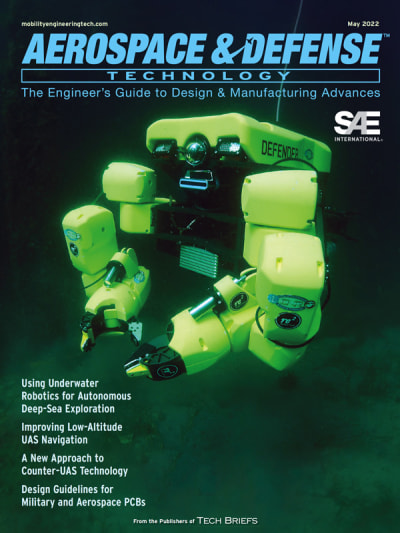
The May 2022 issue of Aerospace & Defense Technology presents a comprehensive overview of the latest advancements and technologies in the aerospace and defense sectors. This issue features a variety of articles that delve into critical topics such as unmanned aerial systems (UAS), counter-drone technology, underwater robotics, and design guidelines for military and aerospace printed circuit boards (PCBs).
Key Features
-
UAV Navigation Systems: The issue opens with an in-depth exploration of improving low-altitude UAS navigation. As the use of drones becomes more prevalent in both military and commercial applications, enhancing their navigation capabilities is crucial. The article discusses various technologies and methodologies being developed to ensure accurate and reliable navigation for UAVs operating at low altitudes, which is particularly challenging due to obstacles and varying terrain.
-
Counter-Drone Technology: Another significant feature is a discussion on counter-drone technology, highlighting a new approach to countering unmanned aerial systems. As drones pose increasing threats in various contexts, including military operations and security, the article examines innovative strategies and technologies being implemented to detect, track, and neutralize unauthorized drones. This includes advancements in radar systems, electronic warfare, and other countermeasures.
-
Undersea Robotics: The magazine also covers the use of underwater robotics for autonomous deep-sea exploration. This feature emphasizes the importance of robotic systems in conducting research and exploration in environments that are hazardous for human divers. The article discusses the advancements in computer vision, artificial intelligence, and manipulation systems that enable these robots to perform complex tasks with precision and dexterity, thereby expanding our understanding of underwater ecosystems.
Robotic Aircraft Maintenance: A fascinating article details the use of laser-equipped robots for removing aircraft paint. This innovative approach not only enhances the efficiency of aircraft maintenance but also improves safety by reducing the need for human workers to perform potentially hazardous tasks. The article outlines the technology behind these robots and their impact on maintenance operations in the aerospace industry.
-
PCB Design Guidelines: The issue includes a section on design guidelines for military and aerospace PCBs, which are critical components in the functionality of various systems. The article provides insights into best practices for designing PCBs that meet the stringent requirements of military and aerospace applications, including considerations for durability, reliability, and performance under extreme conditions.
Tech Briefs
In addition to the feature articles, the magazine presents several tech briefs that highlight ongoing research and developments in the field:
- Unmanned Aerial Systems Electromagnetic Induction Sensor Development: This brief discusses advancements in sensor technology that enhance the capabilities of UAS.
- Evaluation of Future Unmanned Underwater Vehicle Capabilities: This brief explores the potential of unmanned underwater vehicles in automated wargames, emphasizing their strategic importance.
- Hardening UAS Against High-Power Microwave Threats: This article addresses the need for UAS to be resilient against emerging threats, particularly high-power microwave attacks.
- Experimental Assessment of Entanglement for Unmanned Underwater Vehicles: This brief examines the challenges faced by underwater vehicles in avoiding entanglement with underwater obstacles.
- Foreign Counter-Unmanned Aerial Systems: This article provides insights into the international arms market's developments concerning counter-UAS technologies.
Departments and Additional Content
The magazine also features application briefs that provide real-world examples of how these technologies are being implemented. Additionally, a section on new products showcases the latest innovations and tools available in the aerospace and defense sectors, offering readers a glimpse into the future of technology in these fields.
Conclusion
Overall, the May 2022 issue of Aerospace & Defense Technology serves as a valuable resource for professionals and enthusiasts in the aerospace and defense industries. It highlights the ongoing innovations and challenges faced in these sectors, providing insights into how technology is evolving to meet the demands of modern warfare, exploration, and safety. With a focus on robotics, UAS, and advanced materials, this issue underscores the critical role of technology in shaping the future of aerospace and defense.
Features
-
Application Briefs
34 Communications Infrastructure UAVs
36 Drone-Mounted Search and Rescue Technology
38 Underwater Acoustic Communication System
38 Expendable Jet Engine Oil Tank
-
Articles
4 Improving Low-Altitude UAS Navigation
10 A New Approach to Counter-UAS Technology
14 Using Underwater Robotics for Autonomous Deep-Sea Exploration
Tech Briefs
-
Aerospace
32 Foreign Counter-Unmanned Aerial Systems: Developments in the International Arms Markets
-
Unmanned Vehicles & Robotics
27 Unmanned Aerial Systems Electromagnetic Induction Sensor Development
28 Evaluation of Future Unmanned Underwater Vehicle Capabilities in an Automated Computer-Aided Wargame
Products
-
45 New Products
Top Stories
NewsRF & Microwave Electronics
 Microvision Aquires Luminar, Plans Relationship Restoration, Multi-industry Push
INSIDERAerospace
 A Next Generation Helmet System for Navy Pilots
INSIDERDesign
 New Raytheon and Lockheed Martin Agreements Expand Missile Defense Production
INSIDERMaterials
 How Airbus is Using w-DED to 3D Print Larger Titanium Airplane Parts
NewsPower
 Ford Announces 48-Volt Architecture for Future Electric Truck
ArticlesAR/AI

Webcasts
Electronics & Computers
 Cooling a New Generation of Aerospace and Defense Embedded...
Automotive
 Battery Abuse Testing: Pushing to Failure
Power
 A FREE Two-Day Event Dedicated to Connected Mobility
Unmanned Systems
 Quiet, Please: NVH Improvement Opportunities in the Early Design Cycle
Automotive
 Advantages of Smart Power Distribution Unit Design for Automotive &...
Energy
 Sesame Solar's Nanogrid Tech Promises Major Gains in Drone Endurance