




Unmanned Aerial Systems Electromagnetic Induction Sensor Development
Developing drone-mounted electromagnetic induction (EMI) sensors capable of detecting and characterizing unexploded ordinance and improvised explosive devices will provide a distinct improvement in the ability of ground troops to quickly and efficiently recover from an attack.

The U. S. Army Engineer Research and Development Center (ERDC) is the lead Army research and development organization for force protection, military engineering, and geospatial research engineering. The ERDC is expanding its efforts in support of new Department of Defense (DoD) protection requirements and capability gaps for troops in high-threat environments. The present work is critical to meet protection requirements and capability gaps for current research and development programs and for the planning and scheduling for future science and technology efforts within the U.S. DoD.
The Cold Regions Research and Engineering Laboratory (ERDC-CRREL) and the Geotechnical Structures Laboratory (ERDC-GSL) are supporting the U.S. Air Force Civil Engineer Center through research and development of an unmanned aerial vehicle–mounted electromagnetic induction (EMI) device capable of localizing embedded unexploded ordinance (UXO) for expedited runway and military range remediation. There are presently no standoff (no ground contact) UXO detection capabilities available to soldiers. Developing and delivering such a capability will provide a distinct improvement in their ability to quickly and efficiently recover from an attack.
EMI is a noninvasive, standoff geophysical technique that can be used to localize and determine orientation of UXO and underground cavities caused by fragmented munitions detonation. EMI devices have long been used for mapping UXO and detecting improvised explosive devices (IED). Additionally, they have been flown on helicopter-based airborne systems for large-scale mineral exploration and groundwater applications. Yet, until recently, they have not been evaluated for use on unmanned aerial systems (UASs) in a reconnaissance approach. While other geophysical techniques are gaining popularity for UAS sensor implementation, EMI for UASs has not yet been successfully implemented. With that in mind, there are some academic institutions and research groups working on the problem.
Potential applications for a UAS-based EMI system are widespread from civil infrastructure, such as permafrost mapping, levee and dam assessment, slope stability assessment, and landfill characterization, to military mobility operations, including UXO and IED detection, runway remediation, and ground surface structural competency evaluations.
The initial development phases of this UAS-based EMI system require an understanding of the electromagnetic fields emitted by the UAS platform itself to optimize the performance of the system. Here we measure the fields emitted by two different UAS motor configurations at varying standoff distances from 0 to 53 cm. For this initial phase of the investigation, shielding variables are not introduced. The results from the investigation determine the minimum distance needed for the sensor to operate without negative influence from the electrical noise of the UAS motor.
The U.S. military has a need to remotely characterize in situ UXO associated with runway bombardment. While EMI sensors exist for UXO detection, there are currently no UAS-based EMI systems that can provide this remote characterization of UXO with a near-real-time target classification. The EMI sensors currently available for detection and classification of metallic UXO and IEDs are bulky and cumbersome, making it difficult to implement on a remotely controlled UAS acquisition system. ERDC-CRREL and ERDC-GSL, in conjunction with Dartmouth College, has developed or aided in the development of multiple EMI devices for detection of UXO and IEDs, including GEM-3D, MPV, MPV-II, Pedemis, and High-Frequency EMI (HFEMI) for nonmetallic UXO.
This work was done by Benjamin Barrowes, Dan R. Glaser, Brian G. Quinn, Mikheil Prishvin, and Fridon Shubitidze for the Army Engineer Research and Development Center. For more information, download the Technical Support Package (free white paper) below. ERDC-0012
This Brief includes a Technical Support Package (TSP).
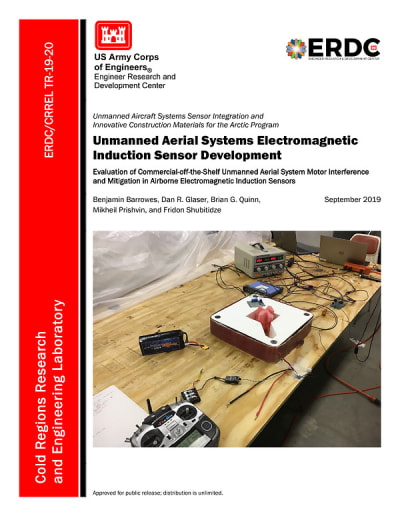
Unmanned Aerial Systems Electromagnetic Induction Sensor Development
(reference ERDC-0012) is currently available for download from the TSP library.
Don't have an account?
More From SAE Media Group
Aerospace & Defense Tech Briefs
Determining Detection and Classification Potential of Munitions Using Advanced EMI Sensors in the Underwater Environment
Tech Briefs
Army Research Laboratory
Tech Briefs
Facility Focus: Battelle Memorial Institute
Aerospace & Defense Tech Briefs
Optimal UAS Assignments and Trajectories for Persistent Surveillance and Data Collection from a Wireless Sensor Network
Tech Briefs
System Helps Drones Detect and Avoid Power Lines
Aerospace & Defense Tech Briefs
Designing Rugged Computing Platforms for UGVs
Aerospace & Defense Tech Briefs
Drone Swarms: A Transformational Technology
Aerospace & Defense Tech Briefs
Connectors Lighten the SWaP Burden in UAV/MUMT Aircraft Electronics
Tech Briefs
Insect-Sized Agile Drones
Aerospace & Defense Tech Briefs
Autonomous Collaborative Platform
Aerospace & Defense Tech Briefs
Directed-Energy System to Defeat Small Unmanned Aircraft System Swarms
Aerospace & Defense Tech Briefs
Power-Line UAV Modeling and Simulation
Tech Briefs
Drones Use Machine Learning to Detect Landmines
Aerospace & Defense Tech Briefs
Implementing Secure Command and Control in Unmanned Systems
Aerospace & Defense Tech Briefs
Powering Better Battlefield Drones
Aerospace & Defense Tech Briefs
Remotely Piloted Air Systems
Aerospace & Defense Tech Briefs
Using SWaP-C Reductions to Improve UAS/UGV Mission Capabilities
Aerospace & Defense Tech Briefs
ONR Short Pulse Research, Evaluation and non-SWaP Demonstration for C-sUAV Study

Aerospace & Defense Tech Briefs
UPS Devices Keep UAVs in the Air
Aerospace & Defense Tech Briefs
Counter-UAS Technology
Aerospace INSIDER
F-22 Pilot Controls Drone With Tablet
Aerospace & Defense Tech Briefs
Sonobuoy Dispensing & Remote Processing System
Aerospace & Defense Tech Briefs
A New Approach to Counter-UAS Technology
Aerospace & Defense Tech Briefs
Multispectral Airborne Reconnaissance System
Aerospace & Defense Tech Briefs
Playing Defense — Uncertain Regulations Stall the Implementation of Counter-UAS Technology in The U.S.
Aerospace & Defense Tech Briefs
Automatic Drone Detection System
Aerospace & Defense Tech Briefs
New Diamond Super-Material Enhances Aircraft Survivability

Aerospace & Defense Tech Briefs
Deceiving the Enemy: These Are the Drones You Are Looking For
Overview
The document titled "Unmanned Aerial Systems Electromagnetic Induction Sensor Development: Evaluation of Commercial-off-the-Shelf Unmanned Aerial System Motor Interference and Mitigation in Airborne Electromagnetic Induction Sensors" presents research conducted by the U.S. Army Cold Regions Research and Engineering Laboratory (CRREL) to develop unmanned aerial systems (UAS) equipped with electromagnetic induction (EMI) sensors. The primary objective of this research is to enhance the detection and localization of unexploded ordnance (UXO) to facilitate expedited remediation of military ranges and runways.
The study addresses the limitations of existing EMI sensors, which, while effective for UXO detection, lack the capability for remote characterization and near-real-time target classification when mounted on UAS. The research aims to fill this gap by developing a UAS-mounted EMI device that can efficiently identify embedded UXO, thereby improving operational safety and recovery efforts for military personnel.
The document outlines the methodology employed in the research, including the configuration of EMI sensors, the testing of various UAS motor setups, and the calibration of targets. The study involved measuring the electromagnetic fields emitted by different UAS motor configurations at varying distances, with a focus on determining the optimal platform-to-sensor standoff distance for effective operation. The findings indicate that a minimum standoff distance of 60 cm is necessary for the planned frequency ranges, which will inform the design of the sensor-carrying frame.
In addition to UXO detection, the research also explores the potential for using UAS to map permafrost extent, which is crucial for assessing the impacts of construction activities in cold regions. This capability would provide a cost-effective and efficient means of conducting environmental assessments.
The report concludes with a discussion of the results and implications for future work, emphasizing the importance of developing expeditionary solutions for both UXO detection and environmental monitoring. The research is supported by funding from the FY17 Do3F Congressional Add for “Unmanned Aircraft System Sensor Integration” and aims to significantly enhance the operational capabilities of military forces in challenging environments.
Overall, this document highlights the innovative integration of UAS technology with EMI sensors, representing a significant advancement in military engineering and environmental assessment methodologies.
Top Stories
NewsRF & Microwave Electronics
 Microvision Aquires Luminar, Plans Relationship Restoration, Multi-industry Push
INSIDERAerospace
 A Next Generation Helmet System for Navy Pilots
INSIDERDesign
 New Raytheon and Lockheed Martin Agreements Expand Missile Defense Production
INSIDERMaterials
 How Airbus is Using w-DED to 3D Print Larger Titanium Airplane Parts
NewsPower
 Ford Announces 48-Volt Architecture for Future Electric Truck
ArticlesAR/AI

Webcasts
Electronics & Computers
 Cooling a New Generation of Aerospace and Defense Embedded...
Automotive
 Battery Abuse Testing: Pushing to Failure
Power
 A FREE Two-Day Event Dedicated to Connected Mobility
Unmanned Systems
 Quiet, Please: NVH Improvement Opportunities in the Early Design Cycle
Automotive
 Advantages of Smart Power Distribution Unit Design for Automotive &...
Energy
 Sesame Solar's Nanogrid Tech Promises Major Gains in Drone Endurance