




F-22 Pilot Controls Drone With Tablet
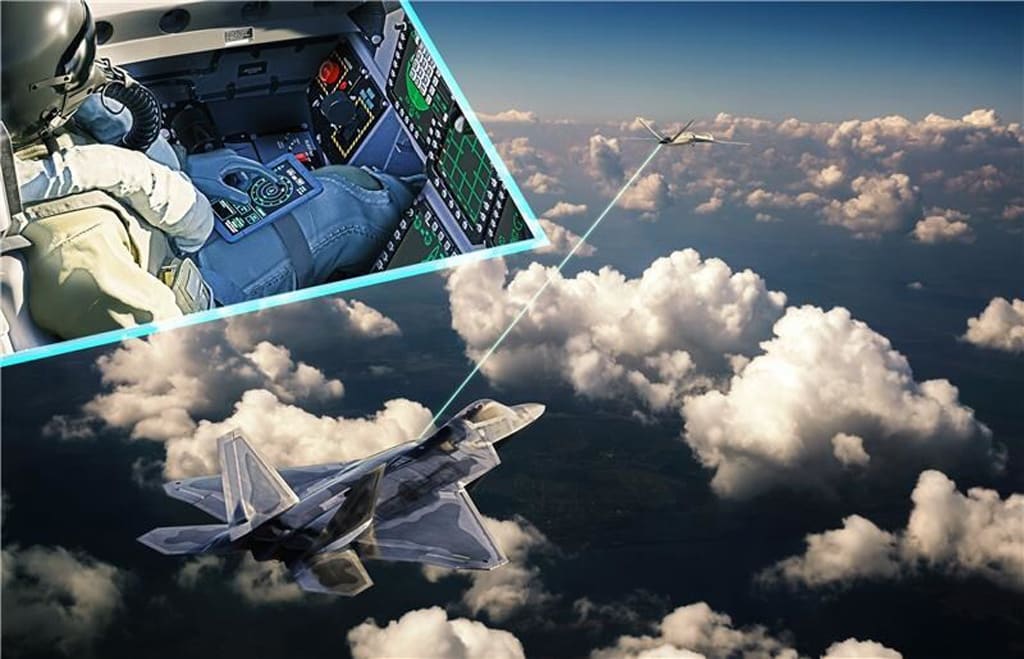
Lockheed Martin Skunk Works®, with industry partners and the U.S. Air Force, controlled an uncrewed aerial system (UAS) from the cockpit of a fifth generation fighter jet while in flight.
During the recent flight out of Nellis Air Force Base, Nevada, an F-22 Raptor pilot successfully used an open interface in the cockpit to send control directions to another airborne UAS.
"This effort represents Skunk Works driving a breakthrough in air combat capability, where single-seat aircraft command and control drones with simple and intuitive interfaces in the cockpit," said OJ Sanchez, vice president and general manager, Lockheed Martin Skunk Works.
The F-22 pilot used a pilot vehicle interface (PVI) to command the drone to execute a specific mission profile. The PVI represents a flexible system to provide integration-ready capabilities for both current and future platforms.
The flight occurred in collaboration with General Atomics Aeronautical Systems, Inc. (GA-ASI) and L3Harris Technologies. The effort integrated L3Harris’ BANSHEE™ Advanced Tactical Datalinks with its Pantera software-defined radios (SDRs) via Lockheed Martin’s open radio architectures, all integrated and shared from an F-22 Raptor.
Two L3Harris Software‑Defined Radios (SDRs) supported the demonstration. The first SDR was installed into the General Atomics MQ‑20 Avenger, and the second was integrated in the Lockheed Martin F‑22 Raptor. Through the Pilot Vehicle Interface (PVI) tablet and the F‑22’s GRACE module, the system provided end‑to‑end communications, enabling the F‑22 command and control of the MQ‑20 in flight.
The collaborative demonstration showcased non-proprietary, U.S. government-owned communications capabilities and the ability to fly, transition, and re-fly flight hardware that is core to the Open Mission Systems and skills-based uncrewed autonomy ecosystem.
This event demonstrates human-machine teaming capabilities and the future of air combat, today. Lockheed Martin has been focused on the transformative power of autonomous and AI-enabled operations in crewed and uncrewed systems for years, with particular focus on integrating autonomous drones with the F-22 and F-35.
This flight event and other ongoing evaluations are crucial steps in realizing the Air Force's family of systems vision. Human-machine teaming enhances situational awareness, interoperability, survivability and flexibility, unlocking a significant advantage for the U.S. Air Force.
More From SAE Media Group
Aerospace INSIDER
L3Harris Starts Low Rate Production Of New F-16 Viper Shield
Aerospace INSIDER
Anduril Completes First Semi-Autonomous Flight of CCA Prototype
Aerospace INSIDER
The Future of Collaborative Combat Aircraft
Aerospace INSIDER
MQ-1C Completes First Air-Launched Effect Flight Demonstration
Aerospace INSIDER
European KC-135s Get Real Time Cockpit System Upgrades
Aerospace INSIDER
DARPA AI Algorithms Transition from Simulator to Flying Modified F-16
Aerospace Manufacturing and Machining INSIDER
A New AI-Piloted VTOL Fighter Jet for Contested Environments
Aerospace INSIDER
F-35 Completes First Flight with Technology Refresh 3 Upgrades
Aerospace INSIDER
Air Force Pilots Control XQ-58s from Fighter Jets
Aerospace & Defense Tech Briefs
High-Speed Data Cables for Fighter Aircraft
Aerospace & Defense Tech Briefs
BAE Systems Will Supply Flight Control and Target Identification Systems for Boeing’s Carrier-Based MQ-25

Defense INSIDER
AgilePod Flies on U.S. Air Force MQ-9 Reaper
Aerospace INSIDER
First F-15Es Equipped With EPAWSS Ready for Flight
Aerospace INSIDER
AFMC Completes First Ever Flight of F-35 with F-22 Software
Defense INSIDER
Sikorsky Converts Black Hawk into U-Hawk Autonomous Helicopter
Aerospace INSIDER
AI Algorithms Fly Uncrewed XQ-58A Valkyrie Drone for Three Hour Sortie
Aerospace & Defense Tech Briefs
Aitech Defense Will Provide Data Interface Technology for Boeing’s Unmanned MQ-25 Refueling Platform
Aerospace & Defense Tech Briefs
The Air Force’s New Unmanned Wingmate Completes Inaugural Flight
Aerospace & Defense Tech Briefs
Textron Systems, Textron Aviation Defense Demonstrate Simulated Manned-Unmanned Teaming Capability



Aerospace INSIDER
Eurofighter Typhoons to Receive Touchscreen Cockpit Display Upgrades
Aerospace & Defense Tech Briefs
UAV Ground Control Station
Aerospace & Defense Tech Briefs
Autonomous Collaborative Platform
Top Stories
INSIDERManufacturing & Prototyping
 How Airbus is Using w-DED to 3D Print Larger Titanium Airplane Parts
INSIDERManned Systems
 FAA to Replace Aging Network of Ground-Based Radars
NewsTransportation
 CES 2026: Bosch is Ready to Bring AI to Your (Likely ICE-powered) Vehicle
NewsSoftware
 Accelerating Down the Road to Autonomy
EditorialDesign
 DarkSky One Wants to Make the World a Darker Place
INSIDERMaterials
 Can This Self-Healing Composite Make Airplane and Spacecraft Components Last...
Webcasts
Defense
 How Sift's Unified Observability Platform Accelerates Drone Innovation
Automotive
 E/E Architecture Redefined: Building Smarter, Safer, and Scalable...
Power
 Hydrogen Engines Are Heating Up for Heavy Duty
Electronics & Computers
 Advantages of Smart Power Distribution Unit Design for Automotive...
Unmanned Systems
 Quiet, Please: NVH Improvement Opportunities in the Early Design...
