




ONR Short Pulse Research, Evaluation and non-SWaP Demonstration for C-sUAV Study
Research project is designed to map small unmanned aerial vehicle (sUAV) effects space, empirically and by simulation, as a function of high power microwave (HPM) waveform to develop effective countermeasures.
The OSPRES (ONR Short Pulse Research, Evaluation and non-SWaP) program performed fundamental work in the areas of Silicon (Si) and Gallium Nitride (GaN) based photoconductive switch development, measurement of HPM waveform dependent effects on small unmanned aerial vehicle (sUAV), adaptive design of experiments, noise injection, RF coupling to sUAV's, minimally dispersive wave theory, and positive feedback non-linear transmission line (NLTL) development.
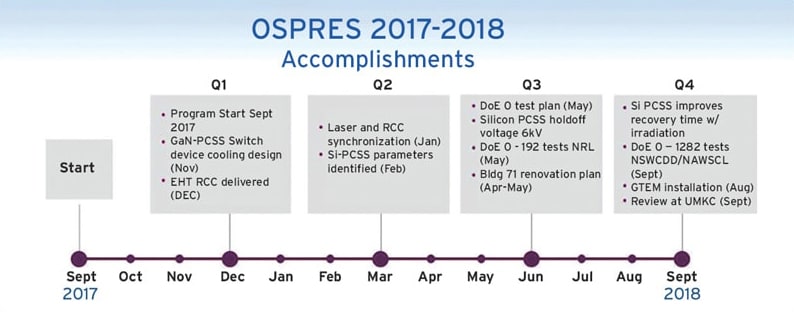
The photoconductive solid state switch (PCSS) subgroup worked to develop a fundamental understanding of the limitations of Silicon and Gallium Nitride based photoconductive switches and their application to pulsed power. With an estimated 2 megawatts (MW) peak power generation (benchtop equivalent), the Si-PCSS subgroup has succeeded in achieving one-third of the peak power required for an individual element in the envisioned phased array required to meet mission needs.
Si-PCSSs have been integrated with a rapid charge capacitor system and pulse forming transmission lines for pulse testing. Si-PCSS hold-off voltage has been pushed to >6 kV with 3 kV output pulse moving closer to the project goal of 10 kV hold-off. Currently, thermal mitigation issues are the primary issue plaguing the Si- PCSS group. Cooling system designs are changing weekly and progressively moving towards a goal of 500 W/cm2 cooling capacity.
The University of Missouri – Kansas City's (UMKC's) effects team has developed a custom UAV model for RF effects testing, written code for the automation of testing, and researched the areas of an adaptive design of experiments (DoE) and noise injection. The adaptive DoE was developed to refine/inform optimum source parameters that will result in known effects on sUAV's and further inform the requirements for a tunable HPM system with control over the policy desired levels-of-lethality. The effects team has also traveled to multiple test locations performing over 1300 effects tests with the custom UAV.
UMKC's GaN:C simulations/modeling subgroup has made progress in optimizing GaN:C for a high power, high repetition rate solid state switch. They have computed electronic structure properties of GaN:C including the optical and symmetric band structure of GaN:C, and obtained the software to perform GaN-PCSS device level calculations to model optical absorption, hold-off voltage, and thermal dissipation relevant to determining the optimum design of a GaN:C based PCSS.
The RF coupling subgroup used Characteristic Mode Analysis (CMA) to computationally quantify electromagnetic coupling and interference to UAV frames over the L-band and Sband and validated CMA coupling predictions using experimental measurements. The RF coupling group also reviewed the most common sUAV shapes, sizes, material compositions, and electronics commercially available and developed a table of occurrences and frequency in sUAVs.
The Positive Feedback NLTL group has developed a positive feedback power amplifier coupled with a nonlinear transmission line generating ones-of-kW power RF pulses in a closed-loop network coupled with a 9-section 1200 V rated Schottky diode NLTL. Several closed-loop experiments at low voltage level within a frequency range of 5 to 70-MHz have been performed and continuous RF signal outputs with positive gain at different stages of the NLTL have been performed.
Preliminary results of the Focused Wave Mode (FWM) group suggest that EM pulses with smaller rise times can effectively launch electromagnetic waves whose time-average power density shows minimal spatial decay contrary to the standard 1/r2 decay of EM waves. The group designed and simulated low-profile, ultra-wideband micro-strip patch antennas to demonstrate the potential of launching low dispersion EM waves with results demonstrating the feasibility of short EM pulses for c-sUAV ranges relevant to the project.
This work was done by E.R. Myers, T. Fields, J.A. Crow, D. Chatterjee, P. Rulis, P. Doynov, A. Hassan, J. Lancaster, F. Khan, J. Verzella, J. Beaudin, L. Moler and A.N. Caruso of the University of Missouri – Kansas City for the Naval Research Laboratory.
This Brief includes a Technical Support Package (TSP).
ONR Short Pulse Research, Evaluation and non-SWaP Demonstration for C-sUAV Study
(reference NRL-0075) is currently available for download from the TSP library.
Don't have an account?
More From SAE Media Group
Aerospace & Defense Tech Briefs
Ka-Band Front-End Monolithic Microwave Integrated Circuits (MMICs) and Transmit/Receive (T/R) Modules Testing
Aerospace & Defense Tech Briefs
90° Hybrid Coupled Power Amplifier – Pros and Cons
Aerospace & Defense Tech Briefs
Electronic Warfare Technology
Aerospace & Defense Tech Briefs
Compact Power Amplifier Solution for Electronic Warfare
Aerospace & Defense Tech Briefs
From DC to Daylight — How Innovations in Microwave Absorbers Shield the Warfighter
Aerospace & Defense Tech Briefs
Development of a 94 GHz Radar System for Dedicated Bird Detection at Airports and Airfields
Tech Briefs
Facility Focus: Georgia Tech Research Institute
Tech Briefs
Coherent Optical Transistor
Aerospace & Defense Tech Briefs
Using SWaP-C Reductions to Improve UAS/UGV Mission Capabilities
Aerospace & Defense Tech Briefs
Hardening Unmanned Aerial Systems Against High-Power Microwave Threats in Support of Forward Operations
Tech Briefs
Conformal, Lightweight, Aerogel-Based Antenna
Off-Highway Engineering
Addressing Electromagnetic Compatibility in the Context of Aircraft Electrification
Aerospace & Defense Tech Briefs
Avoiding EMI
Aerospace & Defense Tech Briefs
Anti-Drone Jammer
Tech Briefs
Low-Inductance DC Power Bus

Aerospace & Defense Tech Briefs
Ghoul Tool: The Weapon-Mountable Counter UAS Transmitter
Aerospace & Defense Tech Briefs
Design and Analysis of a Small Unmanned Aerial System (UAS) Power Distribution System
Aerospace & Defense Tech Briefs
Directed-Energy System to Defeat Small Unmanned Aircraft System Swarms
Aerospace & Defense Tech Briefs
Curled RF MEMS Switches For On-Chip Design
Tech Briefs
Test Strategies to Track Hypersonic Threats
Aerospace & Defense Tech Briefs
RF FPGAs for Multi-Function Systems
Aerospace & Defense Tech Briefs
Solid-State Microwave Power Module

Aerospace & Defense Tech Briefs
Scaling LiDAR Optical Payloads from Drones to Miniature UAVs
Aerospace & Defense Tech Briefs
Broadband 1.2- and 2.4-mm Gallium Nitride (GaN) Power Amplifier Designs
Aerospace & Defense Tech Briefs
Designing VME Power Systems With Standard Modules
Aerospace & Defense Tech Briefs
Microwave Photonic Notch Filter
Automotive Engineering
EV Energy-Management Powers-Up
Overview
The document is the Annual Technical Report for the ONR Short Pulse Research, Evaluation, and non-SWaP Demonstration for the C-sUAV Study, conducted by the University of Missouri – Kansas City (UMKC) and dated November 30, 2018. It outlines the progress and findings from the research conducted between September 2017 and September 2018, focusing on the development and testing of small unmanned aerial vehicles (sUAV) and high-power microwave (HPM) technologies.
The primary objective of the OSPRES program is to empirically and through simulation map the effects of various HPM waveforms on sUAVs. This includes analyzing parameters such as power density, frequency, bandwidth, pulse repetition frequency, angle of incidence, polarization, pulse shape, and pulse width. The goal is to identify waveform configurations that can effectively control the lethality levels on sUAVs while minimizing power density, thereby facilitating the development of transitionable HPM sources and electronically steerable radiators.
The report details significant advancements in UAV hardware and software, including the creation of a platform capable of real-time sensor data collection and the integration of this system with a custom HPM source automation platform. Over the year, nearly 1400 HPM tests were conducted across four facilities, contributing to a comprehensive understanding of the interactions between HPM systems and UAVs.
Key areas of research highlighted in the report include the development of photoconductive solid-state switches (PCSS), focusing on optimizing hold-off voltage, on-state resistance, and recovery time. The report emphasizes the importance of understanding the underlying physics of these metrics to enhance device performance.
Additionally, the document discusses the design and simulation of low-profile, ultra-wideband micro-strip patch antennas aimed at launching minimally dispersive electromagnetic pulses, which are crucial for effective communication and control in hostile environments. The feasibility of using short electromagnetic pulses for disabling hostile mobile units is also explored.
Overall, the report serves as a comprehensive summary of the ongoing research efforts, experimental designs, and future plans related to sUAV and HPM technologies, providing valuable insights into the potential applications and advancements in this field.
Top Stories
NewsRF & Microwave Electronics
 Microvision Aquires Luminar, Plans Relationship Restoration, Multi-industry Push
INSIDERAerospace
 A Next Generation Helmet System for Navy Pilots
INSIDERDesign
 New Raytheon and Lockheed Martin Agreements Expand Missile Defense Production
INSIDERMaterials
 How Airbus is Using w-DED to 3D Print Larger Titanium Airplane Parts
NewsPower
 Ford Announces 48-Volt Architecture for Future Electric Truck
ArticlesAR/AI

Webcasts
Electronics & Computers
 Cooling a New Generation of Aerospace and Defense Embedded...
Automotive
 Battery Abuse Testing: Pushing to Failure
Power
 A FREE Two-Day Event Dedicated to Connected Mobility
Unmanned Systems
 Quiet, Please: NVH Improvement Opportunities in the Early Design Cycle
Automotive
 Advantages of Smart Power Distribution Unit Design for Automotive &...
Energy
 Sesame Solar's Nanogrid Tech Promises Major Gains in Drone Endurance