




Design and Analysis of a Small Unmanned Aerial System (UAS) Power Distribution System
All electrically powered autonomous vehicles possess a system that distributes power to all the vital components of the vehicle. The U.S. Army Combat Capabilities Development Command (DEVCOM) Army Research Laboratory (ARL) uses group 1 unmanned aerial systems (UASs) (weighing 20 lb) as the vehicle platform in several projects.
All electrically powered autonomous vehicles possess a system that distributes power to all the vital components of the vehicle. At the U.S. Army Combat Capabilities Development Command (DEVCOM) Army Research Laboratory (ARL), several projects are using unmanned aerial systems (UASs) as a vehicle platform. Some UAS being used are classified as group 1, meaning they weigh under 20 lb. The group 1 UASs that ARL conducts research with are very fast and agile quadrotors. Such quadrotors typically have four rotors and light payloads and can very quickly accelerate and effortlessly reach speeds over 100 kph. To do this, these quadrotors can draw upward of 400 A at 30 VDC in bursts. To meet those requirements, the motor/ propeller combination requires large amounts of power relative to the size of the UAS. Up until this point, ARL’s UASs have been using commercial off-the-shelf power distribution boards (PDBs) to meet the power distribution demands. A custom PDB would satisfy the DOD’s desire to source more UAS components domestically, as it would be designed and made in the U.S., which is unique for this type of UAS component.
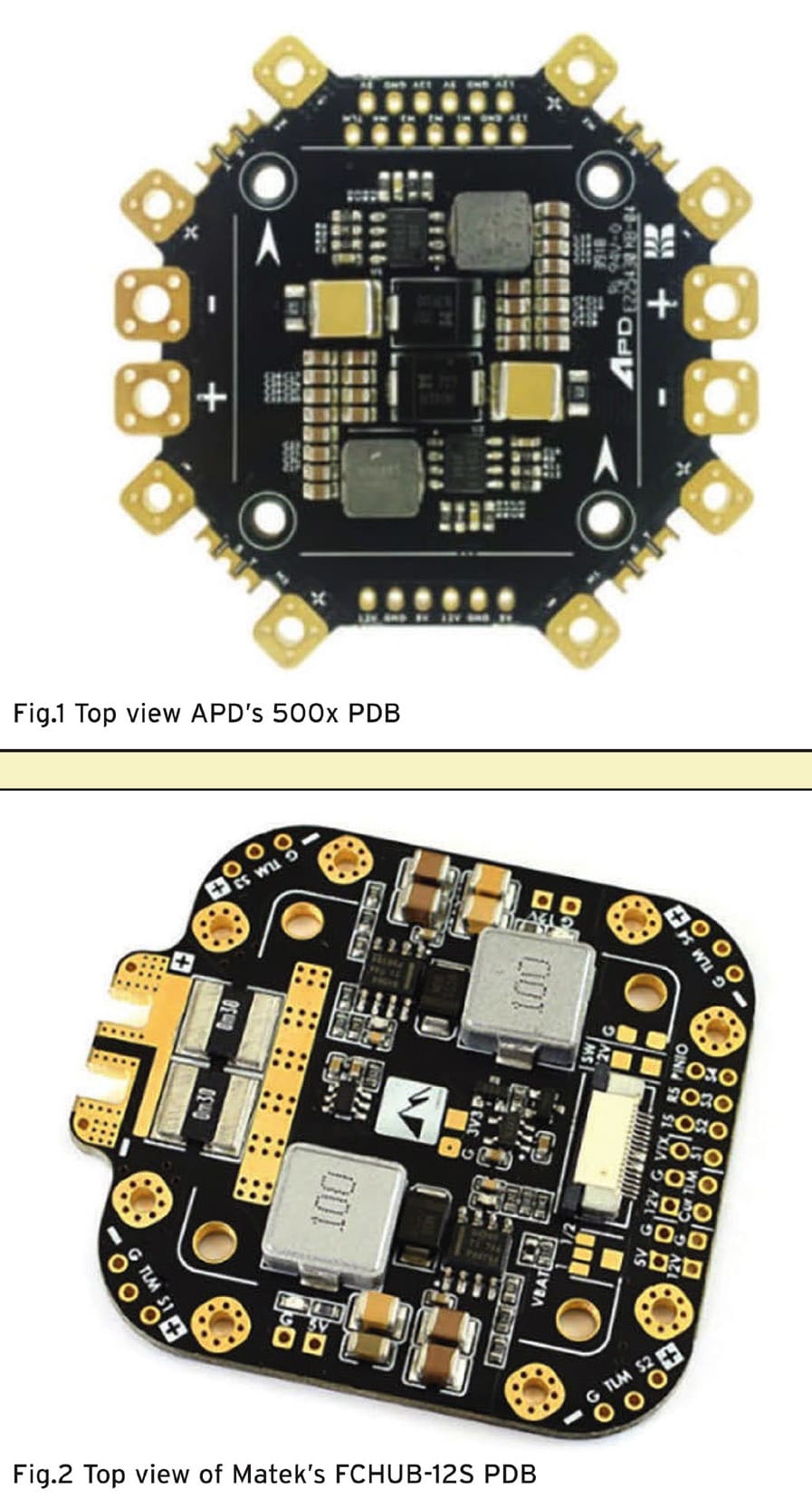
This report considers all aspects of design of a PDB to include shape, size, components, cost, voltage regulators, peripherals, and so on. This report explores these issues in the context of a custom designed PDB needed for a specific ARL project, but can be used as a starting point for ARL engineers who are working on semiautonomous and fully autonomous vehicle projects. For the custom PDB to succeed, the board needs to perform just as well, if not better, than the current PDBs used on the UAS. The two PDBs this project currently uses are the following: Advanced Power Drives’ (APD’s) 500X (Fig. 1) and Matek Systems’ FCHUB-12S PDB (Fig. 2).
The manufacturer-claimed specifications of the APD 500X are the following:
4S–12S battery input
500-A continuous current
1000-A burst current
The manufacturer-claimed specifications of the Matek FCHUB-12S are the following:
3S–12S battery input
280-A continuous current
440-A burst current
Both designs use the standard M3 × 0.5 mm with 30.5- × 30.5-mm mounting holes,and they both have the ability to provide ESC telemetry, battery voltage readings,current readings, and 5-V and 12-V outputs.
To be a suitable replacement for either of these PDBs, the custom PDB must beable to do the following:
Accept up to 6S batteries.
Handle continuous current draw of over 500 A.
Handle burst current draws over 1000 A.
Provide ESC telemetry.
Provide voltage and current readings from the PDB.
The program used to design and create the custom PDB is a free PCB/schematic application called KiCad. The main competitors to KiCad are Eagle and Altium. The reasons for using KiCad over the other two applications was because KiCad is compatible with the Windows, OSX, and Linux operating systems. Thus, projects can easily be transferred between workstations with little difficulty. The other reason is because KiCad is supported by popular electronics vendors, such as DigiKey and Mouser, which offer free KiCad models for components that one might plan to use in a design.
This work was performed by Darren R Webb for the Army Research Laboratory. For more information, download the Technical Support Package (free white paper) at mobilityengineeringtech.com/tsp under the Power category. ARL-9606.
This Brief includes a Technical Support Package (TSP).
Design and Analysis of a Small Unmanned Aerial System (UAS) Power Distribution System
(reference ARL-9606) is currently available for download from the TSP library.
Don't have an account?
More From SAE Media Group
Aerospace & Defense Tech Briefs
Hybrid-Powered Unmanned Helicopter

Aerospace & Defense Tech Briefs
Boeing, SparkCognition Partner on Safe Integration of Autonomous Air Vehicles in Airspace
Tech Briefs
Anti-Phase Noise Suppression Rotor Technologies
Automotive Engineering
Beyond the EV Technology Horizon: Now It’s All About Speed
Aerospace & Defense Tech Briefs
Simultaneous Vibration Suppression and Energy Harvesting for a Multifunctional UAV Spar
Battery & Electrification Technology
The Road to Net-Zero EV Development Labs
Battery & Electrification Technology
Extending Battery Life of Small Drones
Aerospace & Defense Tech Briefs
How High-Reliability Capacitors Support Electrical Power in Military Vehicles
Aerospace & Defense Tech Briefs
DC to DC Power Distribution in MilAero Applications
Automotive Engineering
WCX 2025: Vicor’s New Power Modules Arrive with 48V
Tech Briefs
Approach Makes Unmanned Agents Self-Sufficient
Automotive Engineering
Powering the IoT Without Batteries Using Energy Harvesting
Aerospace & Defense Tech Briefs
Drone Charging System
Aerospace & Defense Tech Briefs
Simultaneous Vibration Suppression and Energy Harvesting
Aerospace & Defense Tech Briefs
Ghoul Tool: The Weapon-Mountable Counter UAS Transmitter
Aerospace & Defense Tech Briefs
ONR Short Pulse Research, Evaluation and non-SWaP Demonstration for C-sUAV Study
Aerospace & Defense Tech Briefs
AUVSI XPONENTIAL
Automotive Engineering
Brunswick Launches All-Electric Marine Outboard
Tech Briefs
Drones Change Shape Mid-Flight
Off-Highway Engineering
Addressing Electromagnetic Compatibility in the Context of Aircraft Electrification
Automotive Engineering
Innovative ‘Afreecar’ Wins SAE’s 2021 Create the Future Design Award

Aerospace & Defense Tech Briefs
Air Racing Is Going Electric
ADAS & Autonomous Vehicle Engineering
Kodiak Targets Class 8 Electric Truck for Autonomous System
Aerospace & Defense Tech Briefs
UAV Applications Challenge the Limits of Embedded Computing Technologies
Aerospace & Defense Tech Briefs
Solar Powering UAVs
Off-Highway Engineering
Deere Pursues Electric Construction Machines and Charging Infrastructure
Aerospace & Defense Tech Briefs
Microturbine Propulsion for UAVs
Overview
The document titled "Design and Analysis of a Small Unmanned Aerial System (UAS) Power Distribution System," authored by Darren R. Webb and published in October 2022, presents a detailed exploration of power distribution systems for small unmanned aerial systems (UAS), specifically focusing on group 1 UASs that weigh around 20 pounds. These UASs are characterized by their agility and speed, capable of exceeding 100 kph and requiring significant power—up to 400 A at 30 VDC in bursts—to operate effectively.
The report outlines the necessity for a custom power distribution board (PDB) to meet the unique power demands of these UASs, as existing commercial off-the-shelf solutions may not adequately address the specific requirements of military applications. The development of a custom PDB aligns with the Department of Defense's (DOD) initiative to source more components domestically, ensuring that the design and manufacturing processes are conducted within the United States.
The document is structured into several key sections, beginning with an introduction that sets the context for the research. It then details the requirements for the PDB, followed by an in-depth discussion of the design and theoretical underpinnings of the proposed system. The report also includes a cost analysis, test setups, and results that validate the design's effectiveness. Future work is suggested to enhance the PDB's capabilities and address any limitations identified during testing.
The findings of this report are significant for engineers and researchers involved in the development of semiautonomous and fully autonomous vehicle projects, providing a foundational resource for designing efficient power distribution systems. The report emphasizes the importance of tailored solutions in the rapidly evolving field of unmanned aerial systems, where performance and reliability are critical.
Overall, this technical report serves as a comprehensive guide for the design and analysis of power distribution systems in small UAS, contributing to advancements in energy management and operational efficiency in military and civilian applications. The document is unclassified and approved for public release, making it accessible for further research and development in the field.
Top Stories
INSIDERManufacturing & Prototyping
 How Airbus is Using w-DED to 3D Print Larger Titanium Airplane Parts
INSIDERManned Systems
 FAA to Replace Aging Network of Ground-Based Radars
NewsTransportation
 CES 2026: Bosch is Ready to Bring AI to Your (Likely ICE-powered) Vehicle
NewsSoftware
 Accelerating Down the Road to Autonomy
EditorialDesign
 DarkSky One Wants to Make the World a Darker Place
INSIDERMaterials
 Can This Self-Healing Composite Make Airplane and Spacecraft Components Last...
Webcasts
Defense
 How Sift's Unified Observability Platform Accelerates Drone Innovation
Automotive
 E/E Architecture Redefined: Building Smarter, Safer, and Scalable...
Power
 Hydrogen Engines Are Heating Up for Heavy Duty
Electronics & Computers
 Advantages of Smart Power Distribution Unit Design for Automotive...
Unmanned Systems
 Quiet, Please: NVH Improvement Opportunities in the Early Design...
