




UAV Applications Challenge the Limits of Embedded Computing Technologies
Unmanned Vehicles (UAV/UAS) have proven to be vital, strategic new weapons in the military’s arsenal by providing needed critical intelligence, surveillance and reconnaissance (ISR) capabilities as well as the ability to strike enemy forces. The complexity and diversity of UAV applications and their underlying computing systems present some of the most difficult design challenges for developers. Military designers have to contend with a long and multifaceted list of requirements that challenge the limits of embedded computing technologies. For instance, UAV systems need the highest performance computing for sensor, data collection/distribution and image processing that must fit within strict size, weight and power (SWaP) constraints. Plus, these systems must also be highly ruggedized to survive and perform reliably in the most demanding and harsh operational environments.
Meeting Complex Design Requirements
 Every UAV airframe has a defined set of requirements that is specific to each type’s unique operational objectives. There is, however, a group of key requirements for embedded computing platforms that is shared by all to ensure the successful deployment of UAV system programs.
Standards-Based Interoperability
The mandate for interoperability and connectivity demands that military OEMs design around a common set of airframes based on standard interfaces and interoperable ‘plug and play’ payloads as opposed to developing multiple systems dedicated to separate tasks. This calls for increased computing and communications capabilities and greater real-time operational control. Designers must also consider that UAV systems are becoming more complex and now must support ground stations and other systems besides the actual aircraft, so embedded platforms must be able to support multiple tasks. As an example, many UAV programs must include multiple functions and sensors in its payload such as vision and radar systems along with heat, biological, electromagnetic and chemical sensors.
In addition, the military has initiated new UAV programs that feature onboard intelligence able to make real-time adjustments to mission parameters for truly autonomous flight. This highlights how UAVs have become more sophisticated, and calls into service the latest advancements in embedded computing to deliver the increased levels of connectivity in highly interoperable standards-based platforms. Accom plishing this convergence of capabilities enables UAV missions to be tightly integrated with other land-sea-air assets as well as unmanned ground vehicles, and is one of the most innovative developments in this new era of integrated battlefield applications.
Military system designers are continually turning to proven, standards-based platforms such as VPX, MicroTCA and Computer-on-Modules (COMs) to reach interoperability program objectives. However, each must also be weighed for its ability to meet SWaP and thermal management requirements of the airframe and its mission.
Imaging and Sensor Data Support
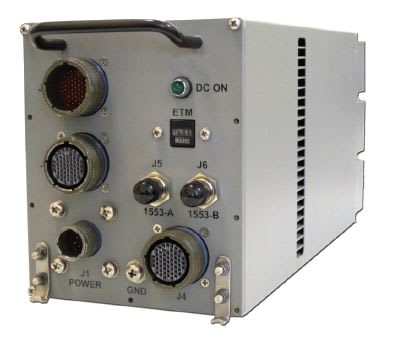
High Reliability/Availability in Harsh Environments
Continuous, reliable operation of all system elements within the specified environment is critical to success over the life of any UAV application. Therefore, it is important that the selected embedded computing solution be placed into a chassis or enclosure that is manufactured to meet the requirements of MIL-STD-810 for environmental, shock and vibration. Enclosures that meet these standards assure that the system, along with the electronics and computing components, will be able to withstand extreme temperature, vibration, shock, salt spray, sand and chemical exposure in a sealed and temperature- controlled chassis.
It is wise for designers to select the thermal management and mounting solution at the outset. It is the ability to leverage pre-qualified COTS platforms that can also be optimized or tailored to suit the unique thermal equation needs of each UAV airframe or program that makes for a solid foundation at the start of a design.
Finding the Right Solution
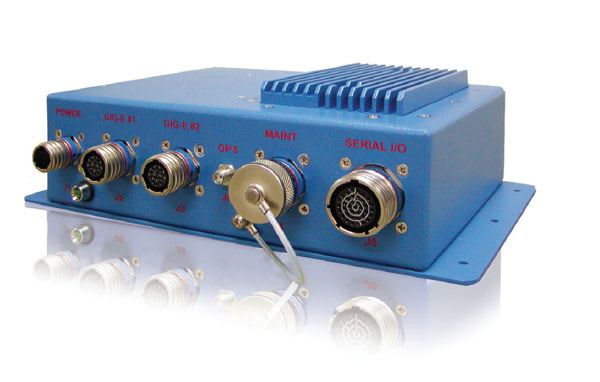
VPX – High-Speed Signal Processing
The range of UAV payloads, regardless of the size or mission objective of the airframe, can call for a combination of communications, environmental sensors, high-resolution radar, streaming video imaging systems, and weaponry. Situational intelligence is paramount, so the ability to download compressed, live video or other information to mobile or portable ground equipment is a primary design goal. VPX has become an ideal platform for this type of data-intensive system that demands image compression and bandwidth as well as highfrequency processing in a highly reliable fabric solution.
VPX enables higher-performance processing per slot but also higher-speed interconnects between processing and I/O elements using PCIe, 10GbE or sRIO. These interconnects provide up to 10 Gb/s performance, and VPX systems can achieve greater than 5 Gb/s using a number of different serial fabric technologies. An example of how VPX is ideal for video streaming applications is that it can be integrated with ITU-T H.263, H.264 (MPEG-4 part 10) and JPEG2000 CODECs to provide very efficient image compression. The H.264 CODEC is particularly optimized for streaming and offers the capability to trade-off image quality or compression as the available bandwidth changes. This flexibility makes using VPX with this CODEC well-suited for UAV video payloads that must support a number of data link options and operational scenarios.
MicroTCA – Rugged, High-Bandwidth Requirements

The ability to re-use and harden the popular AMC small form factor to create a rugged MicroTCA system gives designers access to a cost-effective solution with multiple applications on the same platform. By accommodating a high number of multicore AMCs and allowing a tight coupling of processors over high-speed backplane communication links, this type of MicroTCA implementation is well suited for radar and real-time image processing, or voice, data and video applications in single-channel or dual-channel architectures. High light ing its bandwidth capabilities, MicroTCA offers the ability to leverage as many as 21 high-speed serial connections on the backplane, each delivering bandwidth of 3.125 Gb/s. Depending on the airframe or its ground control system, an extensive range of MicroTCA-based communications bandwidth capacities is available ranging from 40 Gb/s to >1Tb/s. If the data processing performance environment is approaching the demands of 10 Gigabit Ethernet, MicroTCA may be an optimal choice.
Computer-on-Modules – SwaP for Constrained Spaces
The small classes of UAV airframes have diverse requirements for payloads and capabilities that can deliver life-saving situational awareness. COM Express Computer-on-Modules (COMs) are excellent solutions due to their small form factor and customizable I/O options. As a widely available, standardsbased solution, COM Express COMs are very cost-effective building blocks that are excellent solutions for the evolving mobile MIL sub-segment.
Further, the Type 6 COM Express® pin-out enables a performance jump from earlier pin-out options and supports the latest graphics architectures needed for advanced video used in surveillance for situational awareness. The addition of native support for the newest display interfaces simplifies carrier board design, and its extensive PCI Express support helps designers migrate from legacy parallel interfaces toward pure serial embedded system designs for higher bandwidth and reduced latency. COM Express COMs enable space-constrained UAV designs to have increased compute, data flow and imaging performance from new integrated chipset and advanced display interfaces that are needed for surveillance UAV upgrade programs.
System-Level Solutions
The availability of pre-validated, multi-mission, rugged computer systems enables the rapid deployment of UAV applications. For example, Kontron’s ApexVX offers a complete OpenVPX-based system-level solution that employs smart software to facilitate the integration of all components required for the early evaluation phase up to long-term deployment. The prequalified Kontron ApexVX provides a proven basis for OEMs who need to develop reliable solutions within strict time and budget limitations.
Successful Deployment
Some problems and delays typically arise when working to configure the software solution for UAV configurations. Kontron has solved this problem by offering a proven suite of software solutions that include its VXFabric™, VXControl™ and PBIT. Kontron VXFabric™ offers hardware-assisted TCP/IP on PCIe for data flow applications to implement efficient inter-board communication at ultra-high speed. VXControl™ uses the onboard controllers interfaced through the standard System Management Bus (SMB) of the VPX backplane for sophisticated Out of Band Health Management. VXControl™ includes system monitoring and control of critical parameters such as temperature, airflow/fans and power supply. Kontron’s PBIT (built-in power on self-test solution) provides an in-depth system diagnosis including all peripheral components across the backplane. Its system-wide test solution can be used from early lab trials up to deployed systems to check whether the computer configuration matches a prerecorded reference. PBIT can also identify and record transient errors in order to increase quality and reliability.
The demands of today’s UAV designs mean a successful deployment must meet basic program requirements along with the typical UAV system specifications such as the ability to process, disseminate and react to vast amounts of multi-sensor data. New VPX SBCs utilizing Intel 3rd generation Core i7 processors along with an appropriate switch and carrier board allows system designers a flexible solution. Working with application-specific FMC modules (XMC, FMC, PMC), this type of solution can be used to interface to other subsystems within the UAV for signal processing, status and control. Additionally, a 3U VPX SATA Storage Module can be used for non-volatile storage. This configuration also offers UAV systems developers a solution for video recording and image processing (to a remote ground station) with real-time processing requirements for automated decision-making.
All of these platforms provide small form factor solutions with the highest level of performance in their class. With mandates that deployed systems remain flexible, upgradable and be able to maintain a long service support life, systems built on proven standards-based building blocks are necessary. New system or technical upgrade systems must meet aggressive time-to-market testing and deployment schedules. OpenVPXbased and other configured solutions using the same proven platform can quickly be achieved and leverage existing work. This provides system engineers a path forward for continuous product enhancement and support for solving the increasing demands and expectations for UAV airframes of today and into the future.
This article was written by RJ McLaren, Product Manager, Kontron (Poway, CA). For more information, Click Here .
More From SAE Media Group
Aerospace & Defense Tech Briefs
Achieving Performance Advantages in Unmanned Systems
Aerospace & Defense Tech Briefs
Connectors Lighten the SWaP Burden in UAV/MUMT Aircraft Electronics
Aerospace & Defense Tech Briefs
Deploying COTS Subsystems in UUVs
Aerospace & Defense Tech Briefs
VITA 90: Small Form Factors for UAVs and Other Space Constrained Platforms
Aerospace & Defense Tech Briefs
UAV Airframes and Missions Drive Embedded Computing Choices
Aerospace & Defense Tech Briefs
Ground Control System

Aerospace & Defense Tech Briefs
New Technologies Tackle UAV Challenges
Aerospace & Defense Tech Briefs
Optimal UAS Assignments and Trajectories for Persistent Surveillance and Data Collection from a Wireless Sensor Network
Aerospace & Defense Tech Briefs
Designing Rugged Computing Platforms for UGVs
Aerospace & Defense Tech Briefs
New Products
Aerospace & Defense Tech Briefs
Automatic Drone Detection System
Aerospace & Defense Tech Briefs
Design and Analysis of a Small Unmanned Aerial System (UAS) Power Distribution System
Aerospace & Defense Tech Briefs
Defeating Commercial Drone Threats with Software Defined Radio
Aerospace & Defense Tech Briefs
Modeling a UAV-Based Mesh Network to Analyze Latency and Throughput
Tech Briefs
Approach Makes Unmanned Agents Self-Sufficient
Tech Briefs
System Helps Drones Detect and Avoid Power Lines
Aerospace & Defense Tech Briefs
New Method to Measure Wind Speed Could Unlock Drones’ Potential
Aerospace & Defense Tech Briefs
Using SWaP-C Reductions to Improve UAS/UGV Mission Capabilities
Aerospace & Defense Tech Briefs
Thermal Management Techniques in Avionics Cooling
Aerospace & Defense Tech Briefs
Communications Infrastructure UAVs
Aerospace & Defense Tech Briefs
Autonomous Collaborative Platform
Aerospace & Defense Tech Briefs
Playing Defense — Uncertain Regulations Stall the Implementation of Counter-UAS Technology in The U.S.
Aerospace & Defense Tech Briefs
Autonomous Surveillance Technologies Relating to Dismounted Soldiers
Aerospace & Defense Tech Briefs
Small Form Factor Strategies for Military Embedded Systems
Aerospace & Defense Tech Briefs
DDDAMS-based Urban Surveillance and Crowd Control via UAVs and UGVs
Aerospace & Defense Tech Briefs
Drone Swarms: A Transformational Technology
Aerospace & Defense Tech Briefs
Developing New Anti-Drone Radar Technology
Aerospace & Defense Tech Briefs
Robotic Combat Vehicles: Putting the Brains Behind the Brawn
Aerospace & Defense Tech Briefs
Breathing Life into Artificial Intelligence and Next Generation Autonomous Aerospace Systems
Top Stories
NewsRF & Microwave Electronics
 Microvision Aquires Luminar, Plans Relationship Restoration, Multi-industry Push
INSIDERAerospace
 A Next Generation Helmet System for Navy Pilots
INSIDERDesign
 New Raytheon and Lockheed Martin Agreements Expand Missile Defense Production
INSIDERMaterials
 How Airbus is Using w-DED to 3D Print Larger Titanium Airplane Parts
NewsPower
 Ford Announces 48-Volt Architecture for Future Electric Truck
ArticlesAR/AI

Webcasts
Electronics & Computers
 Cooling a New Generation of Aerospace and Defense Embedded...
Automotive
 Battery Abuse Testing: Pushing to Failure
Power
 A FREE Two-Day Event Dedicated to Connected Mobility
Unmanned Systems
 Quiet, Please: NVH Improvement Opportunities in the Early Design Cycle
Automotive
 Advantages of Smart Power Distribution Unit Design for Automotive &...
Energy
 Sesame Solar's Nanogrid Tech Promises Major Gains in Drone Endurance