




Modeling a UAV-Based Mesh Network to Analyze Latency and Throughput
Improving network technology through effective systems architecture can ensure better communication between a ground station and multiple UAVs.
As the military has moved toward network-centric operations, unmanned aerial vehicles (UAVs) have become increasingly valuable for capturing realtime information for joint operations on the ground. Several attributes inherent in electronic systems architecture, however, contribute to issues in using these systems today. Enhancing the capabilities of electronic systems requires reinforcing the command and control cycle and supporting the frontline mission.
A friendly fire incident in northern Iraq in 1991 displayed several problems that arise with electronic systems architecture in this regard. F-15 fighters shot down a U.S. Blackhawk in a no-fly zone area due to the failure of the IFF (Identification Friend or Foe) system, among other failures.

Managing complex flight capabilities systems requires building efficient systems architecture. This efficient systems architecture requires a comprehensive and integrated effort to reduce human error caused by electronic systems in various military operation services. This challenge of integration necessitates standardization of electronic systems to run all systems efficiently as one, which in turn requires researchers and engineers to agree on electronic specification and standardized military aviation capabilities.
While aviation has changed since the friendly fire incident, the issue of how to design an aviation electronics system architecture that integrates with other aviation systems in battle still remains. In particular, as the military moves toward network-centric operations, unmanned aerial vehicles (UAV) will be valuable for capturing real-time information for joint operations on the ground; these UAVs facilitate the mission by conveying the scene accurately to the decision maker. In light of the technological progress of the armed forces, UAVs have become active weapons that support the front lines in battle by tracking the movement of the enemy on the battlefield.
Since more battles occur in constrained areas where it is difficult to transmit information over fixed networks, using UAVs’ ad-hoc networking communication architecture in these areas is a challenge. There are several ways to integrate communication architecture to connect multiple UAVs in a mesh network, but network latency affects the quality of battlefield information transfer via the UAV. The same is true for situational awareness views at the operations centers; network latency has a negative impact on decision makers in the theatre of operations.
In constrained areas, operators use UAVs to support mission achievement through reconnaissance to detect the enemy's position in battle. Therefore, a delay in signal communication between UAVs and the ground station will impact ground forces’ movement; commanders will not have enough information about the situation on the ground to guide or inform ground forces to attack or defend, which can cause loss of position, as well as increase the possibility of causalities.
The military needs an adaptive flexible network architecture to reduce vulnerability arising from latency. Future wars will require ensuring performance of packets in the network and providing a real-time picture to avoid lack of communication in battlefield environments. Therefore, network topology, network architecture, wireless propagation, network routing, network performance, and network applications are all needed to face this phenomenon. These technologies facilitate the exchange of information among nodes and also defend network capabilities in the operational theater for continued transmission.
Although some research has been conducted in the area of reinforcing signal strength between UAVs to ensure that network performance endures, the question remains of what type of network architecture maximizes signal performance in the face of constraints. This requires a network technology capable of facilitating electronic integration among various systems to establish efficient coordination. Given these requirements, improving network technology through effective systems architecture can ensure communication between a ground station and multiple UAVs’ nodes to reinforce network and telecommunication technology in mesh networks.
This research focuses on the effect of the UAV nodes’ altitude from a ground station on wireless performance within mesh network. Decentralized mesh networking topology indirectly supports UAV communication through an intermediate UAV. Altitude creates unstable network performance because of UAV speed and movement in free space that affect the antenna orientation, which in turn affects performance in this network. In order to reinforce the strength of ground forces, and support front line missions, it is necessary to maintain the connectivity of UAVs and the continuous transmission of information between UAVs and the ground station; it is therefore critical to understand what UAV altitude enhances network performance and minimizes mobile ad hoc network (MANET) latency.
This work was done by Abdulkarim Rashed T. Aljaber for the Naval Postgraduate School. For more information, download the Technical Support Package below. NPS-001
This Brief includes a Technical Support Package (TSP).
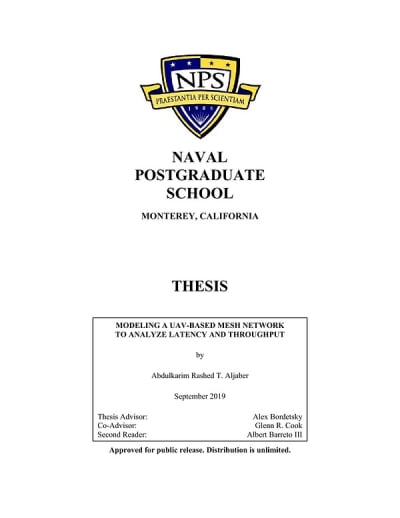
Modeling a UAV-Based Mesh Network to Analyze Latency and Throughput
(reference NPS-0016) is currently available for download from the TSP library.
Don't have an account?
More From SAE Media Group
Aerospace & Defense Tech Briefs
Optimal UAS Assignments and Trajectories for Persistent Surveillance and Data Collection from a Wireless Sensor Network

Aerospace & Defense Tech Briefs
Bio-inspired Airborne Infrastructure Reconfiguration (BioAIR)

Aerospace & Defense Tech Briefs
PAE ISR Engineers Boost Resolute Eagle UAS Networking, Endurance, Payload Capacity with Persistent Systems MPU5

Aerospace & Defense Tech Briefs
Designing for the Connected Battlespace
Aerospace & Defense Tech Briefs
Persistent Systems Auto-Tracking Antenna Adds Aircraft to Network, Enhances Data Sharing
Sensor Technology
Keeping Data Fresh for Wireless Networks
Photonics & Imaging Technology
Testing 800G Direct Modulated Optical Signaling
Aerospace & Defense Tech Briefs
Middleware Offers Integration Framework for Dynamic UAV Applications
Tech Briefs
Sensor Network for Air Vehicles
Aerospace & Defense Tech Briefs
Enhanced SATCOMs for Unmanned Aerial Systems
Aerospace & Defense Tech Briefs
Communications Infrastructure UAVs

Off-Highway Engineering
Addressing Electromagnetic Compatibility in the Context of Aircraft Electrification
Aerospace & Defense Tech Briefs
Taking the Tactical Cloud with You Small Form Factor, Modular Data Centers at the Edge of the Battlefield
Aerospace & Defense Tech Briefs
DDDAMS-based Urban Surveillance and Crowd Control via UAVs and UGVs
Aerospace & Defense Tech Briefs
Improving Military Communications Through COTM
Aerospace & Defense Tech Briefs
Achieving Performance Advantages in Unmanned Systems
Aerospace & Defense Tech Briefs
Unmanned Aircraft Must Rise Above Barriers for Commercial Applications
Aerospace & Defense Tech Briefs
Quantifying Autonomous Soaring on a Surveillance and Communications Relay Mission
Motion Design
Rethinking Industrial Ethernet
Aerospace & Defense Tech Briefs
New University-Led Air Force Center of Excellence Focuses on Securing Autonomous Systems Operating in Contested Environments

Aerospace & Defense Tech Briefs
Automatic Drone Detection System
Tech Briefs
Long-Range Wireless Sensor Network
Aerospace & Defense Tech Briefs
Information Warfare: Staying Protected at the Edge
Aerospace & Defense Tech Briefs
Connectors Lighten the SWaP Burden in UAV/MUMT Aircraft Electronics
Tech Briefs
Data Transfer Service
Overview
The document is a Master's thesis titled "Modeling a UAV-Based Mesh Network to Analyze Latency and Throughput," authored by Abdulkarim Rashed T. Aljaber and submitted to the Naval Postgraduate School in September 2019. The thesis focuses on the development and analysis of a mesh network utilizing Unmanned Aerial Vehicles (UAVs) to enhance communication capabilities in scenarios where traditional infrastructure is lacking.
The primary objective of the research is to model the performance of a UAV-based mesh network, specifically examining key metrics such as latency and throughput. These metrics are critical for ensuring effective communication in military operations, where timely and reliable data transmission can significantly impact decision-making and operational success.
The thesis outlines the methodology used to create the network model, which includes simulations that replicate various operational environments and conditions. By analyzing different configurations and parameters, the author aims to identify optimal setups that minimize latency and maximize throughput. The findings of the research are expected to provide insights into the feasibility and efficiency of deploying UAVs as a communication backbone in remote or contested areas.
The document also discusses the implications of the research for military applications, emphasizing the potential of UAVs to serve as mobile communication nodes that can adapt to dynamic battlefield conditions. The author highlights the importance of understanding network performance in order to enhance situational awareness and coordination among military units.
In addition to the technical aspects, the thesis addresses the broader context of UAV technology in modern warfare, including the challenges and opportunities presented by the integration of UAVs into existing military communication frameworks. The research contributes to the ongoing discourse on the role of advanced technologies in enhancing operational capabilities and addresses the need for innovative solutions to overcome communication barriers in complex environments.
Overall, this thesis represents a significant contribution to the field of military communications and UAV technology, providing valuable insights that could inform future research and operational strategies. The views expressed in the thesis are those of the author and do not necessarily reflect the official policy or position of the Department of Defense or the U.S. Government.
Top Stories
NewsSensors/Data Acquisition
 Microvision Aquires Luminar, Plans Relationship Restoration, Multi-industry Push
INSIDERRF & Microwave Electronics
 A Next Generation Helmet System for Navy Pilots
INSIDERWeapons Systems
 New Raytheon and Lockheed Martin Agreements Expand Missile Defense Production
NewsAutomotive
 Ford Announces 48-Volt Architecture for Future Electric Truck
INSIDERAerospace
 Active Strake System Cuts Cruise Drag, Boosts Flight Efficiency
ArticlesTransportation

Webcasts
Aerospace
 Cooling a New Generation of Aerospace and Defense Embedded...
Energy
 Battery Abuse Testing: Pushing to Failure
Power
 A FREE Two-Day Event Dedicated to Connected Mobility
Automotive
 Quiet, Please: NVH Improvement Opportunities in the Early Design Cycle
Electronics & Computers
 Advantages of Smart Power Distribution Unit Design for Automotive &...
Unmanned Systems
 Sesame Solar's Nanogrid Tech Promises Major Gains in Drone Endurance