




Improving Military Communications Through COTM
Avital component for any military organization is the ability to communicate, share information and provide support for large, mobile groups of personnel anytime, anywhere. Satellite technology is well suited to meet these needs. It provides a flexible, reliable and high-capacity service that can cover a large area. For units deployed around the world, satellite provides a high-speed communications backbone. It connects soldiers to each other and to central operations. It also enables them to stay united with friends and family back home.
Communications on the Move (COTM) satellite technology increasingly is helping the military with mission-critical connectivity when they need to be mobile. As the name implies, COTM provides communications for soldiers on the move.
The following are three main types of COTM which are increasingly vital for warfighters on the battlefield.
Ground COTM
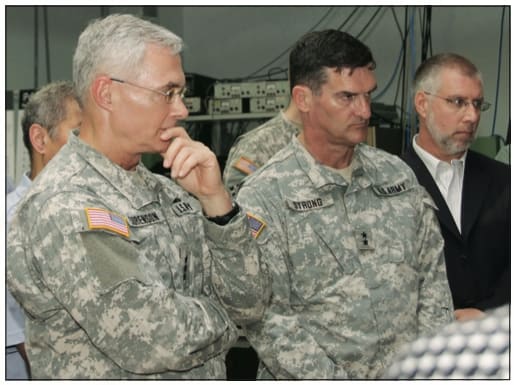
New developments in portable ground COTM technology offer several critical advantages. Soldiers can receive battlefield imagery that identifies potential threats, transmit situational video to base, receive command and control information and even transmit X-rays and imagery of a wounded soldier to doctors who can interpret the injury and provide guidance on proper treatment. The value of ground COTM was demonstrated during a recent exercise at Fort Monmouth, NJ. The exercise involved a 15-mile route designed to test-drive COTM systems. In the exercise, a designated COTM vehicle maintained a live video teleconference with Fort Monmouth and a joint task force forward operating base. Using an L-3 Datron Ku-band antenna system, the network sustained connectivity for 35 minutes, passing under overpasses and through heavily wooded areas in the Fort Monmouth vicinity, at speeds as high as 65 miles per hour.
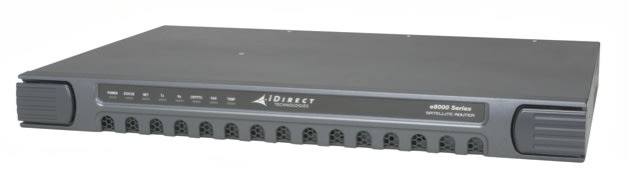
COTM systems traditionally were deployed in larger vehicles; however, significant advancements in satellite communications have brought the technology to the warfighter. New satellite router boards that are half the size of current product standards are now available to fit in soldiers’ rucksacks, providing COTM connectivity to on-the-foot warfighters.
At the Fort Monmouth demonstration referenced above, a ground task force integrated a small form factor satellite router board into a portable terminal to support mobile X-band connectivity. The compact unit uses a light dual paneled antenna for voice, video, and data connectivity. The unit was configured with multiple hubs, allowing troops to accomplish simulated objectives while on the move.
With a dynamic ground COTM solution, a vehicle in the field becomes “broadband-enabled,” capable of supporting Internet, voice, data, and video services. Satellite routers can fit in the rear of a vehicle. A low-profile antenna installs on top, and inside the cabin, users benefit from wireless connectivity on laptop computers and Voice over Internet Protocol phones.
Airborne COTM
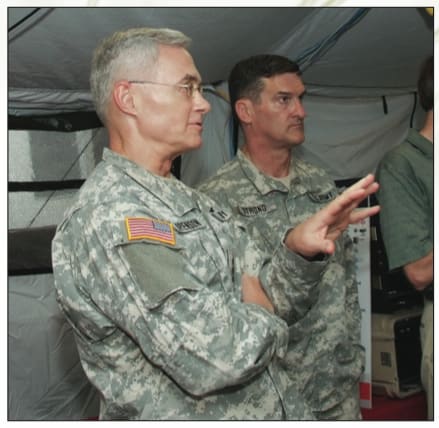
Recent developments in airborne COTM, however, are making reliable high-definition video a reality for critical airborne communications. Airborne COTM can be just as reliable as ground-based COTM with the use of specialized wave forms that support increased vehicle speeds. By utilizing automatic beam switching and persistent IP addressing for airborne communications, an aircraft can be flown from the United States to Europe and on to a final destination in Southwest Asia and maintain a seamless global network of advanced communications while switching satellites throughout its journey. This network even extends to soldiers departing the aircraft with communications-equipped manpacks that include mobile satellite router boards. Paratroopers can quickly and easily set up communications on the ground to suit any mission.
Maritime COTM
Managing a satellite network in a maritime environment can be extremely challenging, especially for users with numerous mobile assets to monitor. Military vessels at sea depend on seamless coverage and maritime COTM helps to provide this. Ships rely on a network of regional satellite networks and network operations centers (NOCs) that provide warfighters with global tracking and communications.
Maritime COTM networks can serve more than 150 military ships and support a full range of broadband applications onboard, including Voice over IP (VoIP), video streaming, data transfer and Internet access. Network operators see a huge volume of network management statistics with so many remotes in the network. But new technology collates the data and displays it in a graphical, intuitive format for easy management.
the military are particularly challenging in satellite communications (SATCOM) because of the broadcast nature of the medium. Recent upgrades in Transmission Security (TRANSEC) include the ability to obfuscate any traffic volume or remote terminal acquisition activity which either on its own or when coupled with other intelligence information may prove useful to an adversary. The challenge of obfuscating acquisition activity is particularly daunting for COTM applications since transient blockages necessitate frequent reacquisition.
COTM is one of the fastest growing areas for satellite communications. Having broadband IP connectivity in a mobile environment on the ground, at sea and in the air provides instant access to vital information. When combined with a solid TRANSEC solution to address security concerns, it provides unparalleled benefits.
Advances in COTM technology are providing critical and secure connectivity to warfighters on the battlefield. Military personnel cannot afford to lose secure connectivity at any moment. Because of this, COTM is increasingly crucial to a successful mission.
This article was written by Karl Fuchs, Vice President of Engineering, iDirect Government Technologies (iGT) (Herndon, VA). For more information, Click Here .
More From SAE Media Group
Aerospace & Defense Tech Briefs
A New Network Design for the “Internet from Space”
Aerospace & Defense Tech Briefs
WIN-T: The Warfighter's Communications Backbone for Today and Tomorrow
Aerospace & Defense Tech Briefs
Modeling a UAV-Based Mesh Network to Analyze Latency and Throughput
Aerospace & Defense Tech Briefs
A New Approach to Satellite Communications
Aerospace & Defense Tech Briefs
Optimal UAS Assignments and Trajectories for Persistent Surveillance and Data Collection from a Wireless Sensor Network
Aerospace & Defense Tech Briefs
Enhanced SATCOMs for Unmanned Aerial Systems
Aerospace & Defense Tech Briefs
New Satellite Connectivity for Air Force Research Aircraft
Aerospace & Defense Tech Briefs
Communications Infrastructure UAVs

Aerospace & Defense Tech Briefs
Bio-inspired Airborne Infrastructure Reconfiguration (BioAIR)

Aerospace & Defense Tech Briefs
Cellular Satellites: Joint Communications with Integrated Acquisition
Aerospace & Defense Tech Briefs
Advanced Satellite Communications Research


Aerospace & Defense Tech Briefs
Satellite System

Aerospace & Defense Tech Briefs
SpaceRAN Demonstrator Will Test 5G Connectivity on Software-Defined Satellite
Aerospace & Defense Tech Briefs
Five-Satellite MUOS Constellation to Deliver Secure, Next-Gen SATCOM on Battlefield
Aerospace & Defense Tech Briefs
Unmanned Aircraft Must Rise Above Barriers for Commercial Applications
Aerospace & Defense Tech Briefs
Impact of Satellite Intelligence, Surveillance and Reconnaissance on Modern Naval Operations
Aerospace & Defense Tech Briefs
Critical Communications Break Out of the Analog Mold
Aerospace & Defense Tech Briefs
Electronically Steered Array Antennas for E2 Jets
Motion Design
Insect-Inspired Motion Sensing
Aerospace & Defense Tech Briefs
Improving Battlefield Connectivity for the Modern Warfighter
Aerospace & Defense Tech Briefs
Pushing the Boundaries of RF Passive Hardware with Additive Manufacturing

Aerospace INSIDER
Metamaterials Antenna Makes Generational Leap in Multi-Band Connectivity

Top Stories
NewsSensors/Data Acquisition
 Microvision Aquires Luminar, Plans Relationship Restoration, Multi-industry Push
INSIDERRF & Microwave Electronics
 A Next Generation Helmet System for Navy Pilots
INSIDERWeapons Systems
 New Raytheon and Lockheed Martin Agreements Expand Missile Defense Production
NewsAutomotive
 Ford Announces 48-Volt Architecture for Future Electric Truck
INSIDERAerospace
 Active Strake System Cuts Cruise Drag, Boosts Flight Efficiency
ArticlesTransportation

Webcasts
Aerospace
 Cooling a New Generation of Aerospace and Defense Embedded...
Energy
 Battery Abuse Testing: Pushing to Failure
Power
 A FREE Two-Day Event Dedicated to Connected Mobility
Automotive
 Quiet, Please: NVH Improvement Opportunities in the Early Design Cycle
Electronics & Computers
 Advantages of Smart Power Distribution Unit Design for Automotive &...
Unmanned Systems
 Sesame Solar's Nanogrid Tech Promises Major Gains in Drone Endurance