




Simultaneous Vibration Suppression and Energy Harvesting
This technology can be used to provide energy to micro air vehicles.
The goal of this work was to investigate the concept of using harvested energy to directly control the vibration response of flexible aerospace systems. Small, lightweight, flexible micro air vehicles (MAVs) operate near flutter, providing both harvesting opportunities and vibration suppression requirements. The possibility that the ambient energy might be harnessed and recycled to provide energy to mitigate the vibrations through various control laws was investigated. The goal was to integrate harvesting, storage, control, and computation into one multifunctional structure.
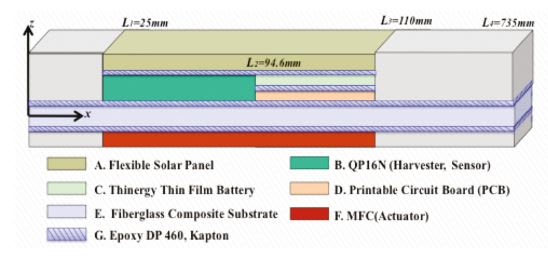
It was found that as much as two-thirds of the required energy can be saved by using a saturation control. This reduction makes running a control law off of harvested energy possible. In implementing these control laws, it was discovered that the high voltages commanded by the control laws result in the piezoelectric coupling coefficient being non-constant. An adaptive control law (exponential actually) was implemented to account for the change in coupling coefficient as the control voltage demand increased. The next major result was to integrate harvesting and storage into the same package with a control actuator and a control law (i.e. the circuitry) all embedded in a multifunctional composite structure as illustrated in the accompanying schematic.
A multifunctional system was fabricated, modeled, and tested, and was capable of energy harvesting, sensing, energy storage, vibration suppression using active control, embedded computing (providing energy management and control laws), and structural integrity. Before proceeding, the harvesting, sensing, and control authority of several different types of piezoelectric material were considered in order to choose the best components for each task. Macro fiber composites form the best control actuation devices, and monolithic piezoceramic forms the best sensing and harvesting device.
Following these initial results, the concept of a multifunctional composite beam was applied to a problem prevalent in unmanned air vehicles (UAVs). UAVs tend to be light and travel near their flutter speed, which means that they are susceptible to instabilities caused by gusts. While the UAV is in normal flight, its wing vibrates. The multifunctional wing spar, modeled after the schematic, would transfer the wing vibration into electrical energy and store it in the embedded battery. When the UAV hits a gust, the sensor function of the multifunctional spar would then see the increased strain, and turn on the active control system embedded in the PCB part of the spar.
The resulting feedback control law would then quiet the gust response and keep the vibration suppressed during the period of the gust. The laboratory results show great agreement with the theoretical models and numerical simulations.
Simulations were then used to predict how the system would behave as a gust suppression system for a small UAV. The gust and clear sky condition (the condition of vibration induced during normal flight) were simulated using the Dryden PSD signal for both clear sky and gust. The simulations were fed into the model of the multifunctional wing spar. The response of the wing to a gust shows a large tip deflection. The response of the wing tip with the controller turned on and the gust as input shows substantial vibration reduction.
There are applications where harvested energy can be of use, even when the energy requirements exceed those that are required, if there is not a constant need for that energy. This is surely the case illustrated here with the gust alleviation example. Many other examples exist in the area of structural health monitoring. The main work here shows that closed loop control can be accomplished with harvested energy.
This work was done by Daniel J. Inman and Pablo Tarazaga of Virginia Tech for the Air Force Office of Scientific Research. AFOSR-0005
This Brief includes a Technical Support Package (TSP).
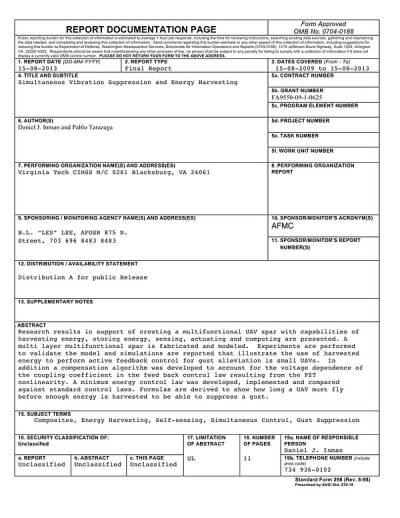
Simultaneous Vibration Suppression and Energy Harvesting
(reference AFOSR-0005) is currently available for download from the TSP library.
Don't have an account?
More From SAE Media Group
Aerospace & Defense Tech Briefs
Simultaneous Vibration Suppression and Energy Harvesting for a Multifunctional UAV Spar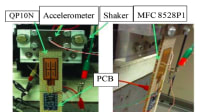
Motion Design
Giving Bug-Like Bots a Boost
Aerospace & Defense Tech Briefs
Bi-Axial Vibration Energy Harvesting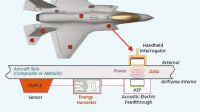
Off-Highway Engineering
Addressing Electromagnetic Compatibility in the Context of Aircraft Electrification
Aerospace & Defense Tech Briefs
Deep Reinforcement Learning Achieves Multifunctional Morphing Airfoil Control
Tech Briefs
Insect-Sized Agile Drones
Aerospace & Defense Tech Briefs
Solar Powering UAVs
Motion Design INSIDER
RoboBee Comes in for a Landing
Tech Briefs
AI Helps UAVs Predict Oncoming Turbulence
Aerospace & Defense Tech Briefs
Design and Analysis of a Small Unmanned Aerial System (UAS) Power Distribution System
Tech Briefs
A Robot with the ‘Brains’ to Morph Mid-Air
Aerospace & Defense Tech Briefs
VITA 90: Small Form Factors for UAVs and Other Space Constrained Platforms
Aerospace & Defense Tech Briefs
Energy-Filtered Tunnel Transistor: A New Device Concept Toward Extremely Low Energy Consumption Electronics
Aerospace & Defense Tech Briefs
New Drone Will Mimic Albatross Flight
Aerospace & Defense Tech Briefs
Ghoul Tool: The Weapon-Mountable Counter UAS Transmitter
Tech Briefs
5 Ws of the Winged Flying Microchip
Aerospace & Defense Tech Briefs
Investigation of Flight Dynamics and Controls for a Solar-Tracker-Mounted UAV
Tech Briefs
System Helps Drones Detect and Avoid Power Lines
Motion Design INSIDER
AI Shapes Autonomous Underwater “Gliders”
Sensing Technology
FAU Engineers Design New Autonomous System to Monitor Arctic Ice Melt
Electronics & Sensors INSIDER
Self-Powered Sensor Automatically Harvests Magnetic Energy
Aerospace & Defense Tech Briefs
Optimizing IoMT Device Battery Life With Emulation and Profiling Software

Tech Briefs
New on the Market
Power Electronics INSIDER
New Microactuator Driving System Could Give Microdrones a Jump-Start
Motion Design
New Products
Aerospace & Defense Tech Briefs
Powering Better Battlefield Drones
Aerospace & Defense Tech Briefs
New Technologies Tackle UAV Challenges


Overview
The document presents a comprehensive report on research conducted to develop a multifunctional spar for unmanned aerial vehicles (UAVs) that integrates energy harvesting, storage, sensing, actuating, and computing capabilities. Authored by Daniel J. Inman and Pablo Tarazaga, the report outlines the objectives, methodologies, and significant findings from the project funded under contract FA9550-09-1-0625, covering the period from August 15, 2009, to August 14, 2013.
The primary goal of the research was to explore the potential of using harvested energy to control the vibration response of flexible aerospace systems, particularly small, lightweight Micro Air Vehicles (MAVs) that operate near flutter conditions. The researchers aimed to create a multifunctional structure that could seamlessly integrate energy harvesting, storage, control, and computation, thereby enhancing the operational efficiency of UAVs.
Key findings from the research include the development of feedback control laws that minimize energy consumption while effectively suppressing vibrations. The study revealed that traditional control laws required more energy than anticipated, prompting the researchers to discover and implement saturation control techniques. These techniques significantly reduced the energy required for vibration suppression, making it feasible to operate control systems using harvested ambient energy.
The report also discusses the challenges encountered during the implementation of control laws, particularly the non-constant nature of the piezoelectric coupling coefficient due to high commanded voltages. To address this issue, a compensation algorithm was developed to improve the feedback control law's performance.
Experimental validations demonstrated that the laboratory results aligned closely with theoretical models and numerical simulations, confirming the effectiveness of the proposed multifunctional spar design. The report includes detailed comparisons of experimental and numerical data for displacement, voltage, and current responses under different control strategies, showcasing the advantages of a reduced energy controller over standard positive position feedback controllers.
In summary, the document highlights significant advancements in the field of smart materials and adaptive structures, emphasizing the potential for energy harvesting technologies to enhance UAV performance through integrated control systems. The findings contribute valuable insights into the design and implementation of multifunctional aerospace structures capable of improving energy efficiency and operational capabilities.
Top Stories
NewsSensors/Data Acquisition
 Microvision Aquires Luminar, Plans Relationship Restoration, Multi-industry Push
INSIDERRF & Microwave Electronics
 A Next Generation Helmet System for Navy Pilots
INSIDERWeapons Systems
 New Raytheon and Lockheed Martin Agreements Expand Missile Defense Production
NewsAutomotive
 Ford Announces 48-Volt Architecture for Future Electric Truck
INSIDERAerospace
 Active Strake System Cuts Cruise Drag, Boosts Flight Efficiency
ArticlesTransportation

Webcasts
Aerospace
 Cooling a New Generation of Aerospace and Defense Embedded...
Energy
 Battery Abuse Testing: Pushing to Failure
Power
 A FREE Two-Day Event Dedicated to Connected Mobility
Automotive
 Quiet, Please: NVH Improvement Opportunities in the Early Design Cycle
Electronics & Computers
 Advantages of Smart Power Distribution Unit Design for Automotive &...
Unmanned Systems
 Sesame Solar's Nanogrid Tech Promises Major Gains in Drone Endurance