




Bi-Axial Vibration Energy Harvesting
This technique can be used to capture airframe vibrational energy, and convert it into electrical power.
For air platforms, the installation of Structural Health Monitoring (SHM) systems is complicated by the fact that the majority of SHM devices need to be fitted on internal aircraft structure, underneath the aircraft’s skin. If the SHM device is in a location that is difficult to access, then powering the device may be problematic because traditional powering methods are generally not feasible. For example, replacing batteries on many SHM devices deployed across a fleet would be impractical, and accessing an onboard power system to supply SHM devices may lead to flight worthiness and certification issues.
The second fundamental issue with most VEH approaches (again, including all known commercial vibration energy harvesters) is that they are uni-directional, and hence can only harvest vibrational energy from host accelerations along a single axis. Therefore, while a considerable amount of scientific literature exists on the topic of VEH, none to date reports on a technique to effectively harvest from bi-axial host accelerations.
A bi-axial approach represents a significant advancement in VEH; specifically, the approach increases the operational directionality from single-axis to 360 degrees in a plane. Furthermore, this design uses a magnet/bearing cantilever analogue (replacing the cantilever design used by many harvesters), potentially allowing a significant reduction in harvester volume. This design also uses an oscillating ball bearing to create magnetic flux steerage through a magnetoelectric laminate transducer to generate harvestable electrical power.
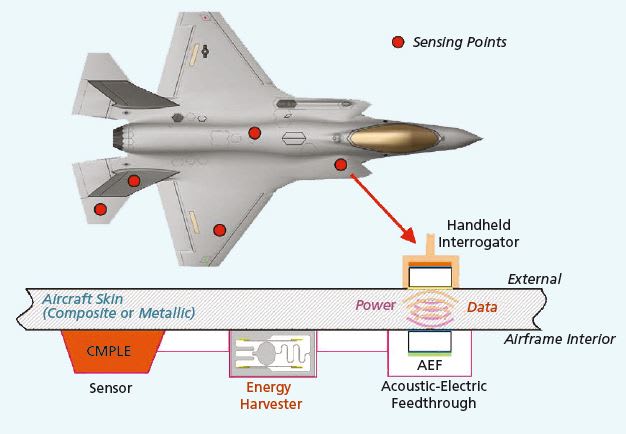
The concept involves three main components: (1) a sensor mounted inside the aircraft at a difficult-to-access location is monitoring in-flight mechanical loads on an airframe, (2) with the sensor utilizing energy that is parasitically harvested from local airframe vibrations by an energy harvester, (3) when the aircraft is on the ground, a wireless link— the acoustic electric feedthrough—is used to download sensor data and simultaneously provide additional energy to the sensor unit.
The bi-axial vibration energy harvesting approach can harvest energy from the multi-axis accelerations experienced by an aircraft. A bi-axial oscillator was created using a permanent-magnet/ballbearing arrangement. The magnet produces a bi-axial restoring force on the bearing, and as the bearing oscillates, it steers magnetic field through a magnetostrictive/ piezoelectric laminate transducer, thereby producing an oscillating charge that can be harvested.
Modeling was used to make a qualitative assessment of the magnetic flux changes in the ME transducer as the bearing oscillates, which indicated that large flux variations occur as the bearing moves from the magnet’s central-line towards the edge. A simple laboratory demonstrator of a biaxial ME energy harvester was created using a Terfenol-D/lead zirconate titanate/Terfenol-D transducer. Harvester output was measured as a function of drive-angle, host acceleration, and load resistance. The harvester produced a peak rms power of 121 mW from an rms host acceleration of 61 mG at 9.8 Hz.
This work was done by Scott Moss, Joshua McLeod, Ian Powlesland, and Steve Galea of the Defence Science and Technology Organisation. DSTO-0002
This Brief includes a Technical Support Package (TSP).
Bi-Axial Vibration Energy Harvesting
(reference DSTO-0002) is currently available for download from the TSP library.
Don't have an account?
More From SAE Media Group
Aerospace & Defense Tech Briefs
Simultaneous Vibration Suppression and Energy Harvesting
Power Electronics INSIDER
Breakthrough Iron-Based Magnetic Material for Next-Generation Power Electronics
Battery & Electrification Technology
Next-Generation Binder for Lithium-ion Batteries
Electronics & Sensors INSIDER
Careful Heating Unlocks Unprecedented Sensitivity to Pressure in Semiconductor Materials

Electronics & Sensors INSIDER
Self-Powered Sensor Automatically Harvests Magnetic Energy
Battery & Electrification Technology
Examining EV Battery Thermal Management
Battery & Electrification Technology
Recyclable ‘Water Batteries’ That Won’t Catch Fire

Power Electronics INSIDER
Diamond Quantum Imaging Can Enable Next-Gen Power Electronics
Aerospace & Defense Tech Briefs
Robust Quantum Sensors Program
Motion Design INSIDER
Programming Robots with Rubber Bands

Aerospace & Defense Tech Briefs
Acceleration Strain Transducer Containing Cantilever Flaps
Battery & Electrification Technology
Sodium Battery Is Capable of Rapid Charging in Just a Few Seconds
Tech Briefs
Thermo-Electron Ballistic Coolers or Heaters
Battery & Electrification Technology
Developing Safer Batteries with Solid-State Polymer Electrolytes

Electronics & Sensors INSIDER
A New Magnetic Transistor for More Energy-Efficient Electronics
Motion Design
Flexible Conductive Skin Gives Robots the Human Touch
Power Electronics INSIDER
Superconducting Diode Bridge Efficiently Converts AC to DC for Quantum Circuits

Tech Briefs
Rotationally Vibrating Electric-Field Mill


Battery & Electrification Technology
Enhancing the Performance of All-Solid-State Batteries
Battery & Electrification Technology
Cheaper and Safer Battery Storage
Power Electronics INSIDER
Fast Charging of Electric Cars Without Cables

Aerospace & Defense Tech Briefs
Expanding Possibilities for Superconducting Qubits With Niobium
Overview
The document titled "Bi-axial Vibration Energy Harvesting" is a technical report published by the Defence Science and Technology Organisation (DSTO) in July 2012. It focuses on the development and demonstration of a novel energy harvesting system designed to capture energy from bi-axial vibrations, which are common in various engineering applications, particularly in aerospace.
The report outlines the motivation behind the research, emphasizing the need for sustainable energy solutions to power structural health monitoring systems in aircraft and other critical infrastructure. Traditional power sources can be impractical in these contexts, making energy harvesting a viable alternative.
Central to the study is the use of a magnetoelectric transducer, which converts mechanical vibrations into electrical energy. The report details the design and implementation of a laboratory demonstrator that effectively harnesses energy from vibrations in two dimensions. This approach allows for greater efficiency and adaptability in energy capture, as it can respond to vibrations from multiple axes.
The results of the experiments conducted with the demonstrator are significant. The system achieved a peak power output of 121 W under specific conditions of acceleration, demonstrating its potential effectiveness in real-world applications. The report includes various figures and data that illustrate the performance of the energy harvesting system, including the two-dimensional arrangement of the transducer and its extension into three dimensions.
In addition to the technical details, the document provides insights into the broader implications of this research for the field of energy harvesting. It discusses potential applications beyond aerospace, including civil engineering and other industries where monitoring and maintenance are critical.
The report is structured to provide a comprehensive overview of the research, including the methodology, results, and potential future directions for the technology. It is intended for public release, making it accessible to a wider audience interested in advancements in energy harvesting technologies.
Overall, the "Bi-axial Vibration Energy Harvesting" report represents a significant contribution to the field, showcasing innovative solutions for energy capture that could enhance the sustainability and efficiency of monitoring systems in various engineering domains.
Top Stories
NewsSensors/Data Acquisition
 Microvision Aquires Luminar, Plans Relationship Restoration, Multi-industry Push
INSIDERRF & Microwave Electronics
 A Next Generation Helmet System for Navy Pilots
INSIDERWeapons Systems
 New Raytheon and Lockheed Martin Agreements Expand Missile Defense Production
NewsAutomotive
 Ford Announces 48-Volt Architecture for Future Electric Truck
INSIDERAerospace
 Active Strake System Cuts Cruise Drag, Boosts Flight Efficiency
ArticlesTransportation

Webcasts
Aerospace
 Cooling a New Generation of Aerospace and Defense Embedded...
Energy
 Battery Abuse Testing: Pushing to Failure
Power
 A FREE Two-Day Event Dedicated to Connected Mobility
Automotive
 Quiet, Please: NVH Improvement Opportunities in the Early Design Cycle
Electronics & Computers
 Advantages of Smart Power Distribution Unit Design for Automotive &...
Unmanned Systems
 Sesame Solar's Nanogrid Tech Promises Major Gains in Drone Endurance