




Energy-Filtered Tunnel Transistor: A New Device Concept Toward Extremely Low Energy Consumption Electronics
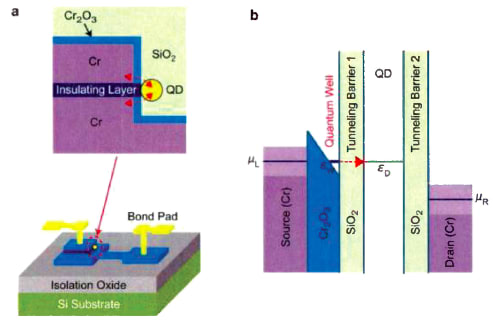
Altering the thermal characteristics of semiconductors can prolong battery life.
Excessive heat dissipation (or power consumption) of modem integrated circuits is an undesirable effect that imposes substantial limitations on the performance of many electronic devices. For example, the level of heat dissipation /power consumption of smart phones, tablets, and laptops is such that it prohibits a continuous and prolonged operation of these devices, requiring frequent recharging. Large power consumption of electronic devices requires large energy storage in batteries, increasing the battery weights that soldiers carry in their missions or the weights of remote controlled equipment such as unmanned aerial vehicles (UAVs). Therefore, technology that enables electronic devices to operate with extremely small energy consumption promises a broad range of commercial, military and space applications.
The root cause of heat dissipation of current metal-oxide-semiconductor field effect transistors (MOSFETs) is the thermal excitation of electrons that obeys thermodynamics, i.e., the Fenni-Dirac energy distribution of electrons. The thermally excited electrons at the tail of the Fenni-Dirac distribution can overcome the energy barrier set in the OFF state of the MOSFETs. This causes substantial OFF state leakage currents even after the gate voltage is reduced below the threshold voltage, resulting in large heat dissipation or energy consumption for integrated circuits. The challenge for this large heat dissipation is that its root cause is an intrinsic phenomenon of thermodynamics (Fermi-Dirac distribution) that cannot be directly manipulated.
Previous studies have demonstrated that it is possible to indirectly suppress electron thermal excitations by utilizing discrete energy levels present in quantum dots (QDs). Here the electrons are made to pass through the QD energy level and this discrete level serves as an energy filter, allowing only those electrons whose energies match the discrete QD level to pass through. It has been experimentally demonstrated that this energy filtering can lower the effective temperature of electrons. Until now, the energy filtering has been demonstrated only when the entire system is cooled to very low temperatures, typically below 1 Kelvin. For practical applications, however, the energy filtering and effective suppression of electron thermal excitations will need to function at room temperature.
This project aimed to investigate a new method that can effectively suppress electron thermal excitations at room temperature and to fabricate device structures in which energy-suppressed cold electrons are transported through device components at room temperature. An important feature of this approach is that the quantum states for the energy filtering are formed in a quantum well of a very thin (-2 nm) layer, so that their energy level spacing is made to be much larger than the room temperature thermal energy, enabling the electron energy filtering and cold-electron transport to function even at room temperature. Fabrication of device structures that enable cold-electron transport at room temperature is demonstrated. A comprehensive microscopic model of the cold electron transport is provided along with numerical calculations. Application of the energy-filtered cold electron transport to single-electron transistors is demonstrated. Device architecture for a large-scale fabrication of energy- filtered tunnel transistors for energy-efficient electronics is presented. Process and material developments for this transistor architecture are presented.
This work was done by Seong Jin Koh of The University of Texas at Arlington for the Office of Naval Research. NRL-0069
This Brief includes a Technical Support Package (TSP).

Energy-Filtered Tunnel Transistor: A New Device Concept Toward Extremely Low Energy Consumption Electronics
(reference NRL-0069) is currently available for download from the TSP library.
Don't have an account?
More From SAE Media Group

Tech Briefs
Stable Polymeric Ink with High Conductivity
Battery Technology
Charge Control Methods for Supercapacitors

Automotive Engineering
EV Energy-Management Powers-Up
Battery & Electrification Technology
EV Energy Management Powers Up
Aerospace & Defense Tech Briefs
Thermal Management Techniques in Avionics Cooling

Tech Briefs
5Ws of the Ultra-Thin Memory Storage Device
Aerospace & Defense Tech Briefs
New Technologies Tackle UAV Challenges
Battery Technology
Stretchable Micro-Supercapacitors Self-Power Wearable Devices

Aerospace & Defense Tech Briefs
Silicon Carbide Junction Field-Effect Transistor Devices for Scalable Solid-State Circuit Breakers
Aerospace & Defense Tech Briefs
Solar Powering UAVs

Tech Briefs
Ultrahigh-Energy-Density Capacitor
Electronics & Sensors INSIDER
MIT Team Takes a Major Step Toward Fully 3D-Printed Active Electronics

Aerospace & Defense Tech Briefs
Designing Battery Packs for Harsh Environment Mission-Critical Devices
Aerospace & Defense Tech Briefs
Investigation of Flight Dynamics and Controls for a Solar-Tracker-Mounted UAV
Tech Briefs
Graphene “Nano-Origami” Creates Tiny Microchips
Medical Design Briefs
New Battery Technology Could Power Wearable, Self-Sustaining Fever Detector
Aerospace & Defense Tech Briefs
AIA Predicts Flying Air Taxis, Supersonic Air Travel, and Space Industry for 2050
Aerospace & Defense Tech Briefs
Optimizing IoMT Device Battery Life With Emulation and Profiling Software
Automotive Engineering
Is GaN the Future for EV Chips?
Tech Briefs
Nanotransistors Stay Cool at High Voltages
Tech Briefs
Ultra-Wide-Bandgap Power Electronics


Overview
The document is a final technical report on the research project titled "Energy-Filtered Tunnel Transistor: A New Device Concept Toward Extremely-Low Energy Consumption Electronics," conducted by Seong Jin Koh at the University of Texas at Arlington, under the sponsorship of the Office of Naval Research (ONR). The project, funded by Grant No: N00014-12-1-0492, spans from April 1, 2012, to September 30, 2015.
The report addresses the critical issue of excessive heat dissipation and power consumption in modern integrated circuits, which limits the performance and operational duration of electronic devices like smartphones, tablets, and laptops. The research focuses on the fundamental physics of electron energy filtering, particularly at room temperature, to mitigate thermal excitations that lead to energy loss in electronic components.
Key accomplishments of the project include the experimental demonstration of energy-filtered cold electron transport at room temperature. The researchers successfully showed that a quantum well energy level can filter out high-energy electrons from the Fermi-Dirac distribution, effectively suppressing thermal excitations and producing cold electrons with an effective temperature of 45 Kelvin. This breakthrough is significant as it allows for energy filtering to occur at room temperature, which is essential for practical applications.
The report details a comprehensive microscopic model that describes the mechanisms of energy filtering, supported by numerical calculations that align with experimental findings. The energy filtering technique has been applied to single-electron transport, resulting in observable Coulomb staircases and oscillations at room temperature, indicating the potential for new electronic architectures.
Additionally, the report outlines the design and fabrication of a new type of energy-filtered cold electron transistor, utilizing optimized materials and processes. This innovation aims to enhance energy efficiency in electronics, which has broad implications for commercial, military, and space applications.
In summary, the report presents a significant advancement in the field of low-energy electronics, demonstrating the feasibility of energy filtering at room temperature and paving the way for the development of next-generation electronic devices that consume significantly less power. The findings contribute to the ongoing quest for energy-efficient technologies that can operate effectively in various applications while minimizing heat dissipation.
Top Stories
NewsSensors/Data Acquisition
 Microvision Aquires Luminar, Plans Relationship Restoration, Multi-industry Push
INSIDERRF & Microwave Electronics
 A Next Generation Helmet System for Navy Pilots
INSIDERWeapons Systems
 New Raytheon and Lockheed Martin Agreements Expand Missile Defense Production
NewsAutomotive
 Ford Announces 48-Volt Architecture for Future Electric Truck
INSIDERAerospace
 Active Strake System Cuts Cruise Drag, Boosts Flight Efficiency
ArticlesTransportation

Webcasts
Aerospace
 Cooling a New Generation of Aerospace and Defense Embedded...
Energy
 Battery Abuse Testing: Pushing to Failure
Power
 A FREE Two-Day Event Dedicated to Connected Mobility
Automotive
 Quiet, Please: NVH Improvement Opportunities in the Early Design Cycle
Electronics & Computers
 Advantages of Smart Power Distribution Unit Design for Automotive &...
Unmanned Systems
 Sesame Solar's Nanogrid Tech Promises Major Gains in Drone Endurance