




Determining Detection and Classification Potential of Munitions Using Advanced EMI Sensors in the Underwater Environment
Electromagnetic induction could be used to locate and characterize potentially dangerous sunken metallic objects.
Hazardous ordnance items are present along coastlines and in rivers and lakes in waters shallow enough to cause concerns for human recreational and industrial activities. The presence of water makes it difficult to detect and remove these hazardous legacies induced from wars, military training and deliberate disposal. Various techniques have been proposed to detect and characterize Unexploded Ordnances (UXO) and discarded military munitions (DMM) in the underwater environment including acoustic waves, magnetometery, and electromagnetic induction (EMI).
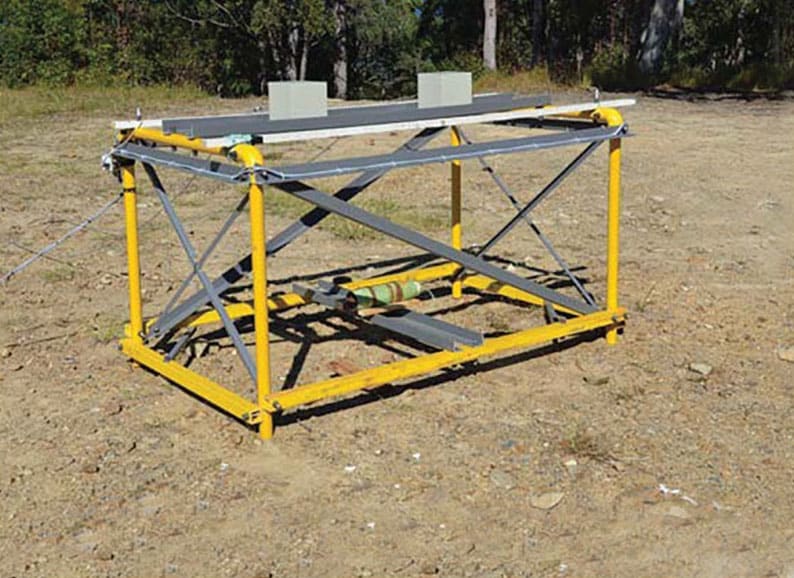
In recent years, terrestrial munitions response has seen significant improvements in our capability to discriminate Munitions and Explosives of Concern (MEC) from benign metallic clutter. These advances have been primarily driven by the development of next-generation EMI sensors designed to interrogate small, near-surface targets. This research concerns underwater sensing using EMI which is distinct from the terrestrial setting in several respects including positioning requirements and techniques, noise environment, and practical constraints on deployment of sensor systems. In terrestrial settings, conduction currents can be ignored in most soil types (conductivity 0.01 S/m). The measured magnetic fields from a subsurface metallic object in the low-frequency EMI regime can be modelled as if the object were in free-space. In contrast, marine environments are generally highly conductive with an average seawater conductivity of around 4 - 5 S/m.
For the numerical studies, an integral equation approach for a layered medium was developed that could account for the changing conductivity of the air, marine and sea-bottom. The model was extended so that it was possible to compute both the background and scattered field response from a highly conducting and permeable sphere for dipole and loop transmitters and receivers. A series of synthetic experiments was carried out by considering various factors that might influence EMI signals, including current channeling effects, sea depth, the size of a loop, lateral offset of the receiver, host conductivity, excitation waveform and antenna insulation.
For the marine measurements, a 2m x 1m x 1m fiberglass frame was built to encase two receiver cubes in epoxy to make them waterproof. The transmitter loop comprised 12 turns of wire arranged in a 2m by 1m rectangle. A 24V power-supply was used to provide a maximum current of 11.4A using a 25 Hz base-frequency with a 50% duty cycle waveform. A series of measurements were conducted in sea-water depths of between 2 and 14m.
The response from a metallic body immersed in a conductive medium is a combination of the eddy current response (ECR) due to currents generated in the target and the galvanic coupling of currents through the body (the current channeling response, CCR). In terrestrial environments only the ECR is important. Simulations showed that the CCR from a highly conducting and permeable sphere embedded in the air-sea-sediment is far smaller than the ECR and decays much faster than the ECR at a rate of t −3. For the time range of 0.1 ms - 25 ms, the CCR contributes little to the target signals and thus can be ignored. At times beyond several hundred microseconds, the ECR response approaches the value for the same object embedded in free space. These numerical observations were confirmed by measurements of an insulated and non-insulated 105 mm projectile at a range of different receiver, transmitter and object offsets.
When considering a survey close to seafloor, it was found that the decay rate of the background response is affected by the sea depth, or equivalently by the distance of the sensor from the air-sea interface. Results showed that the background responses in shallow water decay faster than in deeper water. In deeper water where the sensor is far away from the air-sea interface, the corresponding background responses asymptotically approach the response of a half-space. Simulations demonstrated that sea depths don't impact the scattered field response from a buried metallic object. Measurements conducted in water depths between 2 and 14m showed the response in shallower water (2m) falling off faster than the measurements at 14m. Observed decay rates were between t−5/2 and t −3.
This work was done by Stephen D. Billings of Black Tusk Geophysics Inc. and Lin-Ping Song of the University of British Columbia for the Department of Defense Strategic Environmental Research and Development Program (SERDP). SERDP-0001
This Brief includes a Technical Support Package (TSP).
Determining Detection and Classification Potential of Munitions using Advanced EMI Sensors in the Underwater Environment
(reference SERDP-0001) is currently available for download from the TSP library.
Don't have an account?
More From SAE Media Group
Aerospace & Defense Tech Briefs
Unmanned Aerial Systems Electromagnetic Induction Sensor Development
Aerospace & Defense Tech Briefs
Development and Testing of a New Version of MBUD for Cued Classification of Marine UXO
Aerospace & Defense Tech Briefs
Data Collection Using the MetalMapper in Dynamic Data Acquisition and Cued Modes
Aerospace & Defense Tech Briefs
Ka-Band Front-End Monolithic Microwave Integrated Circuits (MMICs) and Transmit/Receive (T/R) Modules Testing
Tech Briefs
Drones Use Machine Learning to Detect Landmines
Tech Briefs
Battery-Free Sensor for Underwater Use
Aerospace & Defense Tech Briefs
Electronic Warfare: Vying for Control of the Electromagnetic Spectrum
Tech Briefs
Products of Tomorrow
Tech Briefs
System Helps Drones Detect and Avoid Power Lines
Aerospace & Defense Tech Briefs
Designing for the Connected Battlespace
Aerospace & Defense Tech Briefs
Directed-Energy System to Defeat Small Unmanned Aircraft System Swarms
Aerospace & Defense Tech Briefs
Stepped-Frequency Distributed Radar for Through-the-Wall Sensing
Aerospace & Defense Tech Briefs
Electrokinetics Models for Micro- and Nano-Fluidic Impedance Sensors
Aerospace & Defense Tech Briefs
Shape-Shifting Origami Could Help Antenna Systems Adapt On-the-Fly
Aerospace & Defense Tech Briefs
New Diamond Super-Material Enhances Aircraft Survivability
Tech Briefs
Electronics Withstand Extreme Heat
Aerospace & Defense Tech Briefs
Robust Quantum Sensors Program
Aerospace & Defense Tech Briefs
Frequency Agile Plasmonic Antennas and Sensors
Aerospace & Defense Tech Briefs
Nonlinear Effects in Transformation Optics-Based Metamaterial Shields for Counter Directed Energy Weapon Defense
NASA Spinoff
Catch the Waves
Photonics & Imaging Technology
Unique Amplifier Could Change Optical Communication
Tech Briefs
Insect-Sized Agile Drones
Motion Design
Insect-Inspired Motion Sensing
Tech Briefs
Nano-Infused Ceramic Can Report its own Health
Tech Briefs
Inductive Non-Contact Position Sensor
Tech Briefs
Laser-Light-Based Accelerometer
Aerospace & Defense Tech Briefs
sUAS-Based Payload Development and Testing for Quantifying Optical Turbulence
Aerospace & Defense Tech Briefs
Five Missile-Tracking Satellites Launched
Aerospace & Defense Tech Briefs
Validation of Ubiquitous 2D Radar
Overview
The document titled "Determining Detection and Classification Potential of Munitions using Advanced EMI Sensors in the Underwater Environment" is a final report prepared under contract to the Department of Defense's Strategic Environmental Research and Development Program (SERDP). The report, authored by Stephen D. Billings and Lin-Ping Song, covers a project designated as MR-2412, which was conducted from September 2014 to November 2016.
The primary focus of the report is to evaluate the capabilities of advanced electromagnetic induction (EMI) sensors for detecting and classifying munitions in underwater environments. The need for effective detection methods is critical due to the potential hazards posed by unexploded ordnance (UXO) in marine settings, which can threaten both human safety and marine ecosystems.
The report outlines the methodology employed in the project, including the design and implementation of experiments aimed at assessing the performance of EMI sensors. It discusses the various factors that influence detection and classification accuracy, such as the type of munitions, environmental conditions, and sensor technology. The findings indicate that advanced EMI sensors can significantly enhance the detection and classification of munitions compared to traditional methods.
Additionally, the report emphasizes the importance of understanding the limitations and challenges associated with EMI sensor technology. It provides insights into the operational parameters that affect sensor performance and suggests potential improvements for future research and development.
The document also includes an executive summary that encapsulates the key results and implications of the study. It highlights the potential for these advanced sensors to improve the efficiency and effectiveness of munitions detection operations, thereby contributing to safer underwater environments.
While the report does not imply endorsement by the Department of Defense, it serves as a valuable resource for stakeholders involved in environmental safety, munitions management, and underwater exploration. The findings may inform policy decisions and operational strategies aimed at mitigating the risks associated with underwater munitions.
In conclusion, this report presents a thorough investigation into the capabilities of advanced EMI sensors for underwater munitions detection and classification, offering critical insights that could enhance safety and environmental protection efforts in marine environments.
Top Stories
INSIDERManufacturing & Prototyping
 How Airbus is Using w-DED to 3D Print Larger Titanium Airplane Parts
INSIDERManned Systems
 FAA to Replace Aging Network of Ground-Based Radars
NewsTransportation
 CES 2026: Bosch is Ready to Bring AI to Your (Likely ICE-powered) Vehicle
NewsSoftware
 Accelerating Down the Road to Autonomy
EditorialDesign
 DarkSky One Wants to Make the World a Darker Place
INSIDERMaterials
 Can This Self-Healing Composite Make Airplane and Spacecraft Components Last...
Webcasts
Defense
 How Sift's Unified Observability Platform Accelerates Drone Innovation
Automotive
 E/E Architecture Redefined: Building Smarter, Safer, and Scalable...
Power
 Hydrogen Engines Are Heating Up for Heavy Duty
Electronics & Computers
 Advantages of Smart Power Distribution Unit Design for Automotive...
Unmanned Systems
 Quiet, Please: NVH Improvement Opportunities in the Early Design...
