




Robotics Software
MBDA Le Plessis-Robinson, France
+331 71 54 10 00
www.mbda-systems.com
MBDA is a European aerospace and armaments manufacturer, specializing in the design of missiles and missile systems for the operational needs of all three branches of the military (Army, Navy and Air Force).
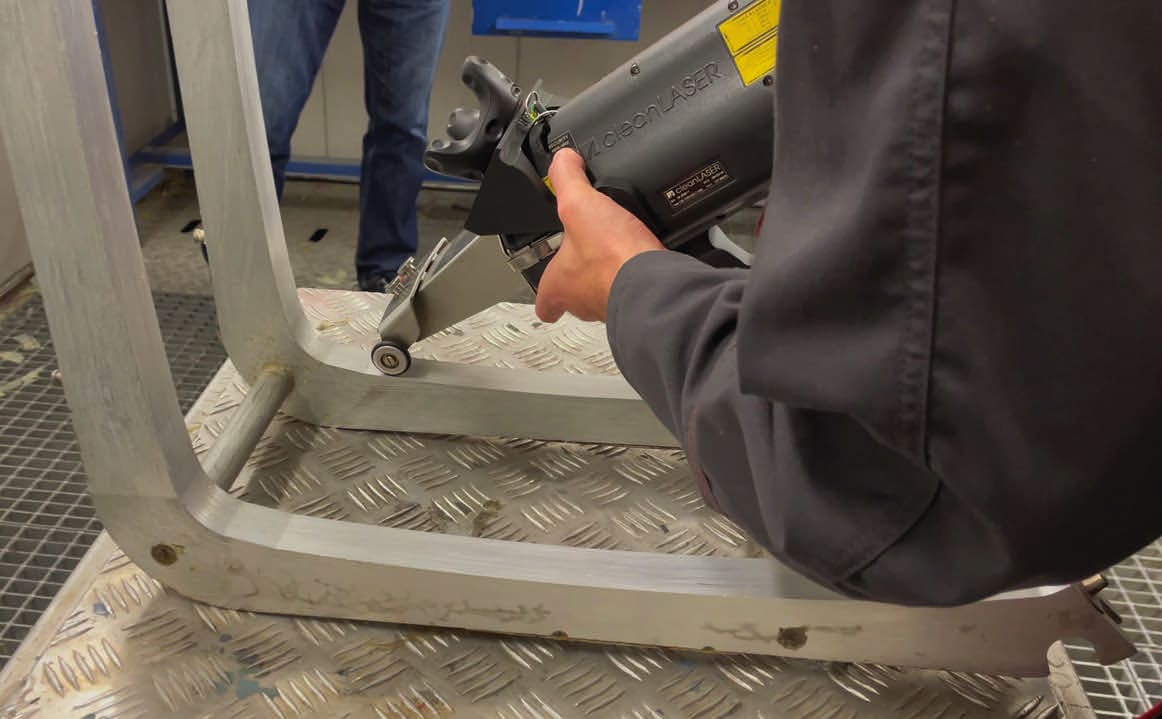
MBDA France's Bourges site produces numerous small composite parts that have to be molded. Each mold is manually stripped clean before being used in production. This operation is complex: the parts to be treated are diverse and numerous and in each series, the level of residue to be stripped off and its location may vary. This method of operation is tedious, and it also requires protecting the operator from exposure to toxic substances.
As Vincent Rafin, Head of the Factory of the Future Project at MBDA explains it: “We want to robotize tasks which cause musculoskeletal disorders in our operators, and which occur in certain cases in the production of very small series or even single parts, so we need to keep the non-recurring costs of programming as low as possible. Programming a robot to define the trajectories of a laser is not the right approach for small series production; it is time-consuming and costly and has to be done by a roboticist.”
For advice, MBDA turned to Meliad, a recognized expert in the aerospace industry for surface preparation and laser stripping, and to Staubli. The latter recommended Fuzzy Logic for its visual programming solutions. Fuzzy Logic developed Repplix™, an extension of its Fuzzy Studio™ software, in cooperation with MBDA. A portable learning device controlled by the operator using his knowledge of the application task teaches the Repplix™ software the first laser alignment. A monitoring function, performed via a real-time digital twin of the robotic installation created in Fuzzy Studio™, takes into account collision monitoring and trajectory feasibility in the robot's environment. Alert parameters are set up. Trajectory capture combines several process parameters such as laser triggering and power. The operator, who is not a roboticist, is also able to modify the trajectory and process parameters via the graphical interface, even after the learning phase.
Then, from this digital twin, the cycle is launched and the robot moves with the laser, guided by the accurate capture of the trajectory learned from the operator. The speed at which the robot operates is set directly in the software and it can differ from the speed in the learning phase. The cycle is performed autonomously by the robot, without the need for operator supervision. The same process, which takes only a few minutes, is done for each new series of molds.
The solution developed in this way is executed with millimeter precision and is capable of extension to even more demanding applications in the future. The manual operation can be reproduced with ease because the learning device is the representation of the real tool and is not directly linked to the robot. The operator manages the execution and planning of the movement himself using the software and the parametrized alerts.
As a result, the time needed to program the mold cleaning operation is slashed from several hours to only a few minutes. Productivity is increased by automating the cleaning operation and the risks for the operator are reduced, making robotizing this operation profitable, both in terms of HSE and economics.
For Free Info Visit Here
More From SAE Media Group
Motion Design
A Cost-Effective Way to Automate Industrial Processes
Aerospace & Defense Tech Briefs
Digital Twins: How The Digital Replica Concept Is Used By Robotic Systems

Motion Design
Guiding the Way in Automotive Plants
Motion Design
Controlling a Robot Without Programming

Medical Design Briefs
Five-Fingered Robot Gets a Grip
Aerospace & Defense Tech Briefs
AFRL Demos Advanced Multipurpose Robotics for Aerospace
Motion Design
NASA's Autonomous Robot Keeps Manufacturing Floors Safe
Aerospace & Defense Tech Briefs
Laser Cleaner Robot
Motion Design
Tentacle Robot Can Grasp Fragile Objects
Aerospace & Defense Tech Briefs
GPS Enabled Semi-Autonomous Robot

Motion Design
Algorithm Helps Swarming Robots Avoid Collisions
Photonics & Imaging Technology
Total Versatility: Flexible Test Station With a Cobot and Camera
Motion Design
Autonomous Robot Opens Doors
Motion Design
Improving Autonomous Robotic Systems
Motion Design
Software Gives Robots Human Touch
Automotive Engineering
Factory Robots See Slight Drop in Growth, but Still Have Momentum
Medical Manufacturing and Fabrication
The Promise of Asimov Robots in Medical Manufacturing

Robotics & Automation INSIDER
Tech Focus: Robots That Think and Act on the Fly at Moving Assembly Line Speeds
Robotics & Automation INSIDER
Safety in Motion: Setting the Standard for Humanoid Robots


Tech Briefs
Algorithm Gives Robots a Faster Grasp
Automotive Engineering
Inkjet Innovation for the Automotive Paint Shop
Motion Design
A New Method to Improve Motion Planning for Robots
Top Stories
INSIDERDefense
 New Raytheon and Lockheed Martin Agreements Expand Missile Defense Production
NewsAutomotive
 Ford Announces 48-Volt Architecture for Future Electric Truck
INSIDERManufacturing & Prototyping
 Active Strake System Cuts Cruise Drag, Boosts Flight Efficiency
ArticlesTransportation
 Accelerating Down the Road to Autonomy
INSIDERMaterials
 How Airbus is Using w-DED to 3D Print Larger Titanium Airplane Parts
Road ReadyTransportation

Webcasts
Electronics & Computers
 Cooling a New Generation of Aerospace and Defense Embedded...
Power
 Battery Abuse Testing: Pushing to Failure
Connectivity
 A FREE Two-Day Event Dedicated to Connected Mobility
Automotive
 Quiet, Please: NVH Improvement Opportunities in the Early Design Cycle
Transportation
 Advantages of Smart Power Distribution Unit Design for Automotive &...
Aerospace
 Sesame Solar's Nanogrid Tech Promises Major Gains in Drone Endurance