




Assessing the Effectiveness of a Combat UGV Swarm in Urban Operations
Fighting in urban areas is extremely complex and challenging due to multi-story structures, new engagement conditions, and the consideration of civilian-military relations, but recent technological advancements could enable the military to employ robotic platforms in swarms to help overcome operational challenges in an urban environment.
The global trend of urbanization that began after World War II continues to grow rapidly. In 2014, 54 percent of the world’s population resided in urban areas, compared to only 30 percent in 1950, and the United Nations estimates that by 2050, that number will reach 66 percent. This global trend necessarily contributes to a shift in the characteristics of any future potential conflicts, and as a result, in the way urban warfare would be conducted.
Fighting in urban areas is extremely complex and challenging. The third dimension in urban areas, such as subterranean and multi-story structures, affects the line of sight and engagement conditions, thus increasing the complexity of the environment. In addition, the presence of civilians introduces constraints, such as reduced air or artillery support for ground troops, to minimize non-combatant causalities and collateral damage. The complexity of the environment requires better situational awareness, equipment, and training to overcome these challenges.
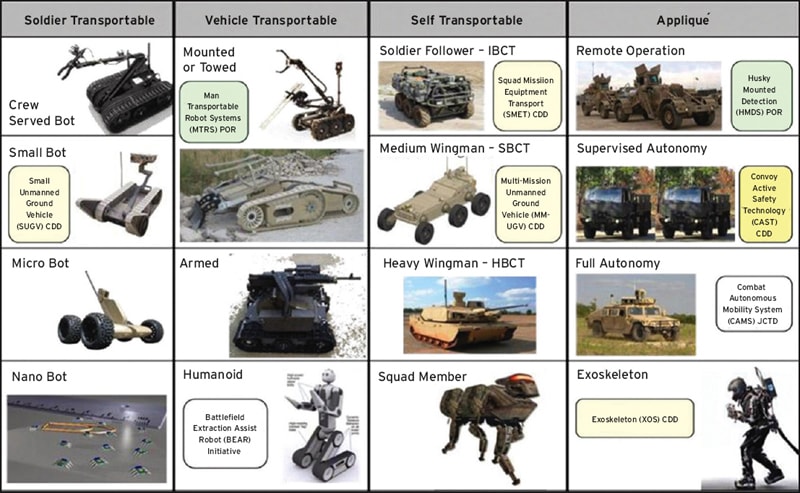
Technological advancements in recent years have equipped armed forces to meet these challenging demands. Such advancements include military robotic platforms, which are now frequently employed by troops for explosive ordinance disposal, loading and carrying heavy items, and repairing ground conditions under fire. Furthermore, according to the 2011 unmanned ground systems roadmap report by the Robotic Systems Joint Project Office (RS JPO) of the United States Department of Defense (DoD), there are plans to develop armed unmanned ground vehicles (UGV) with combat abilities within the next 25 years. The figure shows a variety of the UGVs being developed.
One of the emerging concepts that the RS JPO is actively tracking is the Multi- Mission Unmanned Ground Vehicle (MM-UGV). MM-UGVs possess armed unmanned capability as well as the capability to deal with improvised explosive devices. It is evident that full autonomy for an unmanned combat ground vehicle such as the MM-UGV is a far-term capability anticipated by the U.S. Army.
To meet the future capabilities requirement as identified in the U.S. Army UGV campaign plan, unmanned ground vehicles require further technological advancement. For the micro- and nano-bots depicted in the figure, swarming is considered to be one of the most promising capabilities to be developed. Swarm intelligence is an artificial intelligence discipline that consists of a multi-agent system that takes inspiration from the behavior of colonies of social insects and animal societies, such as flocks of birds or schools of fish. The word “swarm” is an appropriate word because it has special characteristics not found in related terms such as “group.”
The three key special characteristics of a swarm are decentralized control, lack of synchronicity, and the simplicity and homogeneity of the swarm; additionally, the swarm’s algorithms run in an asynchronous and decentralized fashion.
This research explores the area of UGV autonomy, investigating the effects of kinematics inputs (e.g. movement behavior, swarm size, detection range) and engagement inputs (e.g. sensors and weapon range) with an assumption that the hardware and software capabilities requirements mentioned previously are met.
This work was done by Boon Hong Aaron Teow for the Naval Postgraduate School. NPS-0010
This Brief includes a Technical Support Package (TSP).
Assessing the Effectiveness of a Combat UGV Swarm in Urban Operations
(reference NPS-0010) is currently available for download from the TSP library.
Don't have an account?
More From SAE Media Group
Aerospace & Defense Tech Briefs
The Evolution of Tactical Robots
Aerospace & Defense Tech Briefs
Robotic Rifle
Tech Briefs
Approach Makes Unmanned Agents Self-Sufficient
Aerospace & Defense Tech Briefs
The Role of Autonomous Unmanned Ground Vehicle Technologies in Defense Applications
Aerospace & Defense Tech Briefs
Autonomous Air Defense Production
Aerospace & Defense Tech Briefs
Unmanned Ground Vehicles
Aerospace & Defense Tech Briefs
Counter-Drone Technology
Aerospace & Defense Tech Briefs
Robotic Applique Kits Leverage Existing Assets
Motion Design
Computational Model Enables Robots to Learn New Concepts
Aerospace & Defense Tech Briefs
Interoperability Standards Pave the Way for Modular Robotic Manipulators
Aerospace & Defense Tech Briefs
Drone Swarms: A Transformational Technology
Aerospace & Defense Tech Briefs
Systems Engineering Approach to Develop Guidance, Navigation and Control Algorithms for Unmanned Ground Vehicle
Off-Highway Engineering
COMVEC 2022: Electrification Is the Future for Defense Vehicles
Aerospace & Defense Tech Briefs
Weapon Fire Control System
Aerospace & Defense Tech Briefs
Industry Invited to Participate in AeroTech Aerospace and Defense Technical Program

Aerospace & Defense Tech Briefs
Robotic Combat Vehicles: Putting the Brains Behind the Brawn
Aerospace & Defense Tech Briefs
Autonomous Surveillance Technologies Relating to Dismounted Soldiers
Aerospace & Defense Tech Briefs
Armed Medium-Sized UGV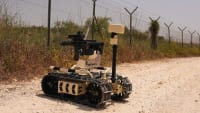
Aerospace & Defense Tech Briefs
Effectiveness of Inter-Vehicle Communications and On-Board Processing for Close Unmanned Autonomous Vehicle Flight Formations
Aerospace & Defense Tech Briefs
Autonomous Collaborative Platform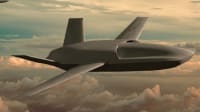
Aerospace & Defense Tech Briefs
Counter UAS Defense System
Aerospace & Defense Tech Briefs
Autonomous Navigation Kits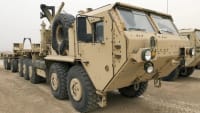
Aerospace & Defense Tech Briefs
Counter IED System
Aerospace & Defense Tech Briefs
Anti-Drone Remote Weapon System
Aerospace & Defense Tech Briefs
Autonomous “Wingman” Vehicles
Aerospace & Defense Tech Briefs
Localization and Mapping of Unknown Locations with Unmanned Ground Vehicles
Aerospace & Defense Tech Briefs
British Army Completes First Test of Drone Killing Radio Frequency Weapon
Aerospace & Defense Tech Briefs
Developing Object Detection Systems for Autonomous Underwater Vehicles
Overview
The document is a thesis authored by Boon Hong Aaron Teow at the Naval Postgraduate School in September 2018, focusing on the effectiveness of combat unmanned ground vehicle (UGV) swarms in urban operations. Urban warfare presents unique challenges due to the complexity of environments, including dense structures, civilian presence, and the need for precise tactical maneuvers. The thesis explores how UGV swarms can address these challenges and enhance military operations.
The research emphasizes the potential of UGVs to perform various tasks such as reconnaissance, surveillance, and direct engagement in urban settings. By utilizing swarms of UGVs, military forces can achieve greater situational awareness, improved coordination, and increased operational efficiency. The document discusses the development of innovative guidance algorithms that enable UGVs to navigate complex urban terrains effectively and work collaboratively as a swarm.
Through computer simulations, the thesis evaluates the performance of these UGV swarms in different urban scenarios. The simulations aim to demonstrate the advantages of swarm tactics over traditional single-vehicle operations, particularly in terms of adaptability, resilience, and the ability to overwhelm adversaries through coordinated actions.
The findings suggest that UGV swarms can significantly enhance the capabilities of ground forces in urban warfare, providing a strategic advantage by reducing risks to human soldiers and increasing the effectiveness of military operations. The research also addresses potential limitations and challenges in deploying UGV swarms, including technological constraints, communication issues, and the need for robust decision-making algorithms.
Overall, the thesis contributes to the understanding of how advanced robotics and swarm intelligence can be integrated into military strategies, particularly in the context of urban combat. It highlights the importance of continued research and development in this field to fully realize the potential of UGV swarms in future military engagements. The work serves as a foundation for further exploration of autonomous systems in complex operational environments, aiming to improve the safety and effectiveness of military missions.
Top Stories
NewsAutomotive
 Microvision Aquires Luminar, Plans Relationship Restoration, Multi-industry Push
INSIDERDesign
 A Next Generation Helmet System for Navy Pilots
INSIDERWeapons Systems
 New Raytheon and Lockheed Martin Agreements Expand Missile Defense Production
NewsPower
 Ford Announces 48-Volt Architecture for Future Electric Truck
INSIDERAerospace
 Active Strake System Cuts Cruise Drag, Boosts Flight Efficiency
ArticlesTransportation

Webcasts
Aerospace
 Cooling a New Generation of Aerospace and Defense Embedded...
Test & Measurement
 Battery Abuse Testing: Pushing to Failure
Internet of Things
 A FREE Two-Day Event Dedicated to Connected Mobility
Transportation
 Quiet, Please: NVH Improvement Opportunities in the Early Design Cycle
Electronics & Computers
 Advantages of Smart Power Distribution Unit Design for Automotive &...
Aerospace
 Sesame Solar's Nanogrid Tech Promises Major Gains in Drone Endurance