




Counter-Drone Technology
Citadel Defense
San Diego, CA
213-819-3380
www.dronecitadel.com
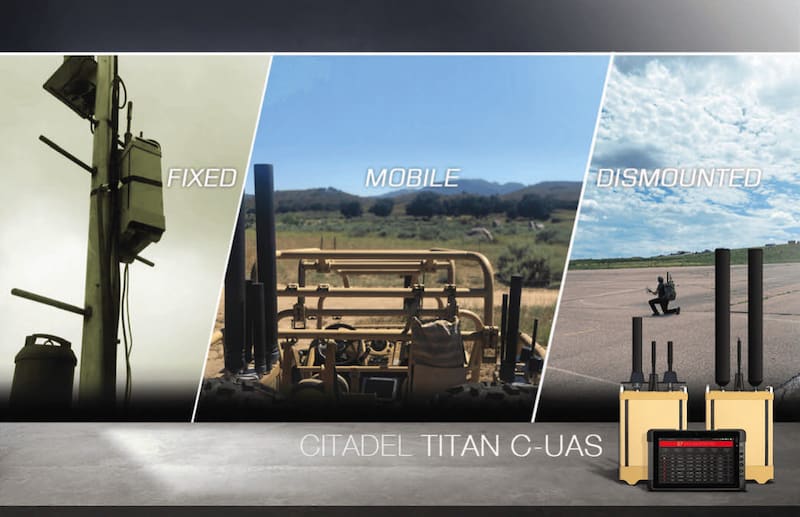
The U.S. Government and Department of Defense recently awarded Citadel Defense a $12.2M contract to defeat enemy drones on the battlefield and at covered locations in the United States. The decision to purchase Citadel's Titan systems was made after extensive U.S. Government evaluation that assessed more than a dozen other counter drone solutions.
The selection of Titan addresses immediate challenges caused by rapidly evolving drones domestically and overseas. Titan operates as a standalone system that is equally effective in fixed, mobile and dismounted operations, which simplifies lifecycle and sustainment challenges burdening troops and budgets today.
According to Matthew England, VP of Citadel Defense, “Deployed warfighters designed the system. Weighing 20 pounds and capable of autonomous operation, Titan has been detecting, identifying and defeating adversarial drones in extremely isolated fixed locations, complex urban environments, mobile missions on-the-move, and dismounted operations where man-portability is a premium.”
In June 2020, the Defense Department determined Titan’s superior performance after 14-months of successful combat deployments and government evaluations. The results of those evaluations showed that Titan adequately addressed the DOTMLPF (doctrine, organization, training, material, leadership and education, personnel, and facilities) strategies required for modernization in the fight against nefarious commercial and handmade drones.
Titan supports control frequencies of 2.4 GHz/5.8 GHz/Wi-Fi, with an optional extended frequency kit for 433 MHz/915 MHz/1.2 GHz/Wi-Fi. It has a detection range of up to 3 km horizontal and 1,500 ft vertical (variable with noise floor and environment) and a defeat range of up to 1.5 km horizontal and 1,500 ft vertical. Battery life is approximately 5 hours in detect mode and 2.5 hours in defeat mode, depending on duty cycle. Operating temperature range is -20° to +50°C.
The system’s artificial intelligence and deep learning foundation enables Titan to match or outpace the speed of the evolving threat, whether multi-agents and/or swarms, and provides the capability for layered C-sUAS defenses. This investment from the Department of Defense highlights a growing trend for relying on commercially available solutions to defend against rapidly evolving threats.
For Free Info Visit Here
More From SAE Media Group
Aerospace & Defense Tech Briefs
Counter UAS Defense System
Aerospace & Defense Tech Briefs
Multi-Mission UAS (MMU) Systems
Aerospace & Defense Tech Briefs
Low-Impact CUAS System
Aerospace & Defense Tech Briefs
Autonomous Air Defense Production
Aerospace & Defense Tech Briefs
British Army Completes First Test of Drone Killing Radio Frequency Weapon
Aerospace & Defense Tech Briefs
A New Approach to Counter-UAS Technology
Aerospace & Defense Tech Briefs
Autonomous Surveillance Technologies Relating to Dismounted Soldiers
Aerospace & Defense Tech Briefs
Anti-Drone Remote Weapon System
Aerospace & Defense Tech Briefs
Autonomous Collaborative Platform
Aerospace & Defense Tech Briefs
Counter-Drone Technology
Aerospace & Defense Tech Briefs
Assessing the Effectiveness of a Combat UGV Swarm in Urban Operations
Aerospace & Defense Tech Briefs
Enabling Off-the-Shelf Autonomous Naval Warfare
Aerospace & Defense Tech Briefs
Counter-UAS Technology
Aerospace & Defense Tech Briefs
Playing Defense — Uncertain Regulations Stall the Implementation of Counter-UAS Technology in The U.S.
Aerospace & Defense Tech Briefs
Anti-Drone Jammer
Aerospace & Defense Tech Briefs
Tactical Data Link Software
Aerospace & Defense Tech Briefs
The Evolution of Tactical Robots
Aerospace & Defense Tech Briefs
Precision Attack Drone

Tech Briefs
Approach Makes Unmanned Agents Self-Sufficient
Aerospace & Defense Tech Briefs
Ghoul Tool: The Weapon-Mountable Counter UAS Transmitter
Aerospace & Defense Tech Briefs
Foreign Counter-Unmanned Aerial Systems: Developments in the International Arms Markets

Aerospace & Defense Tech Briefs
Register Now: Counter UAS Technology 2021
Aerospace & Defense Tech Briefs
The Marines New Installation Counter UAS System
Defense INSIDER
Conference to Focus on Counter-Drone Technology
Aerospace & Defense Tech Briefs
Cutting-Edge Drone Killer Radio Wave Weapon Developing at Pace
Aerospace & Defense Tech Briefs
Light Tactical Vehicle
Aerospace & Defense Tech Briefs
A Simpler Method for Learning to Control a Robot
Aerospace & Defense Tech Briefs
Improving Battlefield Connectivity for the Modern Warfighter
Top Stories
NewsSensors/Data Acquisition
 Microvision Aquires Luminar, Plans Relationship Restoration, Multi-industry Push
INSIDERRF & Microwave Electronics
 A Next Generation Helmet System for Navy Pilots
INSIDERWeapons Systems
 New Raytheon and Lockheed Martin Agreements Expand Missile Defense Production
NewsAutomotive
 Ford Announces 48-Volt Architecture for Future Electric Truck
INSIDERAerospace
 Active Strake System Cuts Cruise Drag, Boosts Flight Efficiency
ArticlesTransportation

Webcasts
Aerospace
 Cooling a New Generation of Aerospace and Defense Embedded...
Energy
 Battery Abuse Testing: Pushing to Failure
Power
 A FREE Two-Day Event Dedicated to Connected Mobility
Automotive
 Quiet, Please: NVH Improvement Opportunities in the Early Design Cycle
Electronics & Computers
 Advantages of Smart Power Distribution Unit Design for Automotive &...
Unmanned Systems
 Sesame Solar's Nanogrid Tech Promises Major Gains in Drone Endurance