




Development and Verification of Body Armor Target Geometry Created Using Computed Tomography Scans
Previous methods of target geometry modeling involving manual measurement of armor systems and the translation of those measurements into computer-aided design geometry could be replaced by more accurate computer scanning technology.
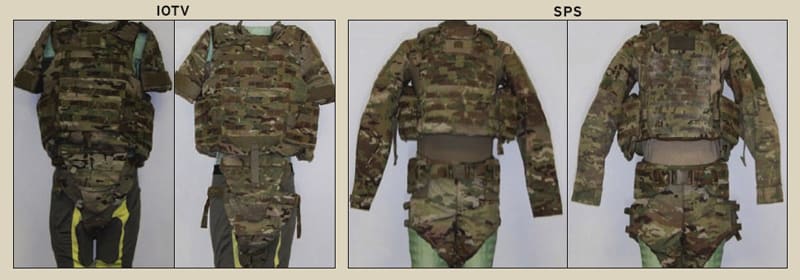
This research involved a new process developed to support the rapid development of computer-aided design (CAD) geometry to model personal protective equipment (PPE). The armor was developed and used in modeling and simulation for analysis of the Tier 4 Soldier Protection System (SPS) compared to the Improved Outer Tactical Vest (IOTV). The goal of modeling the PPE CAD geometry was to create a representation of the armor system to scale relative to the Operational Requirement-based Casualty Assessment (ORCA) man model and place the armor system in the correct location relative to anatomical landmarks.
To reduce production time and increase accuracy of armor placement for vulnerability/lethality modeling, the US Army Research Laboratory’s Survivability/Lethality Analysis Directorate explored a new process for CAD model creation. This methodology included CT scanning using the General Electric BrightSpeed model and placing the physical armor system on a foam manikin representative of ORCA man. This foam ORCA-man surrogate (referred to as foam manikin) is optimal for scanning given it is lightweight and has low density. It also provides real-life dimensions and fit of the armor system to the ORCA-man geometry, which is used for vulnerability/lethality modeling.
Four systems were CT-scanned on the foam manikin: a medium IOTV, the large IOTV pelvic under garment/pelvic outer garment (PUG/POG) system, a medium SPS, and a large SPS. Two scans for each system were conducted. The first included all pieces of the system: the cloth vest holding the hard plates and ballistic soft armor, the PUG/POG; the second included only the ballistic soft armor (outside of its cloth lining) placed on the foam manikin. This latter scan was to prevent scan artifact and material bunching or separation of soft armor layers. Only the large PPE systems were segmented, as those were being created to support SPS live-fire evaluations. Figure 1 displays the full IOTV and SPS systems on the ORCA foam model.
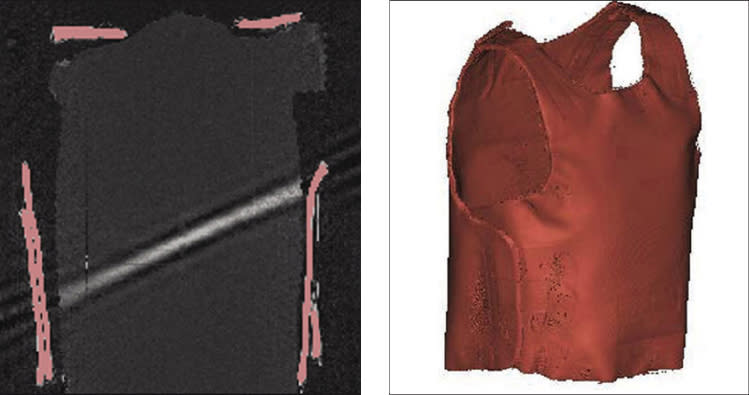
The CT scans resulted in Digital Imaging and Communications in Medicine (DICOM) formatted data. DICOM format is the international standard for medical imaging. The DICOM data and header files provide a series of stacked images along with metadata and measurements. For this process, the DICOM files were used to understand and create a 3-D model of each armor system by examining and defining layers of materials. After the scans were collected, they were analyzed, segmented, re-topologized, and finalized as CAD geometry.
To segment the CT scans, each respective set of the DICOM images was loaded into Materialise’s Mimics analysis software. Each PPE component was segmented into individual pieces, which together define the entire armor system. Segmentation is the process of applying a 2-D mask to each image in the DICOM image series to define the armor system object of interest. The defined 2-D mask was then used to generate 3-D geometry, as shown in Figure 2. The 2-D masks were created using a series of density selection tools as well as manual selection tools. The masks often have high resolution and artifact interference that result in initial geometry that requires further refinement to ensure the model is smooth and watertight.
This work was done by Autumn R. Kulaga, Kathryn L. Loftis and Eric Murray for the Army Research Laboratory. For more information, download the Technical Support Package (free white paper) below. ARL-0227
This Brief includes a Technical Support Package (TSP).
Development and Verification of Body Armor Target Geography Created Using Computed Tomography Scans
(reference ARL-0227) is currently available for download from the TSP library.
Don't have an account?
More From SAE Media Group
Aerospace & Defense Tech Briefs
Adding Context to Full-Motion Video for Improved Surveillance and Situational Awareness
Tech Briefs
3D Image Processing Optimizes Workflow
Aerospace & Defense Tech Briefs
Spatiotemporal Imaging Exploiting Structured Sparsity
Photonics & Imaging Technology
Advancements Make Laser-Based Imaging Simpler and Three-Dimensional

Off-Highway Engineering
TE Connectivity Enhances Digital Platform with CT Data Analysis


Photonics & Imaging Technology
An Alternative Approach to 3D Reconstruction
Tech Briefs
3D Camera Merges Depth and Spectral Data

Tech Briefs
5Ws of the Quanta Image Sensor
Air Force Research Laboratory Technology Horizons
Geo*View
Aerospace Manufacturing and Fabrication
Quality Control for Additive Manufacturing Parts Using Non-Destructive Testing
Aerospace & Defense Tech Briefs
Industry Invited to Participate in AeroTech Aerospace and Defense Technical Program
Photonics & Imaging Technology
Helping Autonomous Vehicles See Around Corners
Aerospace & Defense Tech Briefs
Digital Twins: How The Digital Replica Concept Is Used By Robotic Systems

Tech Briefs
Efficient Hexagonally Sampled Image Processing
Aerospace & Defense Tech Briefs
Simulation of Active Imaging Systems
Photonics & Imaging Technology
Making VR a NASA Reality
Aerospace & Defense Tech Briefs
A 'STEP' Forward for Product Lifecycle Management
Sensor Technology
Digital Twins for Industry
Aerospace & Defense Tech Briefs
The Role of Engineering Simulation in the Evolution of Unmanned Aircraft Systems

Motion Design INSIDER
Physics-Aware Neural Networks Improve Camera-Based Machines
Aerospace & Defense Tech Briefs
3D Scanning Provides Key Weapon for Aerospace and Defense Manufacturing
Aerospace & Defense Tech Briefs
3D Optical Scanner
Tech Briefs
NASA at 60: From Space to Earth
Overview
The document outlines a new process developed for the rapid creation of computer-aided design (CAD) geometry specifically aimed at modeling personal protective equipment (PPE), particularly body armor. This initiative is part of the analysis for the Tier 4 Soldier Protection System (SPS) in comparison to the Improved Outer Tactical Vest (IOTV). The report emphasizes the importance of accurate geometry in modeling and simulation for effective analysis and verification of body armor performance.
The introduction highlights the necessity of advanced modeling techniques to enhance the design and functionality of PPE. The report details the methods, assumptions, and procedures employed in the development of the CAD geometry, ensuring that the models created are precise and suitable for their intended applications. This involves a thorough verification process to confirm the accuracy of the geometries, which is crucial for the reliability of simulations used in evaluating the protective capabilities of the armor.
The document is structured to provide a comprehensive overview, including sections on results and discussions that analyze the effectiveness of the developed models. It also includes conclusions that summarize the findings and implications of the research, as well as references for further reading. The report is designed to be accessible, with a clear distribution policy indicating that it is approved for public release and has unlimited distribution.
In addition to the technical content, the report includes disclaimers stating that the findings should not be interpreted as an official position of the Department of the Army unless specified otherwise. It also emphasizes the importance of proper handling and disposal of the document once it is no longer needed.
Overall, this report serves as a significant contribution to the field of military protective equipment design, showcasing innovative approaches to modeling that can lead to improved soldier safety and performance in the field. The findings and methodologies presented are intended to inform future developments in body armor technology and enhance the overall effectiveness of soldier protection systems.
Top Stories
NewsRF & Microwave Electronics
 Microvision Aquires Luminar, Plans Relationship Restoration, Multi-industry Push
INSIDERAerospace
 A Next Generation Helmet System for Navy Pilots
INSIDERDesign
 New Raytheon and Lockheed Martin Agreements Expand Missile Defense Production
INSIDERMaterials
 How Airbus is Using w-DED to 3D Print Larger Titanium Airplane Parts
NewsPower
 Ford Announces 48-Volt Architecture for Future Electric Truck
ArticlesAR/AI

Webcasts
Electronics & Computers
 Cooling a New Generation of Aerospace and Defense Embedded...
Automotive
 Battery Abuse Testing: Pushing to Failure
Power
 A FREE Two-Day Event Dedicated to Connected Mobility
Unmanned Systems
 Quiet, Please: NVH Improvement Opportunities in the Early Design Cycle
Automotive
 Advantages of Smart Power Distribution Unit Design for Automotive &...
Energy
 Sesame Solar's Nanogrid Tech Promises Major Gains in Drone Endurance