




Simulation of Active Imaging Systems
Better data could lead to systems that improve tactical target acquisition, particularly under adverse environmental conditions.
Active imaging systems offer the promise of significantly improved tactical performance compared to passive military systems operating in adverse ground, air, and underwater/ maritime environments. These improvements would include, but are not limited to:
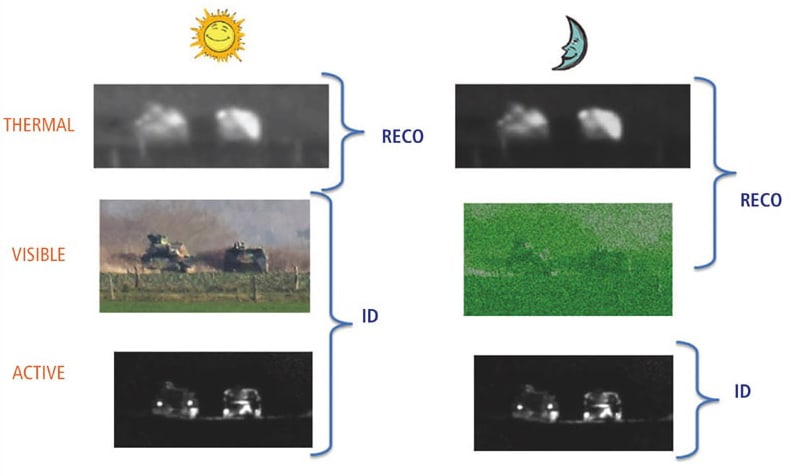
Extending the ability to operate when passive sensors will not perform satisfactorily;
Improving target detection, recognition, and identification performance; and
Improving capability to determine the exact nature of the activity being pursued by individuals or vehicles at increased ranges.
The modern military battlefield could therefore greatly benefit from the use of active imaging systems.
Accurate modelling and simulation tools can aid in the design and development, as well as the performance assessment, of active imaging systems. Currently available imaging models are limited in their ability to accurately represent active imaging systems in full spectral simulations, particularly in the atmosphere's effect on laser beam propagation and corresponding radiometric phenomenology on advanced sensor systems. NATO SET-219 working group proposes to mitigate these limitations by advancing the modelling and simulation tools and techniques for state-of-the-art 1D/2D/3D active imaging systems. In this context, simulation is understood to mean the generation of synthetic image sequences that include laser illumination/environmental/sensor system parameters.
SET-219 began with the following set of objectives and goals that would advance the working group's understanding, leveraging much of what was learned through previous groups (SET-072 and SET-156), and provide situational awareness of the state-of-the-art in active imaging simulation tools and techniques:
Perform a robust review of existing active imaging system simulations currently being used throughout NATO SET community.
Evaluate high resolution physics-based simulations of active imaging system phenomenology, e.g., phase screen propagation and full spectral scene generation; evaluation concentrated on the block components of the simulations, viz.:
Laser interaction with atmospheric and underwater environments;
Target and background characterization;
Sensor system components and subcomponents, i.e., laser illuminator and detector; and
Performance limits and capability gaps.
Demonstrate and exercise simulations on 1D/2D/3D active imaging system applications.
Recommend improvements to active imaging system simulations.
The group was able to address and make progress in each of the main objectives listed above. The resulting enhancements to active imaging simulations will be a critical enabler for future sensor technology development and assessment.
This work was done by the members of SET-219 for the NATO Science and Technology Organization. NATO-0001
This Brief includes a Technical Support Package (TSP).
Simulation of Active Imaging Systems
(reference NATO-0001) is currently available for download from the TSP library.
Don't have an account?
More From SAE Media Group

Aerospace & Defense Tech Briefs
Industry Invited to Participate in AeroTech Aerospace and Defense Technical Program
Aerospace & Defense Tech Briefs
Adding Context to Full-Motion Video for Improved Surveillance and Situational Awareness
Photonics & Imaging Technology
See Objects Hidden Around Corners
Aerospace & Defense Tech Briefs
SAE International Extends Call for Abstracts, Seeks Submissions for AeroTech Conference
Aerospace & Defense Tech Briefs
Spatiotemporal Imaging Exploiting Structured Sparsity
Aerospace & Defense Tech Briefs
Military Vehicle Situational Awareness System

Tech Briefs
A Step Toward More Accurate 3D Object Detection
Tech Briefs
Laser-Light-Based Accelerometer
Photonics & Imaging Technology
Leap in Lidar Could Improve Safety and Security of New Technology
Photonics & Imaging Technology
Megapixel Photon-Counting Camera Technology

Tech Briefs
A Laser-Focused Approach to LiDAR
Aerospace & Defense Tech Briefs
3D Data Acquisition Platform for Human Activity Understanding
Tech Briefs
Long-Distance LADAR System and Method
Medical Design Briefs
Sensor Uses Computer Vision-Based Optical Strain Technology
Tech Briefs
Vision System Sees Through Clouds and Fog
Photonics & Imaging Technology
Researchers Use Inkjet Printing to Make a Portable Multispectral 3D Camera
Off-Highway Engineering
Artificial Intelligence Being Schooled for Mining Applications
Aerospace & Defense Tech Briefs
Characterization of Bore Temperatures and Stresses in Small Caliber Gun Barrels
Tech Briefs
Silicon Chip Improves LiDAR
Tech Briefs
Plenoptic Camera
Photonics & Imaging Technology
Visualizing Value at the Speed of Light
Aerospace & Defense Tech Briefs
Laser Polarimeter Classifies Remote Material

Tech Briefs
Drones Use Machine Learning to Detect Landmines
Overview
The document titled "Simulation of Active Imaging Systems" (STO-TR-SET-219) is a comprehensive report published by the NATO Science and Technology Organization in December 2018. It focuses on the advancements and applications of active imaging systems, which are designed to enhance tactical performance in military operations compared to traditional passive systems.
The report begins with an introduction to the relevance of active imaging technologies, emphasizing their potential to operate effectively in conditions where passive sensors may fail. Active imaging systems utilize various techniques, including electro-optical/infrared (EOIR) sensors and LIDAR, to improve target recognition, identification, and situational awareness at extended ranges.
A significant portion of the document discusses the benefits of numerical simulation in the development and testing of these imaging systems. Numerical simulations allow for the modeling of complex scenarios and the evaluation of system performance without the need for extensive field testing, which can be costly and time-consuming. The report highlights how simulations can identify capability gaps and inform future research directions.
The document also includes case studies that illustrate the practical applications of active imaging systems in various military contexts. These case studies provide insights into the effectiveness of different imaging techniques and their integration into existing military frameworks.
Furthermore, the report addresses the current status of NATO's collaborative research efforts in this domain, outlining existing gaps in simulation capabilities and offering recommendations for future working groups. It emphasizes the importance of continued investment in research and development to keep pace with evolving threats and technological advancements.
In conclusion, the report serves as a valuable resource for understanding the state of active imaging systems and their role in modern military operations. It underscores the necessity of leveraging advanced simulation techniques to enhance the effectiveness of these systems, ultimately contributing to improved defense capabilities for NATO nations and partners. The document is publicly available and contains no distribution restrictions, making it accessible for further study and application in defense research and technology development.
Top Stories
INSIDERDefense
 New Raytheon and Lockheed Martin Agreements Expand Missile Defense Production
NewsAutomotive
 Ford Announces 48-Volt Architecture for Future Electric Truck
INSIDERManufacturing & Prototyping
 Active Strake System Cuts Cruise Drag, Boosts Flight Efficiency
ArticlesTransportation
 Accelerating Down the Road to Autonomy
INSIDERMaterials
 How Airbus is Using w-DED to 3D Print Larger Titanium Airplane Parts
Road ReadyTransportation

Webcasts
Electronics & Computers
 Cooling a New Generation of Aerospace and Defense Embedded...
Power
 Battery Abuse Testing: Pushing to Failure
Connectivity
 A FREE Two-Day Event Dedicated to Connected Mobility
Automotive
 Quiet, Please: NVH Improvement Opportunities in the Early Design Cycle
Transportation
 Advantages of Smart Power Distribution Unit Design for Automotive &...
Aerospace
 Sesame Solar's Nanogrid Tech Promises Major Gains in Drone Endurance