




Rebar Tying Robot
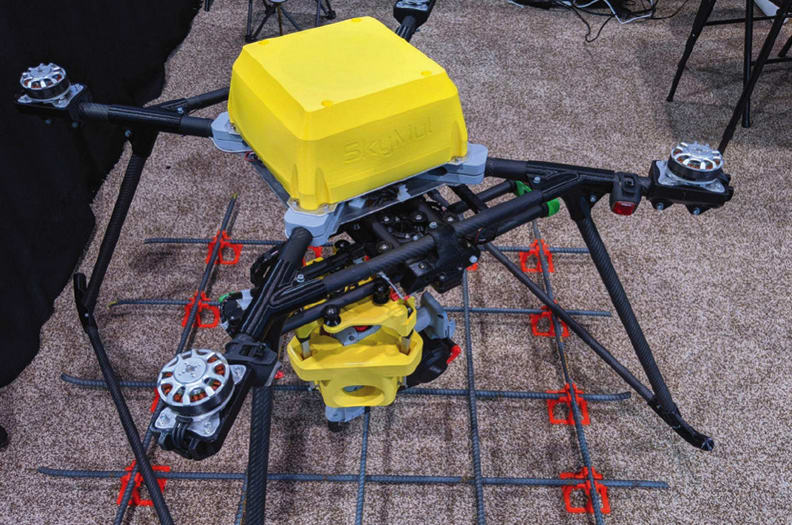
SkyMul
Atlanta, GA
This email address is being protected from spambots. You need JavaScript enabled to view it.
SkyMul, a Comcast incubated company founded by Georgia Tech Robotics Institute alumni and supported by a Small Business Innovation Research (SBIR) grant from various federal government agencies, is getting a lot of attention in the construction industry with their new invention called SkyTy, a swarm of drones that perform the back-breaking physical work of rebar tying for concrete flatwork and other slabs at construction sites.
The process of making structures from concrete is to first place rebar, tie it, pour the concrete, and wait for it to set. The rebar has to be tied so that it doesn’t move around when the concrete is poured or when laborers walk on top of it during the process of installation.
Moving the rebar during any of the above processes makes the building less strong than it was designed to be.
There are currently over 600,000 bridges in the USA and a large number are aging and will require replacement in the next few years. SkyMul founders believe that their SkyTy solution can help speed up the construction of the more than 22,000 bridges that will need to be replaced in the next 10 years.
Rodbusters who do this work, usually with metal wire and a plier-like tool or, in some cases, a rebar tying gun, currently have the highest rate of soft tissue damage (10x more than other industrial trades) and take significantly more time to recover for each injury. It is estimated that rodbusters will spend more than 2000 man-years over the next few years solely tying rebar to fix the 22,000 bridges that need to be fixed in the US. SkyMul believes it has a robotic solution to solve that problem.
SkyTy consists of a control station and a swarm of drones. The swarm size can be varied with the size of the jobs and the schedule for completion. The technician manning the system identifies the rebar installation area that needs tying. A divided section of the work area is assigned to each drone. After the technician selects the percentage of ties (50%,75%,100%) and the pattern for tying, multiple drones from the SkyTy swarm are deployed.
The drones fly over the rebar and identify rebar intersections without using CAD files or programming utilizing computer vision technology. They identify the untied intersection, land, tie it with metal wire, and takeoff towards the next intersection. Each drone, which operates independently of the others and is easily replaceable, then comes back to the landing station for spool and battery replacement.
After the completion of tying, SkyTy’s control station provides a report of the successful ties for quality control and archival. The SkyTy system enables a trained technician to perform the tying job done by multiple rodbusters, freeing up the rodbusters to do other critical tasks for rebar installation.
For Free Info Visit Here
More From SAE Media Group

Tech Briefs
Flying Robot Mimics Rapid Insect Flight
Aerospace & Defense Tech Briefs
Robotic Applique Kits Leverage Existing Assets
Tech Briefs
Insect-Sized Agile Drones
Aerospace & Defense Tech Briefs
XPONENTIAL 2019 – An AUVSI Experience
Aerospace & Defense Tech Briefs
The Evolution of Tactical Robots
Aerospace & Defense Tech Briefs
Digital Twins: How The Digital Replica Concept Is Used By Robotic Systems
Aerospace & Defense Tech Briefs
Soldier-Robot Team Communication: An Investigation of Exogenous Orienting Visual Display Cues and Robot Reporting Preferences
Motion Design
Bipedal Robot Achieves Better Body Balance
Aerospace & Defense Tech Briefs
Laser Cleaner Robot
Tech Briefs
Insect-Inspired Drone Deforms Upon Impact
Imaging Technology
Analyst Roundtable: Machine Vision Moves Beyond Manufacturing
Aerospace & Defense Tech Briefs
Designing the Next Generation of Military Robots
Tech Briefs
Army Research Laboratory
Aerospace & Defense Tech Briefs
XPONENTIAL 2018 – An AUVSI Experience
Motion Design
Giving Bug-Like Bots a Boost
Aerospace & Defense Tech Briefs
Anti-Drone Remote Weapon System
Aerospace & Defense Tech Briefs
SAE International Extends Call for Abstracts, Seeks Submissions for AeroTech Conference
Aerospace & Defense Tech Briefs
Industry Invited to Participate in AeroTech Aerospace and Defense Technical Program
Aerospace Manufacturing and Machining
Changing How the Aerospace Industry Makes Parts
Tech Briefs
Microrobot Powered by Soft Muscles
Aerospace & Defense Tech Briefs
Boeing advances automation with smart and portable orbital drilling tools for 787
Aerospace & Defense Tech Briefs
AIA Predicts Flying Air Taxis, Supersonic Air Travel, and Space Industry for 2050
Tech Briefs
Compact 3D LiDAR Imaging System
Motion Design
A Cost-Effective Way to Automate Industrial Processes
Motion Design
Hybrid Robot Flies, Creeps, and Leaps Off Buildings
Aerospace & Defense Tech Briefs
Removing Aircraft Paint Using Laser-Equipped Robots
Tech Briefs
Large-Scale Robotic Inkjet Printing System
Motion Design
Robots Assemble Large Structures from Little Pieces
Aerospace & Defense Tech Briefs
XPONENTIAL: An AUVSI Experience
Top Stories
INSIDERRF & Microwave Electronics
 FAA to Replace Aging Network of Ground-Based Radars
NewsManufacturing & Prototyping
 Rewriting the Engineer’s Playbook: What OEMs Must Do to Spin the AI Flywheel
Road ReadyTransportation
 2026 Toyota RAV4 Review: All Hybrid, All the Time
NewsDesign
 CES 2026: Bosch is Ready to Bring AI to Your (Likely ICE-powered) Vehicle
INSIDERManned Systems
 F-22 Pilot Controls Drone With Tablet
EditorialLighting Technology

Webcasts
Energy
 Powering America’s EV Future: Connect, Collaborate, Innovate
Power
 E/E Architecture Redefined: Building Smarter, Safer, and Scalable...
Power
 Hydrogen Engines Are Heating Up for Heavy Duty
Electronics & Computers
 Advantages of Smart Power Distribution Unit Design for Automotive...
Transportation
 Quiet, Please: NVH Improvement Opportunities in the Early Design...
