




Soldier-Robot Team Communication: An Investigation of Exogenous Orienting Visual Display Cues and Robot Reporting Preferences
The effective use of robots to conduct dangerous missions depends on accurate man-machine communications.
The advancement of robot capabilities and functionality has changed the way in which soldiers perform many of their operational tasks. The various unmanned air, ground, and submersible vehicles currently deployed have significantly impacted present-day warfare.

Although many of these systems have shown to be beneficial and effective for mission success, traditional control of these systems is through tele-operation. While teleoperation may be necessary and appropriate for situations that may otherwise require soldiers to be exposed to hazardous or life-threatening situations, it is not recommended for dismounted operations. Hence, autonomous robots provide a solution that takes advantage of current robot sensing and intelligence while reducing the cognitive demands on the soldier, allowing robots to maintain awareness of the operational environment. However, the implementation of autonomous robots within human teams carries with it concern regarding human-robot interaction (HRI) and, more specifically, human-robot communication.
Moving beyond teleoperation, military HRI has focused on integrating multimodal communication (MMC) methods that leverage the natural ways in which human-human interaction takes place and the commonly employed functionality for human-computer interaction. In a general sense, MMC is sending and/or receiving information through multiple sensory systems (e.g., seeing text information that is also presented in an audible format).
In terms of benefits for signal-communication processing, MMC systems are robust, flexible, efficient, intuitive, and redundant. While many robot systems are equipped with multimodal interaction capabilities, the impact of each communication type on the soldier's ability to perform task critical operations is not well known. Therefore, systematic evaluation of the components that comprise the transactions between humans and robots and the way in which information is conveyed is critical prior to the deployment of any system to the field.
There were two major goals for this experiment. The first was to investigate the effects on performance and operator perception of various exogenous orientation design cues associated with a visual display in a multimodal interface to facilitate squad-level communication within a dismounted soldier-robot team. In particular, this goal focused on determining whether the elements of visually displayed robot reports provided adequate information about the situational context so the soldier could quickly determine the best course of action the robot should take without being cognitively overloaded. The second goal was to investigate soldiers’ preferences when it came to status updates from a robot teammate (e.g., reporting frequency and format). Specifically, this aspect of the experiment focused on understanding the relationship between robot-reporting preferences, task performance, and situation awareness (SA) with a soldier population.
This work was done by Daniel J. Barber, Julian Abich IV, Andrew B. Talone, Elizabeth Phillips, and Florian Jentsch of the University of Central Florida; and Rodger Pettitt and Linda R. Elliott for the Army Research Laboratory. ARL-0211
This Brief includes a Technical Support Package (TSP).
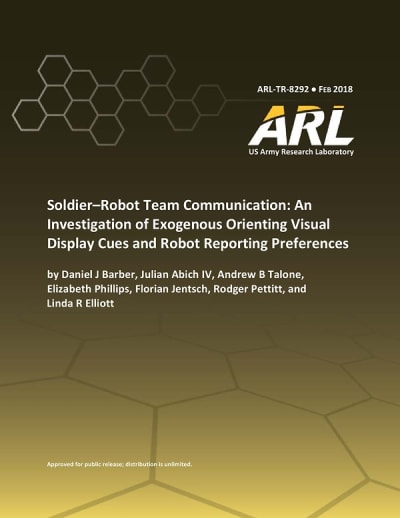
Soldier-Robot Team Communication: An Investigation of Exogenous Orienting Visual Display Cues and Robot Reporting Preferences
(reference ARL-0211) is currently available for download from the TSP library.
Don't have an account?
More From SAE Media Group
Aerospace & Defense Tech Briefs
Characterizing Motion Prediction in Small Autonomous Swarms
Aerospace & Defense Tech Briefs
Making Unmanned Ground Vehicles Operate More Autonomously
Aerospace & Defense Tech Briefs
Autonomous Surveillance Technologies Relating to Dismounted Soldiers
Aerospace & Defense Tech Briefs
SAE International Extends Call for Abstracts, Seeks Submissions for AeroTech Conference
Motion Design
Technique Allows Mobile Robots to Navigate Autonomously
Aerospace & Defense Tech Briefs
Gesture-Based Controls for Robots: Overview and Implications for Use by Soldiers
Aerospace & Defense Tech Briefs
Industry Invited to Participate in AeroTech Aerospace and Defense Technical Program
Aerospace & Defense Tech Briefs
Effectiveness of Inter-Vehicle Communications and On-Board Processing for Close Unmanned Autonomous Vehicle Flight Formations
Medical Design Briefs
Using Robots in Patient Rehabilitation
Aerospace & Defense Tech Briefs
The Evolution of Tactical Robots
Aerospace & Defense Tech Briefs
The CAN Bus: Driving the Future of Autonomous Military Vehicles

Tech Briefs
Approach Makes Unmanned Agents Self-Sufficient
Motion Design
Computational Model Enables Robots to Learn New Concepts
Aerospace & Defense Tech Briefs
Army and Universities Deploy New Warfighter Communication Technology

Tech Briefs
System Provides Robots with Context Awareness
Aerospace & Defense Tech Briefs
3D Data Acquisition Platform for Human Activity Understanding
Tech Briefs
Self-Learning Robot Hands Adapt to Grasp Objects
Tech Briefs
Executive Perspectives: Robotics
Tech Briefs
Pervasive Biocybernetic Adaptation
Tech Briefs
Giving Autonomous Vehicles the Ability to Reason

Aerospace & Defense Tech Briefs
Quantifying Autonomous Soaring on a Surveillance and Communications Relay Mission

Overview
The document titled "Soldier–Robot Team Communication: An Investigation of Exogenous Orienting Visual Display Cues and Robot Reporting Preferences" explores the dynamics of communication between dismounted soldiers and robotic teammates. The research focuses on how visual display cues and reporting preferences can enhance bidirectional communication, which is crucial for effective teamwork in military operations.
Key findings indicate that soldiers benefit from various modalities of communication that do not solely rely on visual displays. The study emphasizes the importance of adaptive automation, which adjusts the frequency of information sharing based on the difficulty of primary tasks. This adaptability helps manage cognitive load and ensures that soldiers receive pertinent information without being overwhelmed.
Participants in the study expressed a preference for condensed and summarized information presented in text format. However, they also valued having multiple report formats available, suggesting that redundancy in information presentation can be beneficial. This insight is critical for future designs of man-machine interfaces (MMIs), as it highlights the need for flexibility in how information is conveyed to users.
The document includes appendices that provide additional context, such as a free response questionnaire and informed consent forms, which are essential for understanding the research methodology and ethical considerations involved in the study.
Overall, the research underscores the significance of effective communication strategies in soldier-robot interactions, advocating for designs that accommodate diverse preferences and task demands. By focusing on user-centered design principles, the findings aim to enhance the operational effectiveness of soldier-robot teams in various scenarios, ultimately contributing to mission success and safety in the field.
In summary, the document presents valuable insights into the communication preferences of soldiers when interacting with robotic systems, emphasizing the need for adaptive and flexible information presentation to support effective teamwork.
Top Stories
NewsRF & Microwave Electronics
 Microvision Aquires Luminar, Plans Relationship Restoration, Multi-industry Push
INSIDERAerospace
 A Next Generation Helmet System for Navy Pilots
INSIDERDesign
 New Raytheon and Lockheed Martin Agreements Expand Missile Defense Production
INSIDERMaterials
 How Airbus is Using w-DED to 3D Print Larger Titanium Airplane Parts
NewsPower
 Ford Announces 48-Volt Architecture for Future Electric Truck
ArticlesAR/AI

Webcasts
Electronics & Computers
 Cooling a New Generation of Aerospace and Defense Embedded...
Automotive
 Battery Abuse Testing: Pushing to Failure
Power
 A FREE Two-Day Event Dedicated to Connected Mobility
Unmanned Systems
 Quiet, Please: NVH Improvement Opportunities in the Early Design Cycle
Automotive
 Advantages of Smart Power Distribution Unit Design for Automotive &...
Energy
 Sesame Solar's Nanogrid Tech Promises Major Gains in Drone Endurance