




Characterizing Motion Prediction in Small Autonomous Swarms
Despite the expanded use of robotic swarms, little is known about how swarms are perceived by human operators. To characterize human-swarm interactions, we evaluate how operators perceive swarm characteristics, including movement patterns, control schemes, and occlusion.

Prior investigations of swarm robot control focus on optimizing communication and coordination between agents, with at most one human control scheme, or with discrete (rather than continuous) human control schemes. In these studies, focus tends to be on human-robot interactions, including human-machine gesture interfaces, human-machine interaction during conversation, or evaluation of higher-level mental states like comfort, happiness and cognitive load. While there is early work in human control of Unmanned Arial Vehicles (UAVs) and interface design, there are few systematic studies of how human operators perceive fundamental properties of small swarms of ground-based semi-autonomous robots. Therefore, the goal of this study is to better understand how humans perceive swarms of semi-autonomous agents across a range of conditions.
Given fundamental properties of tracking swarms derive from basic cognitive processes, prior research offers clues to understand the limits and abilities of human swarm operators. First, object tracking is a ubiquitous real-world visual phenomenon that has been thoroughly investigated. It is established that humans can accurately track the path of single-object motion in straight lines, arcs, and sinusoids. Even through occlusion, humans can accurately predict the future location of a single moving object.
Further, work on motion extrapolation and tracking through occlusion for single objects suggests that humans can accurately align their eyes with the position of an occluded target. It has been suggested that target velocity information encoded prior to occlusion is used to update the tracking mechanism at the correct rate. While humans cannot usually produce smooth eye movements in the absence of a moving target, they can produce anticipatory smooth pursuit eye movements scaled according to the expected velocity of an upcoming target or a target reappearing after occlusion.
Second, multiple object tracking (MOT) defines humans’ ability to simultaneously track small numbers of moving objects. The boundaries of multiple tracking ability suggest capacity limits of approximately 3–5 items.
However, this capacity limit is impacted by multiple factors, including object speed, stimulus complexity, individual variability and motion of the observer. Other variables such as expertise can also impact one’s ability to track multiple objects. For instance, team sports, video game playing, and military activities are thought to impact one’s MOT capacity. While the MOT literature informs our general understanding of tracking multiple objects, work on the perception of ensembles is useful for applications relevant to robot swarms. For instance, objects in groups greater than 3–4 are perceived more like a group or ensemble. When this grouping occurs, humans can quickly estimate average properties such as hue, facial expression, motion, size, and orientation. Furthermore, perception of dynamic ensembles is impacted by group properties, such as group size and inter-object spacing. Specifically, multiple object tracking tends to decline as inter-object spacing dynamically shift from a groups motion trajectory. Overall, humans accurately estimate the position centroid of groups of objects. Nevertheless, the study of ensemble perception to date primarily relies on rapid exposure to static stimuli.
The current investigation lies at the intersection of object tracking and ensemble perception. Specifically, the goal is to characterize the cognitive processes involved in tracking dynamic ensembles (i.e., swarms). While little work has been done on this particular topic thus far, the literature indicates there are indeed perceptual challenges, such as high cognitive demands and non-intuitive behaviors that play a role in the control of semi-autonomous swarms.
This work was performed by Seth Elkin-Frankston for the U.S. Army Combat Capabilities Development Command Soldier Center, Natick, MA. For more information, download the Technical Support Package (free white paper) under the Communications category.
This Brief includes a Technical Support Package (TSP).
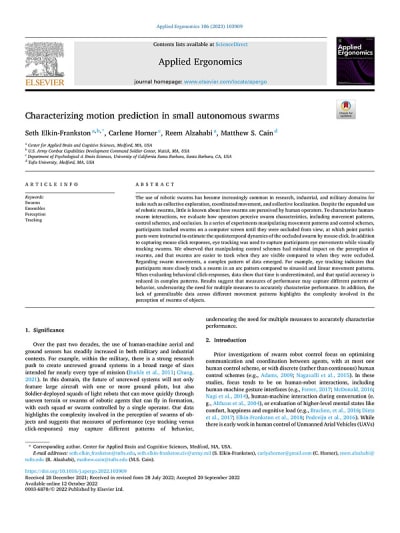
Characterizing Motion Prediction in Small Autonomous Swarms
(reference ARL-96552) is currently available for download from the TSP library.
Don't have an account?
More From SAE Media Group
Aerospace & Defense Tech Briefs
Soldier-Robot Team Communication: An Investigation of Exogenous Orienting Visual Display Cues and Robot Reporting Preferences
Aerospace & Defense Tech Briefs
A Simpler Method for Learning to Control a Robot
Motion Design
Maneuvering Robot Control Using Machine Learning
Aerospace & Defense Tech Briefs
One Person Can Supervise a Swarm of 100 Unmanned Autonomous Vehicles
Aerospace & Defense Tech Briefs
Making Unmanned Ground Vehicles Operate More Autonomously
Tech Briefs
Approach Makes Unmanned Agents Self-Sufficient
Motion Design
Technique Allows Mobile Robots to Navigate Autonomously


Aerospace & Defense Tech Briefs
Drone Swarms: A Transformational Technology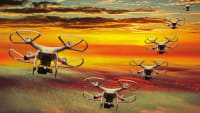
Automotive Engineering
Emulating 5G Networks for AV Testing
Aerospace & Defense Tech Briefs
Gesture-Based Controls for Robots: Overview and Implications for Use by Soldiers
Aerospace & Defense Tech Briefs
Autonomous Surveillance Technologies Relating to Dismounted Soldiers
Tech Briefs INSIDER
Human-Robot Interaction: When Robotics Meets Philosophy
Motion Design
A Robot to Aid People with Mild Cognitive Impairment
Aerospace & Defense Tech Briefs
Validation of Architecture Models for Coordination of Unmanned Air and Ground Vehicles via Experimentation
Tech Briefs
Giving Autonomous Vehicles the Ability to Reason
Aerospace & Defense Tech Briefs
Test and Evaluation of Autonomy for Air Platforms
Aerospace & Defense Tech Briefs
Will Generative AI Transform Robotics?
Aerospace & Defense Tech Briefs
Agile Robust Autonomy: Inspired by Connecting Natural Flight and Biological Sensors
Tech Briefs
Drones Change Shape Mid-Flight
Aerospace & Defense Tech Briefs
Creating and Verifying Stable AI-Controlled Systems in a Rigorous, Flexible Way
Motion Design INSIDER
Unleashing the Power of Intelligent Drone Swarms
Tech Briefs
Executive Perspectives: Robotics
Tech Briefs
Charging Port for Autonomous Drone Swarms
Tech Briefs
Insect-Sized Agile Drones
Overview
The document presents a study on the perception and tracking of small autonomous swarms, focusing on how human operators interact with these robotic ensembles under varying conditions. Conducted by researchers from Tufts University and the U.S. Army Combat Capabilities Development Command, the study aims to enhance understanding of human-swarm interactions, which are increasingly relevant in research, industrial, and military applications.
The introduction outlines the significance of swarm robotics, emphasizing their use in tasks such as collective exploration and coordinated movement. Previous research has primarily focused on optimizing communication and coordination among robots, often with limited human control schemes. This study seeks to fill the gap by investigating how humans perceive and track swarms, particularly in scenarios where swarms exhibit different movement patterns and control schemes.
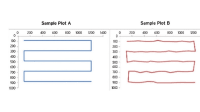
The experimental design involved twenty-four participants who were compensated for their involvement. The study utilized a within-participants design with two main factors: control scheme (lockstep vs. leader) and movement pattern (linear, arc, sinusoid). Participants engaged in tasks where they tracked an ensemble of robotic triangles moving across a screen, either in a synchronized manner (lockstep) or following a designated leader triangle.
Data collection included eye tracking and click-response measures to assess participants' tracking abilities. The apparatus used for the experiment was a Dell Optiplex computer with a high-resolution monitor, and stimuli were generated using MATLAB software. The study aimed to analyze how different control schemes and movement patterns affected participants' ability to track the swarms effectively.
Results from the experiments are discussed, highlighting the significance of the findings in understanding human-swarm interactions. The study concludes with recommendations for future research, emphasizing the need for systematic investigations into how humans perceive the fundamental properties of semi-autonomous robotic swarms in real-world scenarios.
Overall, this research contributes valuable insights into the cognitive processes involved in tracking robotic swarms, which can inform the design of more effective human-robot interaction systems and enhance the operational capabilities of autonomous swarms in various applications.
Top Stories
NewsRF & Microwave Electronics
 Microvision Aquires Luminar, Plans Relationship Restoration, Multi-industry Push
INSIDERAerospace
 A Next Generation Helmet System for Navy Pilots
INSIDERDesign
 New Raytheon and Lockheed Martin Agreements Expand Missile Defense Production
INSIDERMaterials
 How Airbus is Using w-DED to 3D Print Larger Titanium Airplane Parts
NewsPower
 Ford Announces 48-Volt Architecture for Future Electric Truck
ArticlesAR/AI

Webcasts
Electronics & Computers
 Cooling a New Generation of Aerospace and Defense Embedded...
Automotive
 Battery Abuse Testing: Pushing to Failure
Power
 A FREE Two-Day Event Dedicated to Connected Mobility
Unmanned Systems
 Quiet, Please: NVH Improvement Opportunities in the Early Design Cycle
Automotive
 Advantages of Smart Power Distribution Unit Design for Automotive &...
Energy
 Sesame Solar's Nanogrid Tech Promises Major Gains in Drone Endurance