




Predator Mission Aircrew Training Systems
L-3 Link Simulation & Training
Arlington, TX
817-619-2000
www.Link.com
L-3 Link Simulation & Training (L-3 Link) was recently awarded a contract option from the U.S. Air Force to build 34 new Predator Mission Aircrew Training System (PMATS) simulators. The contract was awarded by the U.S. Air Force’s Life Cycle Management Center at Wright-Patterson Air Force Base.
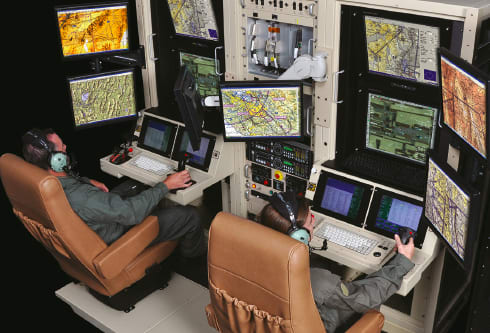 The new PMATS simulators will be used to train Predator and Reaper pilot and sensor operator crews. PMATS training devices, in addition to associated equipment and systems, will be delivered to 15 installations between the U.S. Air Force and U.S. Air National Guard.
The L-3 Link-developed and -produced PMATS training solution has been supporting training for the U.S. Air Force and U.S. Air National Guard since initial devices were delivered in 2007. L-3 Link, under previously awarded contracts, has fielded or is continuing to build 33 PMATS devices. This new dediaward for 34 additional PMATS simulators will result in L-3 fielding a combined total of 67 Predator and Reaper trainers to support the services’ crew training objectives.
Under this contract option, L-3 Link will integrate its simulation environment solution with ground control stations supplied by the U.S. Air Force. L-3 Link’s simulation solution combines a physics-based image generator, Synthetic Automated Forces generator, instructor station, and other training system hardware and software. PMATS training devices create a high-fidelity environment that simulates aircraft performance, weapons, sensors, communications, data link operations, emergencies, degraded video feeds and environmental conditions. On these simulators, Predator and Reaper crews undergo initial qualification, mission qualification, continuation and mission rehearsal training.
For Free Info Click Here
More From SAE Media Group
Aerospace & Defense Tech Briefs
Flight Simulators Help Train Unmanned Aircraft Crews
Aerospace & Defense Tech Briefs
Autonomous Collaborative Platform
Aerospace & Defense Tech Briefs
F-16 Full Mission Trainers
Aerospace & Defense Tech Briefs
Electronic Warfare Combat Training Pod
Aerospace & Defense Tech Briefs
Tactical Fighting System Simulator
Aerospace & Defense Tech Briefs
Remotely Piloted Air Systems
Aerospace & Defense Tech Briefs
Game-Based Training Environment
Aerospace & Defense Tech Briefs
Unmanned Aircraft Training Materials
Aerospace & Defense Tech Briefs
Industry Invited to Participate in AeroTech Aerospace and Defense Technical Program
Aerospace & Defense Tech Briefs
UAV Ground Control Station
Aerospace INSIDER
A-10 Warthog to Get New Mission Computer
Aerospace INSIDER
How the Air Force's B-21 Raider is Advancing Across Test and Production
Aerospace INSIDER
AI-Powered Radar Warning Receiver for Fourth Generation Aircraft
Defense INSIDER
AgilePod Flies on U.S. Air Force MQ-9 Reaper
Aerospace INSIDER
Can Microvanes Improve Fuel Efficiency for Legacy Air Force Aircraft?
Aerospace INSIDER
Helsing AI Agent Completes Saab Gripen E Test Flight
Aerospace INSIDER
Boeing to Develop Two New E-7 Variants for US Air Force
Aerospace INSIDER
F-35 Completes First Flight with Technology Refresh 3 Upgrades
Aerospace & Defense Tech Briefs
Mobile Counter Unmanned Aircraft System
Aerospace INSIDER
AFMC Completes First Ever Flight of F-35 with F-22 Software
Aerospace & Defense Tech Briefs
Electronic Warfare Development Targets Fully Adaptive Threat Response Technology
Aerospace & Defense Tech Briefs
F/A-18 Infrared Search and Rescue System
Aerospace INSIDER
Bombardier to Start Building New Army HADES Prototype Spy Plane
Aerospace & Defense Tech Briefs
Flight Testing Microvanes and Riblets
Aerospace & Defense Tech Briefs
Towed Airborne Plume Simulator
Aerospace & Defense Tech Briefs
Advanced Airborne Defensive Laser for Incorporation on Strike Fighter Aircraft
Aerospace INSIDER
Anduril Completes First Semi-Autonomous Flight of CCA Prototype
Tech Briefs
Next-Generation Radar for the F-35 Lightning II
Aerospace & Defense Tech Briefs
Leveraging COTS Products for Maneuverable Aerial Identification
Top Stories
INSIDERManufacturing & Prototyping
 How Airbus is Using w-DED to 3D Print Larger Titanium Airplane Parts
INSIDERManned Systems
 FAA to Replace Aging Network of Ground-Based Radars
NewsTransportation
 CES 2026: Bosch is Ready to Bring AI to Your (Likely ICE-powered) Vehicle
NewsSoftware
 Accelerating Down the Road to Autonomy
EditorialDesign
 DarkSky One Wants to Make the World a Darker Place
INSIDERMaterials
 Can This Self-Healing Composite Make Airplane and Spacecraft Components Last...
Webcasts
Defense
 How Sift's Unified Observability Platform Accelerates Drone Innovation
Automotive
 E/E Architecture Redefined: Building Smarter, Safer, and Scalable...
Power
 Hydrogen Engines Are Heating Up for Heavy Duty
Electronics & Computers
 Advantages of Smart Power Distribution Unit Design for Automotive...
Unmanned Systems
 Quiet, Please: NVH Improvement Opportunities in the Early Design...
