




Towed Airborne Plume Simulator
Arnold Engineering Development Complex
Arnold Air Force Base, TN
931-454-5655
For more info click here
A team of engineers at AEDC are supporting the continued development and testing of the Towed Airborne Plume Simulator (TAPS), a simulator that can be towed behind aircraft for testing missile warning and infrared countermeasure systems. Most recently the AEDC TAPS team assisted the Air Force Research Laboratory with a mission in Australia.
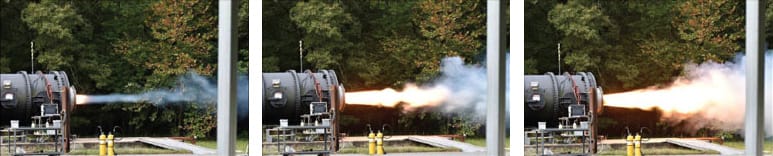
Dr. Robert Hiers, principal investigator for TAPS at AEDC, stated that TAPS is directly aligned with the AEDC mission of providing test tools to the developmental and operational test communities. One of the things that makes this project unique is that it consists of a towed pod that contains a pyrophoric burner. “A pyrophoric fuel is one that combusts on contact with air,” Hiers said. “TAPS contains valves and a control system that allow precise control of the flow rate of the pyrophoric fuel. In this manner, we can simulate the temporal behavior of missile plumes.”
The simulator is used to test missile warning systems on aircraft by being towed behind one aircraft while the missile warning system to be tested, the System Under Test (SUT), is installed on another. Using a towed simulator resolves the shortfalls of emulating spatial / temporal signatures for testing missile warning systems and infrared countermeasures systems.
“The TAPS pyrophoric plume is controlled to simulate the signature of threat missiles,” Hiers said. “The SUT sensor is monitoring for threats, and, if TAPS does its job, the SUT sensor will be put through its paces. Since we don't shoot real missiles at manned aircraft in order to test missile warning systems, TAPS provides the next best overall test technique. The missile warning system is installed on the aircraft and is interacting with all the aircraft systems. TAPS provides an operational realism that cannot be duplicated with ground-based simulators or hardware-in-the-loop simulations.”
AEDC test teams have been involved with TAPS since it began in 2002 with an Analysis of Alternatives for the burner system. This was followed by a burner development program, proof of principle and proof of concept burner testing, and a first flight test that was completed in 2008.
“Current TAPS development efforts are focused on adding capability, including extension of the flight envelope at lower altitudes and airspeeds to support missile warning system testing on helicopters, extension to higher altitudes and airspeeds to enable better simulation of air-to-air missile shots, and brighter pyrophoric burners in order to simulate larger missiles,” Hiers said.
For Free Info Click Here
More From SAE Media Group
Aerospace & Defense Tech Briefs
Advanced Airborne Defensive Laser for Incorporation on Strike Fighter Aircraft
Aerospace INSIDER
Air Force Expands Missile Signature Characterization Capabilities
Aerospace & Defense Tech Briefs
Missile Protection System
Aerospace & Defense Tech Briefs
F/A-18 Infrared Search and Rescue System
Aerospace INSIDER
ATHENA Sensor Brings Generational Leap to Airborne MANPAD Protection
Aerospace & Defense Tech Briefs
Tactical Fighting System Simulator
Aerospace & Defense Tech Briefs
Flight Testing Microvanes and Riblets
Aerospace & Defense Tech Briefs
Anti-Ship Missile
Aerospace & Defense Tech Briefs
Five Missile-Tracking Satellites Launched
Aerospace & Defense Tech Briefs
Unmanned Autonomous Helicopter
Aerospace INSIDER
Helsing AI Agent Completes Saab Gripen E Test Flight
Aerospace INSIDER
Millennium Space to Build Eight 'FOO Fighter' SDA Satellites
Aerospace & Defense Tech Briefs
The Attack-Counterattack Game
Aerospace & Defense Tech Briefs
Predator Mission Aircrew Training Systems
Defense INSIDER
Airbus Defence and Space Produces 2,000th Target Drone
Defense INSIDER
U.S. Army Orders Next-Generation Missile Warning Systems
Aerospace & Defense Tech Briefs
Raytheon, DARPA Push Forward with Hypersonic Weapon Design
Aerospace & Defense Tech Briefs
Autonomous Collaborative Platform

Aerospace & Defense Tech Briefs
F-16 Full Mission Trainers
Aerospace INSIDER
MQ-1C Completes First Air-Launched Effect Flight Demonstration
Aerospace Manufacturing and Machining INSIDER
DARPA Completes Key Milestone on Hypersonic Air-breathing Weapons Program


Aerospace & Defense Tech Briefs
Unmanned Aerial Vehicle
Aerospace & Defense Tech Briefs
Collins Aerospace Provides Avionics for C-130H Modernization Program

Aerospace INSIDER
How the Air Force's B-21 Raider is Advancing Across Test and Production

Top Stories
INSIDERManufacturing & Prototyping
 How Airbus is Using w-DED to 3D Print Larger Titanium Airplane Parts
INSIDERManned Systems
 FAA to Replace Aging Network of Ground-Based Radars
NewsTransportation
 CES 2026: Bosch is Ready to Bring AI to Your (Likely ICE-powered) Vehicle
NewsSoftware
 Accelerating Down the Road to Autonomy
EditorialDesign
 DarkSky One Wants to Make the World a Darker Place
INSIDERMaterials
 Can This Self-Healing Composite Make Airplane and Spacecraft Components Last...
Webcasts
Defense
 How Sift's Unified Observability Platform Accelerates Drone Innovation
Automotive
 E/E Architecture Redefined: Building Smarter, Safer, and Scalable...
Power
 Hydrogen Engines Are Heating Up for Heavy Duty
Electronics & Computers
 Advantages of Smart Power Distribution Unit Design for Automotive...
Unmanned Systems
 Quiet, Please: NVH Improvement Opportunities in the Early Design...
