




Flight Testing Microvanes and Riblets
Defense Innovation Unit
Washington D.C.
This email address is being protected from spambots. You need JavaScript enabled to view it.
www.DIU.mil
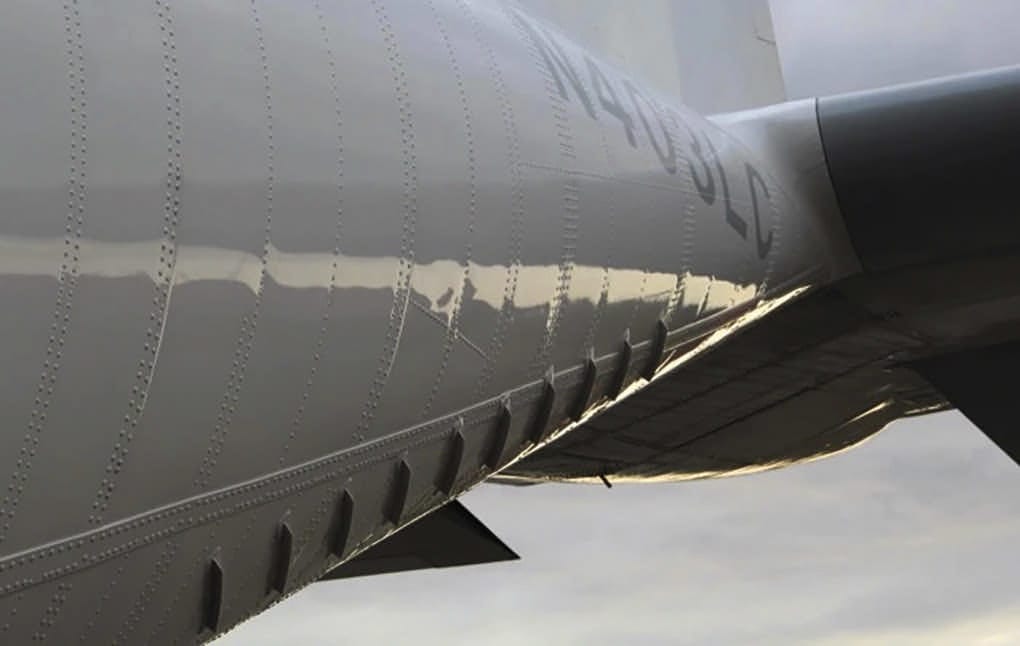
The Department of Defense (DoD) relies on airborne logistics to support global military operations, and airlift and air-to-air refueling are both critical operations in ensuring mission success. The U.S. Air Force (USAF) coordinates and executes the majority of these airlift logistics for joint operations, but primarily with older, legacy aircraft. Reducing the fuel required to achieve these operations is critical to increasing operational capability, reducing cost, and reducing supply chain risks.
The Air Force Operational Energy Office (SAF/IE), the Air Force Research Laboratory (AFRL), Air Force Special Operations Command (AFSOC), and the Defense Innovation Unit (DIU) have partnered together in seeking well-developed, commercially viable technologies to reduce drag, and therefore fuel consumption, on a number of USAF legacy aircraft, including the C-17 Globemaster III, C-130 Hercules, and KC-135 Stratotanker. Possible future applications include other large military aircraft and cross-service applications.
“Optimization programs like these just make sense for the Air Force,” said Robert Guerrero, Deputy Assistant Secretary of the Air Force Operational Energy. “My office has been working to advance initiatives that not only make us smarter about how we consume fuel, but also help to prevent maintenance issues, increase performance, and improve mission planning.”
DIU seeks to accelerate the DoD’s adoption of commercial technology, leveraging flexible acquisition methods to design, prototype, and field commercial technology adapted to the DoD’s needs. DIU focuses on using dual-use technologies to speed entry into the DoD market, lower cost, and solve national security challenges.
DIU, in partnership with SAF/IE, AFRL, and AFSOC, issued awards to four companies to research, develop, and prototype drag reduction solutions for legacy aircraft, including Vortex Control Technologies, Metro Aerospace, and Australian firm MicroTau.
Vortex Control Technologies (VCT) is developing several solutions for the USAF, including ‘Finlets’ for the C-130J and KC-135. Finlets are an array of small fins attached to the aft-body region of the fuselage that help to direct airflow and streamline aerodynamics to reduce drag. Another solution, is developing a ‘big-data’ approach to reduce drag caused by control surface mis-rigging. As already demonstrated in commercial fleets, this solution can detect a misaligned or mis-rigged control surface through standard in-flight reported data.
Finally, VCT was also selected to develop a solution to reduce C-17 engine pylon drag that reduce the strong shock caused by the wing and over-the-top pylons.
Metro Aerospace, has been selected to develop and prototype Metro’s commercial Microvane for USAF C-130 use. Microvanes are small, FAA-approved, 3D-printed structures placed in the aft-body region of the fuselage used to reshape tail section airflow to reduce drag. These Microvanes have been commercially available for multiple C-130 and C-17 variants worldwide since 2016.
MicroTau is developing a sharkskin-inspired ‘riblet’ film that can be adhesively applied to the skin of the aircraft to reduce drag. These riblets are microscopic structures that MicroTau ‘grows’ with ultraviolet light to help lower friction drag and, therefore, improve aircraft efficiency. This solution is already being tested on commercial airlines and is scheduled to be tested on an AFSOC C-130J Super Hercules later this year.
Visit Here
More From SAE Media Group

Aerospace & Defense Tech Briefs
Japan Signs on for Second Boeing KC-46 Military Tanker and Transport Aircraft
Aerospace & Defense Tech Briefs
Boeing KC-46 Program Completes Flight Testing Required for First Delivery to U.S. Air Force
Aerospace & Defense Tech Briefs
Boeing Wins $2.9B for 18 KC-46A Military Tanker Aircraft Based on 767 Jet Airliner
Aerospace INSIDER
Can Microvanes Improve Fuel Efficiency for Legacy Air Force Aircraft?
Aerospace INSIDER
Air Force to Inspect KC-135 Fleet for Non-Conforming Tail Pins
Aerospace & Defense Tech Briefs
New Design Wins over Upgrades for Next US Air Force Military Jet Trainer Aircraft
Aerospace & Defense Tech Briefs
Air Force Begins 3D Printing Nonstructural Aircraft Parts
Aerospace & Defense Tech Briefs
Boeing Wins $9.2B U.S. Air Force Contract for T-X Advanced Military Pilot Training Jets, Simulators, Ground Equipment
Aerospace & Defense Tech Briefs
Old Bird Learns New Tricks
Aerospace & Defense Tech Briefs
New, Clean-Sheet Military Aircraft Design Beats Upgrades to Win US Air Force T-X Contract
Aerospace & Defense Tech Briefs
Honeywell Wins $1.04 Billion U.S. Air Force Power Systems Contract
Aerospace INSIDER
European KC-135s Get Real Time Cockpit System Upgrades
Aerospace & Defense Tech Briefs
Multispectral Airborne Reconnaissance System

Aerospace & Defense Tech Briefs
Canada’s Future Search and Rescue Aircraft Get Its First Set of Eyes
Aerospace & Defense Tech Briefs
U.S. DoD Orders 255 Lockheed Martin F-35 Military Combat Aircraft in $22.7B Deal
Aerospace & Defense Tech Briefs
Ahead of USAF T-X Decision, Leonardo Finds Market for T-100’s Little Brother – the Single-Engine Aermacchi M-345
Aerospace & Defense Tech Briefs
Modified USAF T-1A Aircraft
Aerospace & Defense Tech Briefs
Lockheed Martin Flies FireHerc Firefighting Variant of C-130J Turboprop in Farnborough
Aerospace INSIDER
Archer Delivers First Midnight eVTOL to US Air Force
Aerospace & Defense Tech Briefs
Boeing's Latest Contract Secures New Wings for Remaining A-10 Fleet
Aerospace & Defense Tech Briefs
Militaries Choose Marvin Test Solutions MTS-3060A with Enhanced Flight-Line Test Capabilities, Cybersecurity
Aerospace & Defense Tech Briefs
OA-X Phase Two Kicks Off
Aerospace & Defense Tech Briefs
Curtiss-Wright Will Provide Data Technology Support for Boeing’s MQ-25 Unmanned Air Refueling Platform
Aerospace & Defense Tech Briefs
Collins Aerospace Provides Avionics for C-130H Modernization Program
Aerospace & Defense Tech Briefs
Maintainers Design a $400 Maintenance Fixture to save the U.S. Air Force $500k per Year
Aerospace INSIDER
KC-46A Pegasus Approved to Refuel 97% of Joint Force Receivers
Top Stories
NewsSensors/Data Acquisition
 Microvision Aquires Luminar, Plans Relationship Restoration, Multi-industry Push
INSIDERRF & Microwave Electronics
 A Next Generation Helmet System for Navy Pilots
INSIDERWeapons Systems
 New Raytheon and Lockheed Martin Agreements Expand Missile Defense Production
NewsAutomotive
 Ford Announces 48-Volt Architecture for Future Electric Truck
INSIDERAerospace
 Active Strake System Cuts Cruise Drag, Boosts Flight Efficiency
ArticlesTransportation

Webcasts
Aerospace
 Cooling a New Generation of Aerospace and Defense Embedded...
Energy
 Battery Abuse Testing: Pushing to Failure
Power
 A FREE Two-Day Event Dedicated to Connected Mobility
Automotive
 Quiet, Please: NVH Improvement Opportunities in the Early Design Cycle
Electronics & Computers
 Advantages of Smart Power Distribution Unit Design for Automotive &...
Unmanned Systems
 Sesame Solar's Nanogrid Tech Promises Major Gains in Drone Endurance