




Ahead of USAF T-X Decision, Leonardo Finds Market for T-100’s Little Brother – the Single-Engine Aermacchi M-345
South Africa’s Paramount Group will work with Leonardo to develop on a weaponized version of the Aermacchi M-345 for the African market.

According to a letter of intent signed between Rome-based Leonardo S.p.A. and Paramount Group, the two companies will evaluate a cooperation for the development of an operational configuration of the two-seat Aermacchi M-345 jet trainer for the African market. Paramount Group is conglomerate of defense and military training companies based out of Praetoria, South Africa.
While there are no currently available specifications or requirements that would provide insight into what a weaponized or “operational” M-345 would look like, transitioning the aircraft to a light attack role will not require substantial modifications.
The M-345 is based on Leonardo’s twin-engine M-346 , which has already proven itself as the trainer and light attack aircraft of choice for Israel, the United Arab Emirates, Singapore, Poland, and Italy. Leonardo is also currently proposing their T-100 trainer, based on the M-346, for the United States Air Force T-X trainer replacement program which will likely conclude with a selection this week.
Read more:T-X competition to end in September with selection of new USAF trainer aircraft
Leonardo initially developed the M-345 to offer the superior performance and training effectiveness typical of a jet aircraft at costs comparable to high-powered turboprop trainers. The two-and-a-half-ton-aircraft has considerable performance and maneuverability and an external load-carrying capability of over one ton with an extended range of 960 nautical miles.
The M-345 powerplant is a small Williams FJ44-4M-34 two-spool turbofan engine built by Williams International of Pontiac, Mi. and London-based Rolls-Royce plc . The M-345’s FJ44 engine – which has also appeared on Scaled Composites and Lockheed Martin Skunk Works projects – has been optimized for military and acrobatic use.
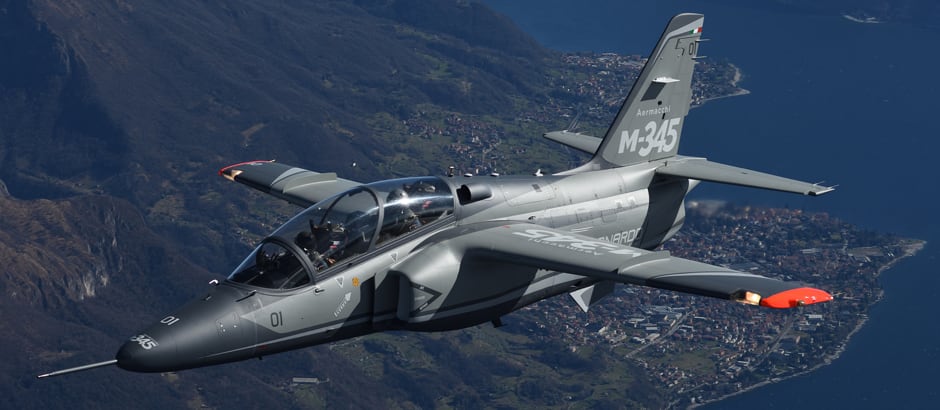
The M-345 cockpit architecture and avionics also include modern equipment found in many global frontline fighters: hand on throttle-and-stick (HOTAS) controls, a glass cockpit with three five-by-seven-inch color multi-function display touchscreens, and a head-up “repeater” display mirrored on a fourth screen in the rear seat.
Beyond its performance capabilities, the aircraft’s impressive durability, or fatigue life, is rated at 15,000 hours of flight time. To further reduce operational costs the M-345 is designed with a two-level maintenance methodology in order to eliminate expensive general overhauls. This is made possible by a Health and Usage Monitoring System (HUMS) that displays airframe and system component prognostics.
The agreement between Leonardo and Paramount Group also includes provisions for the possible involvement of Paramount in the Leonardo SF-260 military trainer aircraft program and its logistic support services. As a light military training and acrobatics aircraft, the three-seat SF-260 serves a similar role to the M-345.
This article is Part One of a two part series on the development of the M-345 for the African market. Check back soon for Part Two.
William Kucinski is content editor at SAE International, Aerospace Products Group in Warrendale, Pa. Previously, he worked as a writer at the NASA Safety Center in Cleveland, Ohio and was responsible for writing the agency’s System Failure Case Studies. His interests include 'literally anything that has to do with space,' past and present military aircraft, and propulsion technology. And also sportscars.
Contact him regarding any article or collaboration ideas by e-mail at
More From SAE Media Group
Aerospace & Defense Tech Briefs
South Africa’s Paramount Group Will Provide New Mission System for Combat Version of the Aermacchi M-345 Jet Trainer
Aerospace & Defense Tech Briefs
Old Bird Learns New Tricks
Aerospace & Defense Tech Briefs
Maintainers Design a $400 Maintenance Fixture to save the U.S. Air Force $500k per Year
Aerospace & Defense Tech Briefs
Astronautics to Upgrade Cockpit Displays on U.S. Customs and Border Protection P-3 Orions
Aerospace & Defense Tech Briefs
First F-35 Crash; Pilot Safe
Automotive Engineering
T-X Competition to End in September with Selection of New USAF Trainer Aircraft
Aerospace & Defense Tech Briefs
Collins Aerospace Provides Avionics for C-130H Modernization Program
Aerospace & Defense Tech Briefs
Air Force Begins 3D Printing Nonstructural Aircraft Parts
Aerospace & Defense Tech Briefs
OA-X Phase Two Kicks Off
Aerospace & Defense Tech Briefs
Boeing's Latest Contract Secures New Wings for Remaining A-10 Fleet
Aerospace & Defense Tech Briefs
The Air Force’s New Unmanned Wingmate Completes Inaugural Flight
Aerospace & Defense Tech Briefs
J-10B Fighter Aircraft Debuts Chinese Thrust Vectoring Technology
Aerospace & Defense Tech Briefs
General Atomics Plans First Trans-Atlantic Flight of Medium-Altitude, Long-Range Remotely Piloted Aircraft
Aerospace & Defense Tech Briefs
GA-ASI Maximizes Fuel Capacity for MQ-25 Entry
Aerospace & Defense Tech Briefs
Honeywell Wins $1.04 Billion U.S. Air Force Power Systems Contract
Aerospace & Defense Tech Briefs
Rockford Xellerix to Support Pilatus PC-24 Electrification
Aerospace & Defense Tech Briefs
L3 Makes Its C-130 Modernization Package Available to Global Operators
Aerospace & Defense Tech Briefs
Boeing Wins $2.9B for 18 KC-46A Military Tanker Aircraft Based on 767 Jet Airliner
Aerospace & Defense Tech Briefs
J-10B Fighter Demonstrates Thrust-Vectoring Supermaneuverability at Airshow China
Aerospace & Defense Tech Briefs
Future of British Air Power: The Next-Gen Tempest
Aerospace & Defense Tech Briefs
Boeing Wins MQ-25 Contract
Aerospace & Defense Tech Briefs
Japan Signs on for Second Boeing KC-46 Military Tanker and Transport Aircraft
Aerospace & Defense Tech Briefs
Boeing KC-46 Program Completes Flight Testing Required for First Delivery to U.S. Air Force
Aerospace & Defense Tech Briefs
General Atomics MQ-9B SkyGuardian Lands at RAF Fairford, Makes History
Aerospace & Defense Tech Briefs
The F-35 Is Getting Life-Saving Automatic Ground Collision Avoidance Systems from the F-16
Aerospace & Defense Tech Briefs
MTSI’s Latest Project Gives Fixed-Wing Aircraft Vertical Cargo Lift Capabilities
Aerospace & Defense Tech Briefs
New Design Wins over Upgrades for Next US Air Force Military Jet Trainer Aircraft
Aerospace & Defense Tech Briefs
Lockheed Martin Flies FireHerc Firefighting Variant of C-130J Turboprop in Farnborough
Aerospace & Defense Tech Briefs
New Boeing Facility Will Improve V-22 Quality, Safety
Aerospace & Defense Tech Briefs
Aitech Defense Will Provide Data Interface Technology for Boeing’s Unmanned MQ-25 Refueling Platform
Transcript
No transcript is available for this video.
Top Stories
INSIDERManufacturing & Prototyping
 How Airbus is Using w-DED to 3D Print Larger Titanium Airplane Parts
INSIDERManned Systems
 FAA to Replace Aging Network of Ground-Based Radars
NewsTransportation
 CES 2026: Bosch is Ready to Bring AI to Your (Likely ICE-powered) Vehicle
NewsSoftware
 Accelerating Down the Road to Autonomy
EditorialDesign
 DarkSky One Wants to Make the World a Darker Place
INSIDERMaterials
 Can This Self-Healing Composite Make Airplane and Spacecraft Components Last...
Webcasts
Defense
 How Sift's Unified Observability Platform Accelerates Drone Innovation
Automotive
 E/E Architecture Redefined: Building Smarter, Safer, and Scalable...
Power
 Hydrogen Engines Are Heating Up for Heavy Duty
Electronics & Computers
 Advantages of Smart Power Distribution Unit Design for Automotive...
Unmanned Systems
 Quiet, Please: NVH Improvement Opportunities in the Early Design...
