




Compressive Oversampling for Robust Data Transmission in Sensor Networks
A paper discusses recent developments in the area of Compressive Sensing (CS) for data loss in wireless sensing applications. Since many physical signals of interest are known to be sparse or compressible, employing CS not only compresses the data and reduces the effective transmission rate, but also improves the robustness of the system to channel erasures. This is possible because reconstruction algorithms for compressively sampled signals are not hampered by the stochastic nature of wireless link disturbances, which has traditionally plagued attempts at proactively handling the effects of these errors.
This paper proposes that if CS is employed for source compression, then CS can further be exploited as an application layer erasure coding strategy for recovering missing data. The paper shows that CS erasure encoding (CSEC) with random sampling is efficient for handling missing data in erasure channels, paralleling the performance of BCH codes, with the added benefit of graceful degradation of the reconstruction error even when the amount of missing data far exceeds the designed redundancy. Further, since CSEC is equivalent to nominal oversampling in the incoherent measurement basis, it is computationally less expensive than conventional erasure coding.
This work was done by Zainul Charbiwala, Supriyo Chakraborty, Sadaf Zahedi, Younghun Kim, and Mani B. Srivastava of the University of California, Los Angeles; and Tin He and Chatschik Bisdikian of IBM T.J. Watson Research Center for the Army Research Laboratory. For more information, download the Technical Support Package (free white paper) at www.defensetechbriefs.com/tsp under the Physical Sciences category. ARL-0097
This Brief includes a Technical Support Package (TSP).
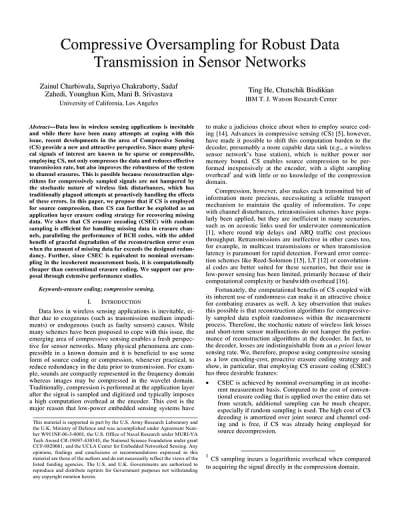
Compressive Oversampling for Robust Data Transmission in Sensor Networks
(reference ARL-0097) is currently available for download from the TSP library.
Don't have an account?
More From SAE Media Group
Aerospace & Defense Tech Briefs
GigE Advanced Imaging Sensor
Aerospace & Defense Tech Briefs
Time-Coding of Asynchronous Data Transmissions
Aerospace & Defense Tech Briefs
Gesture-Directed Sensor-Information Fusion Gloves

Aerospace & Defense Tech Briefs
Evaluating a Data Clustering Approach for Lifecycle Facility Control
Aerospace & Defense Tech Briefs
Adaptive Deblurring of Noisy Images

Aerospace & Defense Tech Briefs
Frangible Polymer Circuit Acts as Tamper Sensor
Aerospace & Defense Tech Briefs
Target Detection and Classification Using Seismic and PIR Sensors
Aerospace & Defense Tech Briefs
Modular, Portable, and Reconfigurable Wireless Sensing System
Aerospace & Defense Tech Briefs
Manifold-Based Image Understanding

Software Tech Briefs
Analysis of Spiral Resonator Filters
Aerospace & Defense Tech Briefs
Robust Quantum Sensors Program

Tech Briefs
A Robot with the ‘Brains’ to Morph Mid-Air
Electronics & Sensors INSIDER
Next-Gen Automotive Semiconductors Are Critical for Level 5 Driverless Cars
Motion Design
Flexible Conductive Skin Gives Robots the Human Touch
Tech Briefs
When Mushrooms Control Robots
Aerospace & Defense Tech Briefs
Improvements in Measurement of Permeability and Permittivity
Aerospace & Defense Tech Briefs
High-Resolution, Measurement-Based, Phase-Resolved Prediction of Ocean Wavefields
Tech Briefs
An Automated Flying-Insect Detection System

Photonics & Imaging Technology
Photonic Processor Could Enable Ultrafast AI Computations
Motion Design INSIDER
Programming Robots with Rubber Bands

Tech Briefs
Lidar Luminance Quantizer
Overview
The document titled "Compressive Oversampling for Robust Data Transmission in Sensor Networks" discusses the challenges of data loss in wireless sensing applications and presents a novel approach using Compressive Sensing (CS) to enhance data transmission reliability. Data loss can occur due to various factors, including transmission medium impairments and faulty sensors. Traditional methods to address these issues often involve high computational overhead and inefficiencies, particularly in low-power sensor networks.
The authors propose leveraging CS not only for data compression but also as an effective erasure coding strategy. CS allows for the efficient representation of compressible signals, enabling the reduction of data redundancy before transmission. This approach shifts the computational burden from the sensor (encoder) to a more capable data sink, such as a base station, which is less constrained by power and memory limitations.
The paper introduces Compressive Sensing Erasure Coding (CSEC), which utilizes random sampling to handle missing data in erasure channels. CSEC is shown to perform comparably to traditional coding methods, such as BCH codes, while offering the advantage of graceful degradation in reconstruction quality even when the amount of missing data exceeds the designed redundancy. This is particularly beneficial in scenarios where retransmission is impractical due to latency or bandwidth constraints.
The authors detail the theoretical foundations of their approach, including the use of a sensing matrix and the conditions necessary for effective reconstruction of the original signal. They emphasize the importance of uniform random sampling and the need for a sufficient number of samples to ensure reliable performance. The document also discusses the implications of using CS for both data concentration and dispersion, highlighting its potential to improve the robustness of data transmissions in sensor networks.
Through extensive performance studies, the authors validate their claims, demonstrating that CSEC can effectively mitigate the impact of data loss while maintaining low computational costs. This research contributes to the growing field of CS and its applications in wireless sensor networks, offering a promising solution for enhancing data transmission reliability in the face of inevitable data loss. Overall, the document presents a compelling case for the integration of CS techniques in modern sensor network designs.
Top Stories
INSIDERManufacturing & Prototyping
 How Airbus is Using w-DED to 3D Print Larger Titanium Airplane Parts
NewsAutomotive
 Microvision Aquires Luminar, Plans Relationship Restoration, Multi-industry Push
INSIDERAerospace
 A Next Generation Helmet System for Navy Pilots
INSIDERDesign
 New Raytheon and Lockheed Martin Agreements Expand Missile Defense Production
ArticlesAR/AI
 CES 2026: Bosch is Ready to Bring AI to Your (Likely ICE-powered) Vehicle
Road ReadyDesign

Webcasts
Semiconductors & ICs
 Advantages of Smart Power Distribution Unit Design for Automotive...
Unmanned Systems
 Quiet, Please: NVH Improvement Opportunities in the Early Design...
Electronics & Computers
 Cooling a New Generation of Aerospace and Defense Embedded...
Power
 Battery Abuse Testing: Pushing to Failure
AR/AI
 A FREE Two-Day Event Dedicated to Connected Mobility
