




Manifold-Based Image Understanding
This method supports the entire image processing chain, from data acquisition through processing, and subsequent archiving and data mining.
The rapid growth of sensing and imaging technology, combined with the need for near-real-time action based on the sensed data, has rendered automatic processing, understanding, and decision-making vital to our national security. A unified theory and practical toolset was developed for the analysis and processing of signal and image manifolds for signal and image understanding purposes. The unifying theme is the multiscale geometric structure of signal and image families and manifolds. Specifically, theory and tools were developed for (1) model-based signal and image recognition and registration, (2) sensing and compressing data on manifolds, and (3) data-driven manifold modeling and learning.
- Model-based signal recognition and registration: It was determined how to best understand and infer signal and image information based on prior models for potential targets. The result was the smashed filter, a new tool for compressive classification and recognition.
- Sensing and compressing data on manifolds: Efficient sampling and measurement schemes were developed for manifold-modeled data. The result was in proving the sufficiency of random projections to compressively capture signals on a manifold, and applying this result to the theory of compressive sensing.
- Data-driven manifold modeling and learning: To bridge the gap to practice, a new theory and algorithms were developed for learning manifold models for signal and image families. Applications of these ideas include adaptation to novel targets, signal and image database mining, and compression.
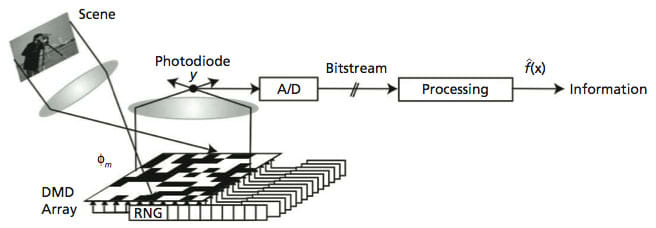
The second part of the theory applies the generalized maximum likelihood method to deal with unknown transformations such as the translation, scale, or viewing angle of a target object. The fact that the set of transformed images forms a low-dimensional, nonlinear manifold in the high-dimensional image space was exploited. The number of measurements required for a given classification performance level grows linearly in the dimensionality of the manifold, but only logarithmically in the number of pixels/samples and image classes. Using both simulations and measurements from a new, single-pixel compressive camera, the effectiveness of the smashed filter for target classification, using very few measurements, was demonstrated.
In addition to the computational and storage savings afforded by compressive classification, the proposed method shares many advantages previously shown for CS reconstruction. In particular, random projections enable universal estimation and classification in the sense that random projections preserve the structure of any low-dimensional signal class with high probability. In this context, it means that one need not know what the classes are or what the classification algorithm will be prior to acquiring the measurements. Additionally, compressive measurements are progressive in the sense that larger numbers of projections translate into higher classification rates due to increased noise tolerance, and democratic in that each measurement can be given equal priority because classification rates depend only on how many measurements are received, not on the particular subset received.
It was demonstrated that, thanks to the pronounced structure present in many signal classes, small numbers of non-adaptive compressive measurements can suffice to capture the relevant information required for accurate classification. Simple parametric models impose a low-dimensional manifold structure on the signal classes within the high-dimensional image space, and the geometric structure of these manifolds is preserved under their projection to a random, lower-dimensional subspace.
The GMLC-based smashed filter is readily implementable with CS hardware, such as the single-pixel compressive imaging camera, and shares many of the attractive features of CS in general, including simplicity, universality, robustness, democracy, and scalability, which should enable it to impact a variety of different applications. More sophisticated algorithms could exploit the manifold structure to more efficiently obtain the ML estimates required by the smashed filter. For example, rather than an exhaustive nearest-neighbor search, which could be computationally prohibitive for a large training set, a greedy approach might offer similar performance at significant computational savings; other approaches that exploit the smoothness of the manifolds could also be beneficial.
This work was done by Richard G. Baraniuk of Rice University for the Office of Naval Research. For more information, download the Technical Support Package (free white paper) at www.defensetechbriefs.com/tsp under the Physical Sciences category. ONR-0020
This Brief includes a Technical Support Package (TSP).

Manifold-Based Image Understanding
(reference ONR-0020) is currently available for download from the TSP library.
Don't have an account?
More From SAE Media Group
Aerospace & Defense Tech Briefs
Evaluating a Data Clustering Approach for Lifecycle Facility Control
Photonics & Imaging Technology
Researchers Use Inkjet Printing to Make a Portable Multispectral 3D Camera
Photonics & Imaging Technology
New Upgrade Will Supercharge Atomic Vision of the World’s Most Powerful X-Ray Laser
Tech Briefs
AI Helps UAVs Predict Oncoming Turbulence
Aerospace & Defense Tech Briefs
GigE Advanced Imaging Sensor


Aerospace & Defense Tech Briefs
Adaptive Deblurring of Noisy Images


Aerospace & Defense Tech Briefs
Target Detection and Classification Using Seismic and PIR Sensors
Motion Design
Flexible Conductive Skin Gives Robots the Human Touch
Tech Briefs
A Robot with the ‘Brains’ to Morph Mid-Air

Tech Briefs
Lidar Luminance Quantizer

Tech Briefs
Compact Autonomous Hemispheric Vision System
Aerospace & Defense Tech Briefs
System for Imaging Turbulent Combustion Flows
Tech Briefs
Improved Cryostat for Cooling a Wide Panel

Electronics & Sensors INSIDER
Next-Gen Automotive Semiconductors Are Critical for Level 5 Driverless Cars
NASA Spinoff
Using AI to Predict the Sky
Photonics & Imaging Technology
Photonic Processor Could Enable Ultrafast AI Computations


Overview
The document titled "Manifold-Based Image Understanding" is the final technical report for ONR Grant N00014-06-1-0829, authored by Richard G. Baraniuk. It addresses the challenges posed by the rapid growth of sensing and imaging technologies, which have made automatic processing and understanding of data crucial for national security.
The report outlines key factors complicating data acquisition and processing, including the increasing volume and diversity of sensor data, as well as the changing operating conditions under which data is collected. These challenges necessitate a unified mathematical and algorithmic foundation for effective data fusion and processing.
The project's primary objective was to develop a comprehensive theory and practical tools for analyzing and processing signal and image manifolds. The focus was on the multiscale geometric structure of signal and image families, leading to three main areas of development:
-
Model-based Signal Recognition and Registration: The project explored methods for understanding and inferring information from signals and images based on prior models of potential targets. A significant outcome was the creation of the "smashed filter," a novel tool designed for compressive classification and recognition.
-
Sensing and Compressing Data on Manifolds: The report discusses the theoretical justification for using random projections to capture information from signals with manifold structures. This has implications for the field of compressive sensing, which aims to efficiently acquire and reconstruct signals.
-
Data-driven Manifold Modeling and Learning: The project also focused on developing new theories and algorithms for learning manifold models that can effectively represent families of signals and images.
The report emphasizes the importance of a coordinated approach to signal and image understanding, advocating for the integration of various methodologies to address the complexities of data processing. It concludes with a summary of the project's accomplishments and potential future work, highlighting the need for continued research in this area.
Overall, the document presents a significant contribution to the fields of image processing and machine learning, offering insights into how geometric structures can enhance the understanding and classification of complex data. The findings have broad applications, particularly in areas requiring real-time data analysis and decision-making.
Top Stories
INSIDERManufacturing & Prototyping
 How Airbus is Using w-DED to 3D Print Larger Titanium Airplane Parts
INSIDERManned Systems
 FAA to Replace Aging Network of Ground-Based Radars
NewsTransportation
 CES 2026: Bosch is Ready to Bring AI to Your (Likely ICE-powered) Vehicle
NewsSoftware
 Accelerating Down the Road to Autonomy
EditorialDesign
 DarkSky One Wants to Make the World a Darker Place
INSIDERMaterials
 Can This Self-Healing Composite Make Airplane and Spacecraft Components Last...
Webcasts
Defense
 How Sift's Unified Observability Platform Accelerates Drone Innovation
Automotive
 E/E Architecture Redefined: Building Smarter, Safer, and Scalable...
Power
 Hydrogen Engines Are Heating Up for Heavy Duty
Electronics & Computers
 Advantages of Smart Power Distribution Unit Design for Automotive...
Unmanned Systems
 Quiet, Please: NVH Improvement Opportunities in the Early Design...
